


California's NEM 3.0 rules have a reputation for making rooftop solar harder to justify on paper, especially when midday power exports bring in relatively little.
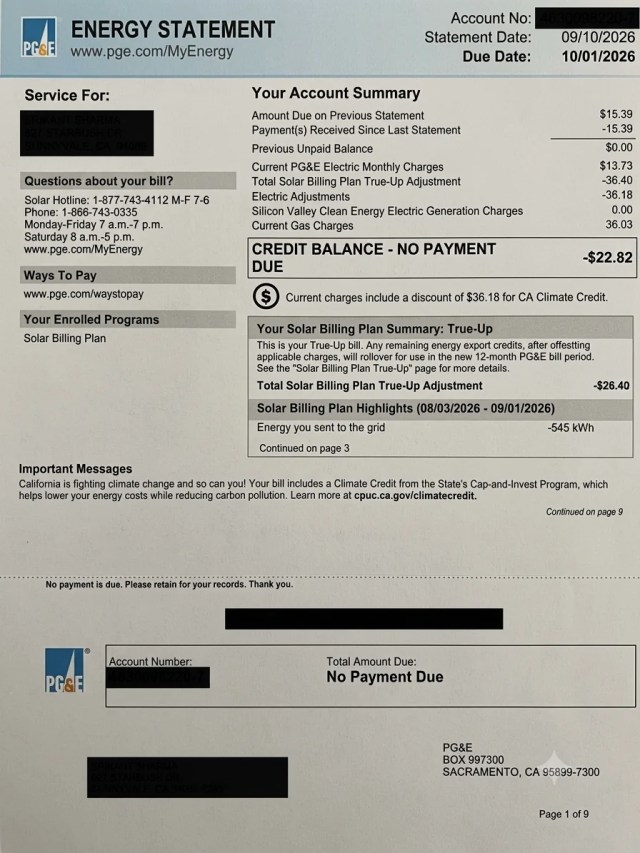
That is why one PG&E customer's first-ever negative bill sparked attention online. On Reddit's r/Solar community, they wrote, "It has been 3 years. I am on the Solar NEM 3.0 plan with PG&E. But I saw a negative bill for the FIRST time ever."
Here's what to know
The South Bay homeowner has a 7.8-kilowatt solar system with a 13.5-kilowatt-hour Powerwall+ battery. The original poster said the home uses roughly 14 kilowatt-hours each day on average, while August production came in at about 40 kilowatt-hours per day.
The OP added that their bill turned negative because stored energy from the Powerwall was sent back to the grid during the 6 p.m. to 8 p.m. period in August, while their daytime solar exports to the grid "get me nothing."
As the OP put it, the negative bill was "something to celebrate before I pay through the nose for the winter heating."
One commenter added, "August is the money making month. It's when the export values are over $1/kWh in certain evening hours."
Several commenters also said the below-zero bill likely was not driven by exports alone. They pointed to the twice-yearly CA Climate Credit as a probable factor and added that NEM 3.0's separate delivered and produced credits can make a flashy export rate look simpler than the actual bill math.
More background
The discussion highlighted a core complaint about California's newer solar billing structure, that extra electricity exported during the day is worth far less than power discharged during a small set of evening hours. Much of the thread focused on batteries as the tool that makes that timing possible.
Save $10,000 on solar panels without even sharing your phone number Want to go solar but not sure who to trust? EnergySage has your back with free and transparent quotes from fully vetted providers that can help you save as much as $10k on installation. To get started, just answer a few questions about your home — no phone number required. Within a day or two, EnergySage will email you the best local options for your needs, and their expert advisers can help you compare quotes and pick a winner. |

A home battery can do more than reduce a utility bill. It can keep key appliances running during outages, help families get through heat waves, and make homes more resilient when the grid is under strain.
And in places with time-based utility rates, batteries can also automate much of the strategy behind when electricity gets used or exported, making ownership lucrative.
For homeowners navigating similar rate plans, the biggest factors are usually system design, battery settings, and when electricity gets used inside the home. A noticeable improvement can come from using more power outside the priciest evening hours and saving stored solar energy for the export period with the strongest payout.
Homeowners can explore EnergySage for information about home battery storage options and solar panel options, including competitive installation estimates.
More From EnergySage
💡Go deep on the latest news and trends shaping the residential solar landscape


With EnergySage's help, the average person can save up to $10,000 on solar purchases and installations. EnergySage's solar map also shows the average cost of a home solar panel system on a state-by-state level, along with details on solar panel incentives for each state.
Where can I learn more?
Other homeowners are asking the same questions about when solar exports pay the most and whether batteries change the equation.
• A California solar owner found the battery changes everything when PG&E export credits stay low.
• Across the country, homeowners learned net metering rules often decide whether a battery pays off.
• In Massachusetts, rooftop panels and mini-splits left a homeowner thousands of kilowatt-hours ahead on paper.

Get TCD's free newsletters for easy tips, smart advice, and a chance to earn $5,000 toward home upgrades. To see more stories like this one, change your Google preferences here.






