


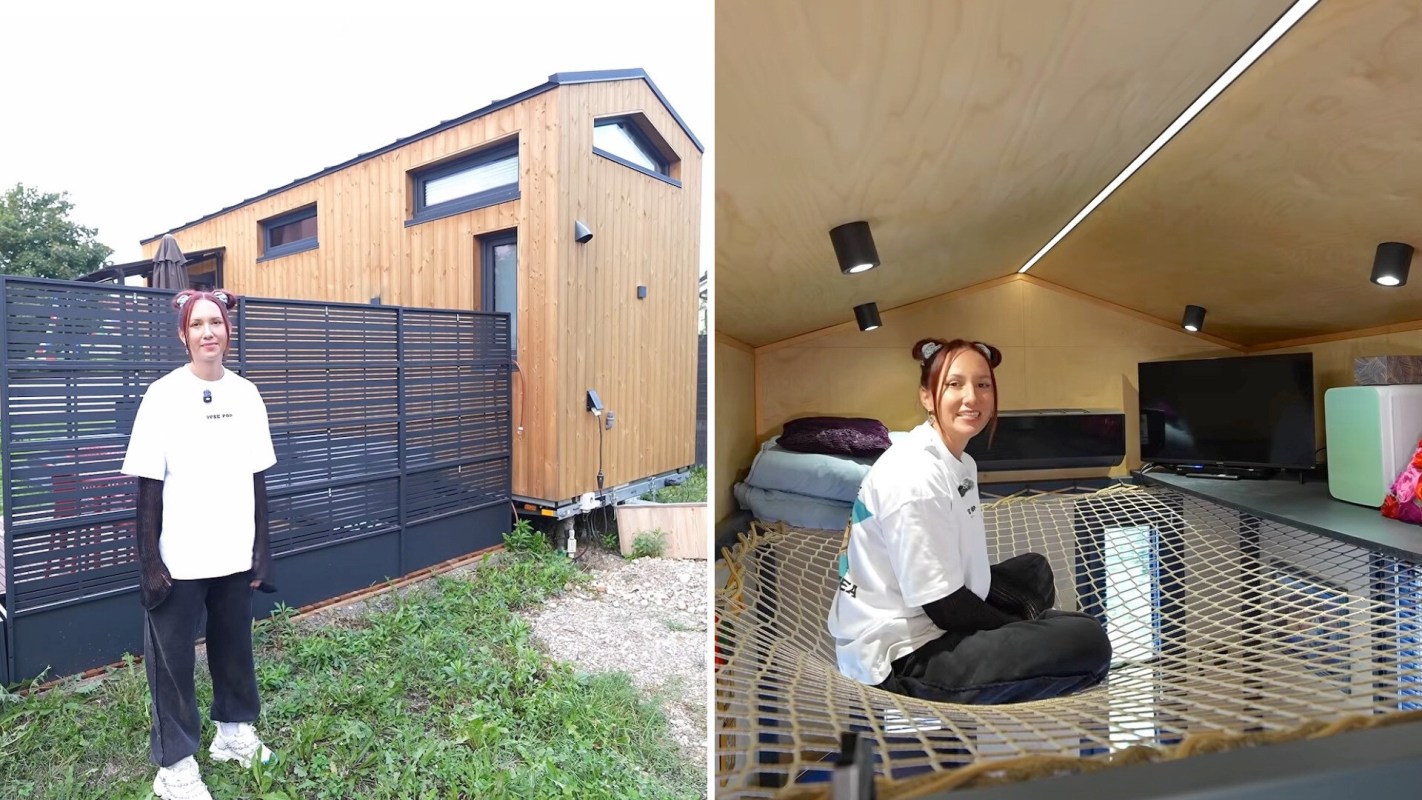
An artist in Munich has found a way to live near her studio without paying rent, though getting there required borrowed money, months of persistence, and a €10,000 investment in land she does not own.
Here's what to know
Katharina, an artist and motion designer, shared her 23-square-meter (248-square-foot) home in a YouTube video by Alternative House (@AlternativeHouse).
"To escape the exorbitant cost of Munich's rental market, an artist invested €60k in a custom 23 sqm mobile tiny house, trading corporate landlord dependence for sovereign, debt-free living," the caption read.
The caption also described her agreement with the landowner as an "unconventional land arrangement" involving "trenching and paying for permanent civic utilities on private land in exchange for a legal primary residence."
Katharina pays no rent to live on the property under a deal that required her to connect the tiny house to utilities.
Savings and credit both went toward the project. According to Katharina, the Polish-built home cost €60,000 (just over $67,000 USD), including delivery. Water, sewage, and electricity connections added another €10,000 ($11,200).
TCD Picks » Quince Spotlight
💡These best-sellers from Quince deliver affordable, sustainable luxury for all




Her ongoing expenses, however, are considerably smaller. Katharina said her water, wastewater, and electricity bill totaled about €70 ($78) for the month before filming.
"The tiny house gives me freedom," she said. "It gives me financial freedom because now the monthly costs are not that high."
More background
Katharina moved from her mother's house, hoping to establish a home base near her Munich art studio without taking on the city's high rents.
Time spent in Nepal inspired one outdoor corner of the property, which also has a private garden and a tool shed.
For the interior, a loft net offers somewhere to relax without blocking as much light as a solid floor. Downstairs, Katharina opted for a desk and large dining table instead of a couch.
Some of the kitchen storage holds clothes. The room also has a dishwasher, an oven, and an induction cooktop.
"The open area makes the house feel bigger and the kitchen and bathroom are stunning," one viewer commented. "The cost of the home is extremely reasonable too!"
Another added, "What a cool house. Just get some solar panels and stuff the grid!"
What can be done?
The home itself should not be a buyer's starting point, Katharina advised. Land and permissions need investigating first.
Finding a site and explaining the proposal to Munich authorities proved harder than the house search she had started with. According to Katharina, it took roughly four months of calls, emails, and visits before officials became receptive.
Utility access presented another challenge. She said arranging permanent electricity in Munich takes around 10 months, leaving her reliant on construction power at the time of the tour.
Katharina hopes to add solar panels gradually. For heating and cooling, she also relies on a split-unit air conditioner.
Where can I learn more?
Katharina's low monthly bills came with substantial upfront costs.
• A homeowner in Germany went off-grid with sodium-ion batteries after rejecting indoor lithium batteries.
• A North Carolina family says off-grid life costs about $400 monthly, with no utility bills.
• A man living in a tiny home near a forest keeps "one foot in society."
• A Texas woman left a $3,000 rental and bought a tiny home for $98,000.
• An off-grid creator shared real cabin living costs, emphasizing that self-reliance still requires a budget.

Get TCD's free newsletters for easy tips, smart advice, and a chance to earn $5,000 toward home upgrades. To see more stories like this one, change your Google preferences here.






