


Annual premiums for employer-sponsored family health insurance reached about $28,300 in 2026, according to new survey data.
Having insurance through a job does not spare a household from budget pressure when wage growth fails to keep pace with rising premiums.
Here's what to know
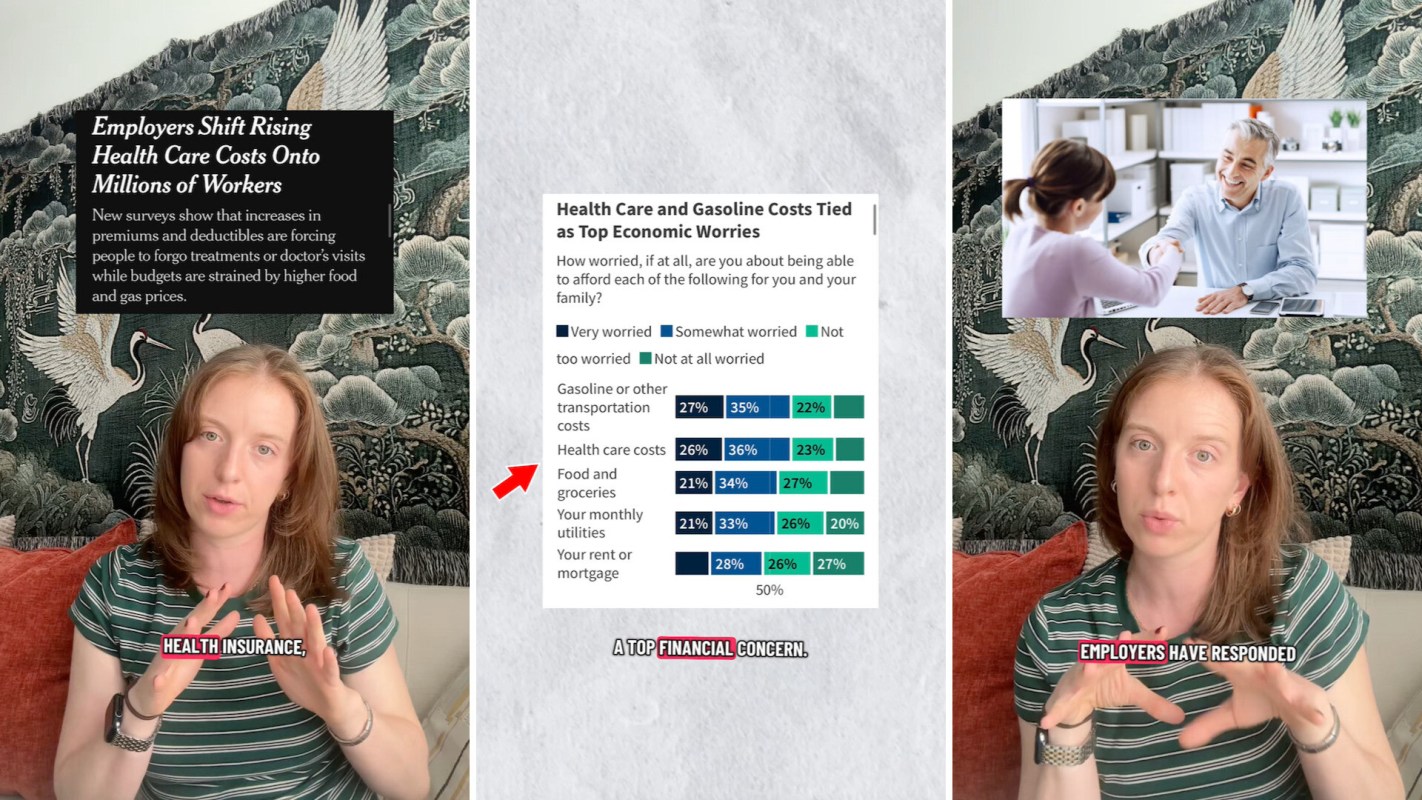
In a TikTok video, Sarah (@econwithsarah), who has a Ph.D. in economics and identifies as a health economist, shared figures from KFF's Employer Health Benefits Survey.
According to KFF's survey, average annual premiums reached about $9,800 for individual coverage and $28,300 for a family of four. Those figures reflect the cost of coverage, not necessarily what employees pay themselves, since employers and workers share the expense.
The creator noted that premiums were 5% higher in 2026 than in 2025, compared with inflation of about 2.7% and wage growth of about 3.7%.
Workers' premium contributions have also risen more quickly. According to the breakdown, those contributions increased 26% from 2021 to 2026, compared with 12% from 2016 to 2021.
TCD Picks » Quince Spotlight
💡These best-sellers from Quince deliver affordable, sustainable luxury for all




The video focused on 2026 coverage, noting that overall costs for 2027 remained largely unknown.
More background
For patients, copays are charges attached to covered services, while deductibles are amounts they must pay before certain insurance benefits begin. Sarah said that employers have increased both.
According to the video's survey breakdown, the share of workers enrolled in plans with deductibles of at least $2,000 rose from 34% in 2025 to 38% in 2026. Premium increases were also steeper in the Northeast and at smaller businesses, the creator said.
Cancer treatment and weight-loss medication costs were among the examples employers cited in attributing the increases to higher medical prices.
Commenters expressed frustration with their own coverage and recent changes.
"Employee-sponsored insurance over here. 100% price increase from June 2025 to July 2026," one shared.
What can be done?
For workers trying to understand the full cost of their employer-sponsored coverage, one commenter suggested checking a tax document.
"It's on your W2, box 12, code DD," they wrote. Paycheck deductions alone do not reflect the total cost of coverage.
For patients who depend on continuous care, losing insurance can interrupt regular appointments and ongoing treatment, the video warned. Sarah said there is no simple fix for affordability and did not present dropping coverage as a solution.
She also reported that the uninsured share increased from 8.9% in 2024 to 11.2% in 2026, attributing the rise partly to the expiration of enhanced Affordable Care Act (ACA) subsidies and increased Medicaid restrictions.
She concluded the video by posing a question: "Even though I think, yes, we do need a transformation of our healthcare system, the reality is, is in the short run, if we burn it all down and set up a new system, what happens to the people who are reliant on a continuation of care in the short run?"
Where can I learn more?
Higher premiums are squeezing workers' and retirees' budgets.
• Most Americans face higher health insurance bills in 2027 across several types of coverage.
• Starbucks workers say premiums have soared, pushing some employees to drop their health coverage.
• California teachers who once had fully paid coverage are rallying over health premiums.
• U.S. federal retirees face $10,000 family premiums, with some considering ACA subsidies for coverage.

Get TCD's free newsletters for easy tips, smart advice, and a chance to earn $5,000 toward home upgrades. To see more stories like this one, change your Google preferences here.






