


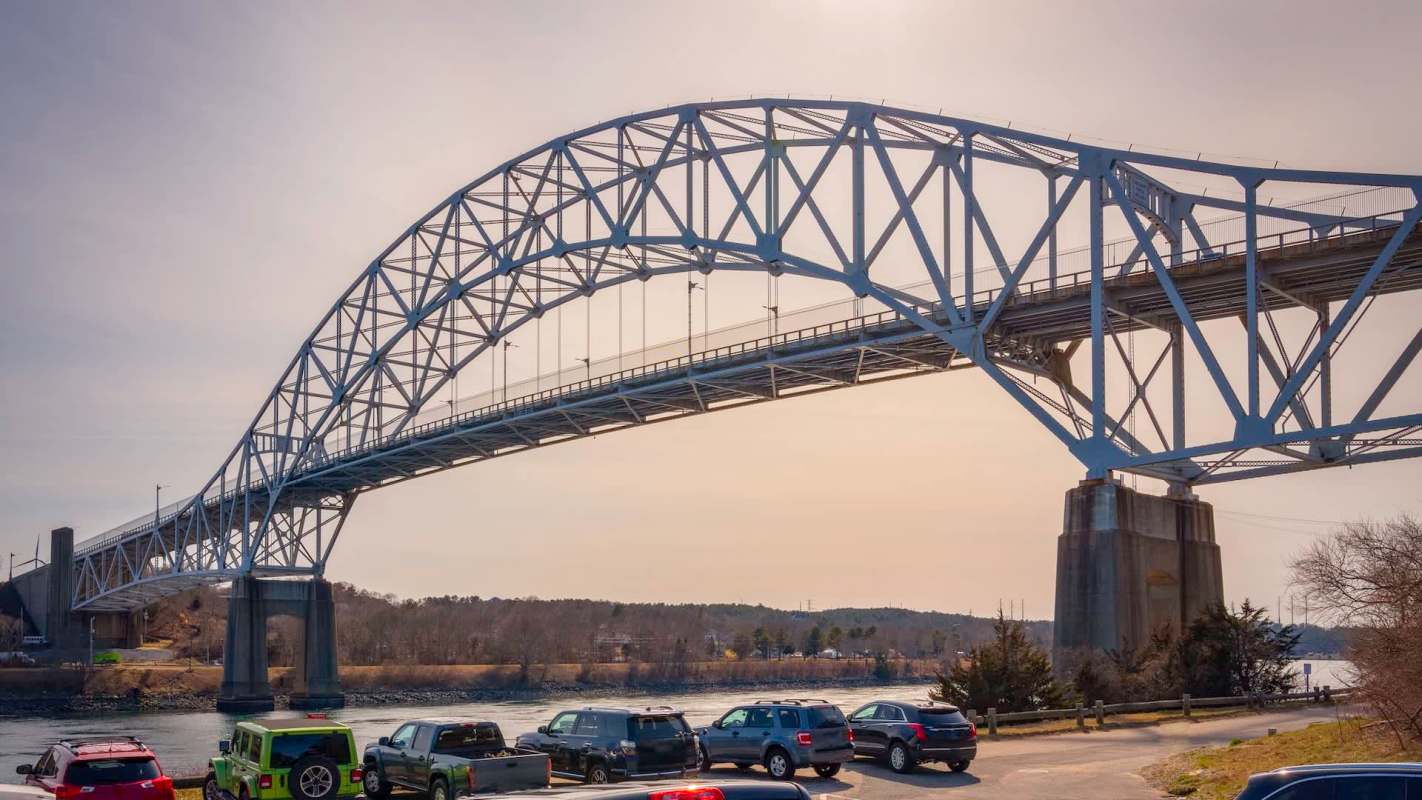
The first of Cape Cod's long-awaited bridge replacements is moving ahead, with Steven Tupper, deputy director of the Cape Cod Commission, saying the new Sagamore Bridge is fully funded at $2.1 billion and could begin carrying traffic by 2033, according to the Cape Cod Chronicle.
For drivers hoping the project would also bring capacity upgrades on Route 6, however, the answer is no — plans for the bridge work do not include capacity upgrades on either Route 6 or Route 3, even as officials press ahead with one of the region's biggest infrastructure overhauls.
Here's what to know
At an Oct. 8 event in Harwich hosted by the Council on Aging and Brooks Free Library, Tupper, deputy director of the Cape Cod Commission, gave an update on the bridge schedule.
Roughly 70 people attended, and many asked how the bridge replacements might affect traffic beyond the canal crossings.
Of the two Cape Cod Canal bridge replacements, the Sagamore project will move first.
The full cost of replacing both bridges is estimated at $4.5 billion, including $2.1 billion for the Sagamore and $2.4 billion for the Bourne, with Sagamore construction expected to end in 2037.
TCD Picks » Quince Spotlight
💡These best-sellers from Quince deliver affordable, sustainable luxury for all




Funding for the Sagamore is in place, including a $993 million federal Bridge Improvement Program grant that MassDOT has received. By contrast, the Bourne Bridge replacement has no appropriated funding.
Tupper said the project is meant to address congestion at the bridges, especially during weekend traffic, rather than add capacity on Route 6 or Route 3.
More background
The project is driven by the bridges' age and the volume of traffic they carry.
Annual crossings are estimated at 38 million vehicles, up from 10 million in 1962 and far beyond the roughly 1 million annual crossings planners expected when they built the bridges in 1935.
The Army Corps of Engineers owns and maintains both bridges, rating the Bourne in poor condition and the Sagamore in fair condition, while Tupper said the two 90-year-old spans are "functionally obsolete."
A 2020 Army Corps report concluded that "replacement of the bridges is the most reliable fiscally responsible solution."
The bridges are a critical gateway for commuting, tourism, freight movement, and emergency access.
Because of environmental concerns, Tupper said, the proposal to improve the Route 6 stretch from Exit 9 in Dennis to the Orleans rotary — the section often called Suicide Alley — is unlikely to move forward.
What's being done?
Under the current plan, the Sagamore replacement would be built just south of the existing bridge and would split traffic into two separate spans, one for each direction.
Each span would have two 12-foot travel lanes, along with 10-foot and 4-foot shoulders, an added entrance lane, and a shared-use path for walking or biking.
Tupper noted that the design also calls for major ramp and access point changes intended to improve vehicle movement near the bridge. He added that Market Basket will remain in place despite the nearby reconfiguration.
Construction plans call for building the bridge sections offsite, floating them to new piers along the canal shoreline, and lifting them into place by 2031. By 2033, at least one of the two new Sagamore spans is expected to be in service, with one lane open in each direction.
The Bourne project is expected to follow and will require longer-term maintenance on the current bridge.
Tupper said the redesign will include major ramp changes and the removal of the Bourne rotary, which he described as among the Cape's highest-crash locations.
He warned that nearby neighborhoods will face disruptions, including delays on the scenic highway along the canal's west side as a new median is installed.
Once both bridge replacements are complete, ownership will shift from the Army Corps to MassDOT, and the new structures are expected to last 100 years.

Get TCD's free newsletters for easy tips, smart advice, and a chance to earn $5,000 toward home upgrades. To see more stories like this one, change your Google preferences here.






