


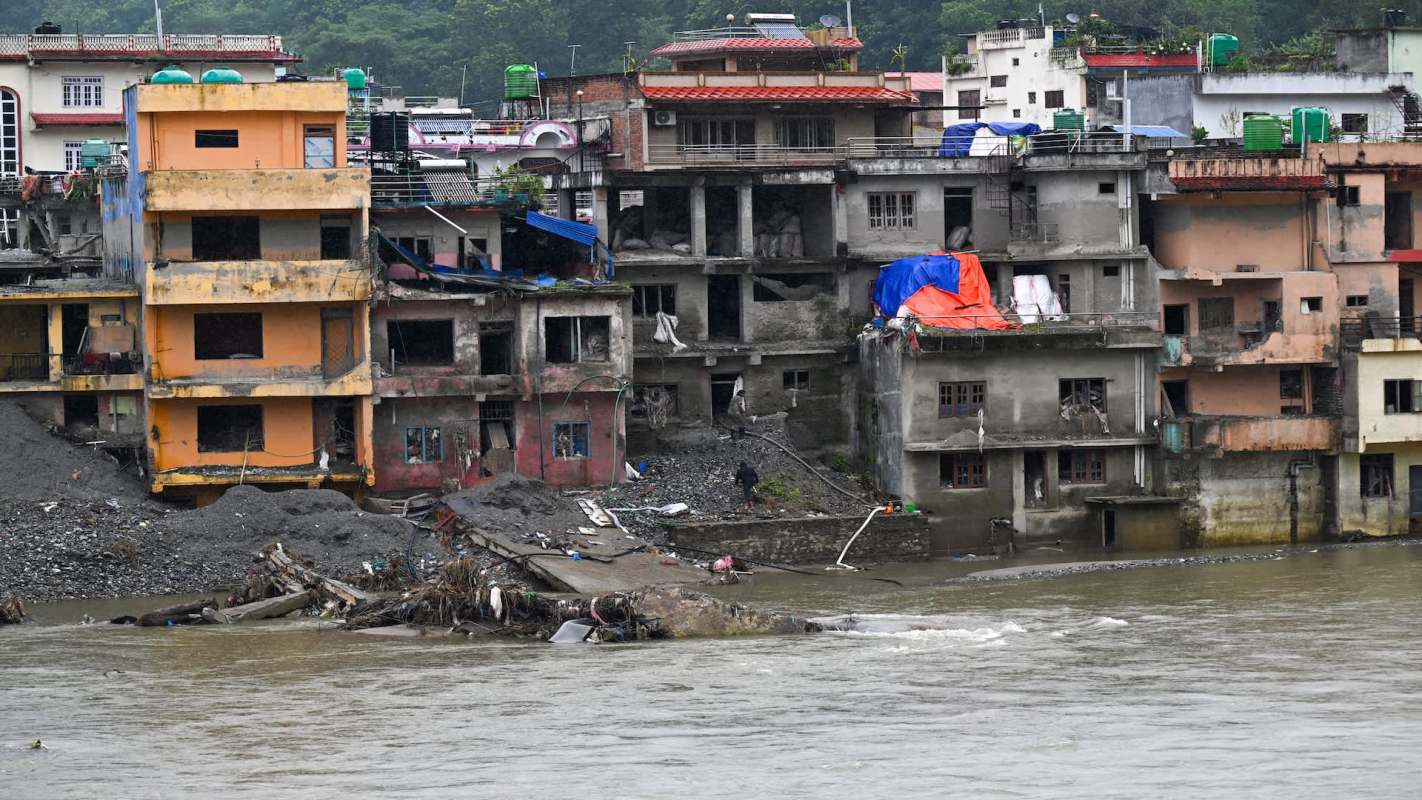
Nepal is seeking $20 million for $2.7 billion in damage and economic losses after catastrophic flooding.
Here's what to know
More than 1,400 people were killed and thousands were left unaccounted for after flash floods struck Nepal on Aug. 26 following a rock-ice avalanche near the Himalayan border.
Carbon Brief reported that Nepal's appeal to the United Nations' loss-and-damage fund requests $20 million as "financial compensation" — the maximum allowed request for a single project — which covers only 0.7% of what it actually needs.
Nepal's disaster management authority estimated about $2.7 billion in physical damage and economic losses from the floods. Add another $4.8 billion in recovery and reconstruction costs, and the country's $20 million request looks even smaller against its overall need.
That gap is why Raju Pandit Chhetri, Nepal's climate negotiator, told Carbon Brief, "That money is going to be a peanut if it was to be invested into reconstruction."
While $20 million may sound like a lot at first, when considered in the context of clearing thousands of ruined buildings and building new ones, it isn't going to go that far. While it's $1 million 20 times, it's also just $100,000 spent 200 times. Since more than 7,500 homes and other buildings were destroyed and another 20,000-plus were damaged, according to Britannica, not to mention major surrounding infrastructure damage, that $20 million can only be divided up so many times to help with addressing those immense needs, even if it's better than nothing.
TCD Picks » Quince Spotlight
💡These best-sellers from Quince deliver affordable, sustainable luxury for all




More background
Climate-vulnerable nations spent decades pushing for the disaster fund before it was established in 2023. Developing countries submitted 176 applications to the fund between December 2025 and July 2026, together seeking more than $2.8 billion.
However, as of September 2026, no country had received any money from the fund, even though it opened $342 million in its first funding round in July 2026. Donor countries have pledged only $822 million, and only about half has been paid.
While a full attribution study is pending, World Weather Attribution and other climate experts linked climate change to drivers of the disaster, including glacial retreat and permafrost thaw. According to BBC News, Nepal plans to use climate attribution studies to bolster its claim.
What's being done?
Nepal is pressing the fund's board to move quickly.
On Aug. 31, Nepal's finance minister Dr. Swarnim Wagle sent the board a letter that called for an "urgent response" that would "signal" the fund "is capable of responding with humanity, speed, flexibility, and solidarity when climate-vulnerable countries face losses and damages beyond their capacity to address alone."
Support for Nepal's request also came from board members representing Asia-Pacific and African countries, who urged the board to convene and "potentially agree to a provisional set-aside allocation of resources to support rapid response funding for Nepal." On September 14, board members from developed countries said they supported a "consultation" on Nepal, but stopped short of committing funding.
That response drew criticism from Harjeet Singh, a loss-and-damage expert and global convenor of the Fill the Fund campaign, who told Carbon Brief, "Developed countries gave a really cold response to Nepal's request."
Nepal's prime minister Balendra Shah is set to address the U.N. General Assembly on Sept. 24 and is expected to raise climate justice, loss and damage, and the vulnerability of mountain countries.
Pandit Chhetri also told Carbon Brief, "If the fund cannot respond in a crisis like this for a country like Nepal – when you have this massive destruction and devastation – then what is the use of the fund itself? That's why it is a test for the fund, though the resources are limited."
Where can I learn more?
Here are some more stories on countries facing natural disasters and the financial impact left behind.
• At the U.N., the adaptation finance gap keeps widening for climate-vulnerable countries.
• Poorer nations face a deepening adaptation funding crisis as climate impacts outpace aid.
• In Thailand, flood damages topped $7 billion, hitting farms and the broader economy.
• Across Bangladesh, extreme floods wiped out crops and deepened pressure on farmers.
• Worldwide, economic losses from natural catastrophes are soaring as disasters grow more severe.

Get TCD's free newsletters for easy tips, smart advice, and a chance to earn $5,000 toward home upgrades. To see more stories like this one, change your Google preferences here.






