


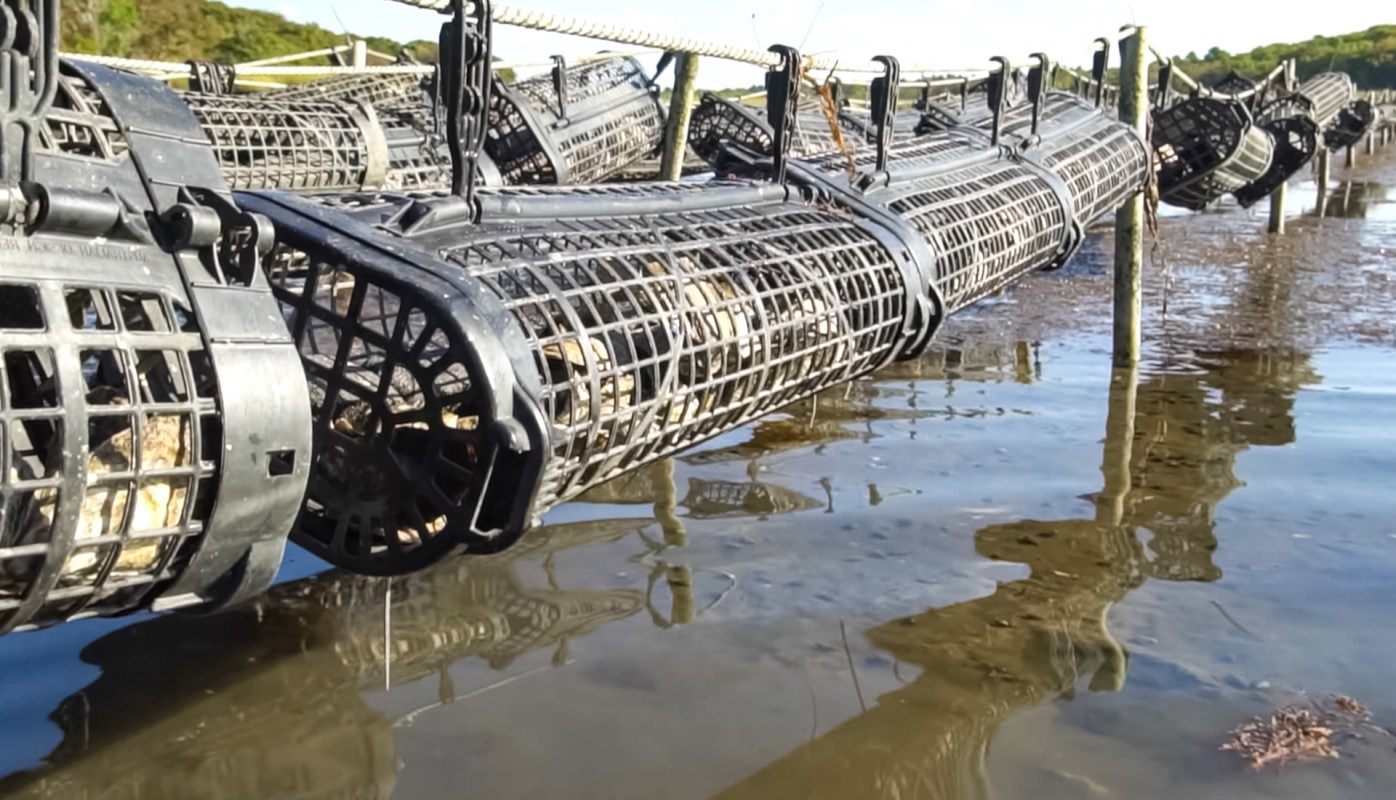
Massachusetts oyster farmers say a growing wave of sewage-linked shellfish facility closures is putting one of the state's signature seafood industries under serious strain.
On the South Coast, growers warn that repeated shutdowns after rain are cutting off sales for weeks at a time, making it increasingly hard for some farms to stay afloat.
Here's what to know
For South Coast oyster growers, closures triggered by combined sewer overflows, or CSOs, have become a mounting business risk since 2024. As Cape and Islands reported, Massachusetts oyster farms produce roughly 54 million oysters a year, and Fairhaven's West Island Oysters spans 47 acres, making it one of the state's biggest operations.
Repeated closures are making survival tougher for growers, said Dale Leavitt, who co-owns West Island Oysters and retired from Roger Williams University as a marine scientist.
"We've already lost one farm in Nasketucket Bay, and we're probably going to lose another one very shortly," he said, per CAI. "I mean, when you're closed 50% of the year to being able to sell oysters, it sort of impacts your cash flow."
A possible sewage release after heavy rain can trigger a 21-day shutdown because stormwater overflowing from New Bedford pipes may carry fecal bacteria into shellfish beds. The state can test oysters after a week and reopen an area if conditions are safe, but when storms keep arriving, one closure can quickly be followed by another.
TCD Picks » Quince Spotlight
💡These best-sellers from Quince deliver affordable, sustainable luxury for all




More background
Shellfish farming supports jobs, local businesses, and coastal communities, and repeated closures can disrupt supply chains while squeezing small operators that rely on consistent harvests.
Contaminated shellfish can make people sick, leaving regulators to balance food safety against the economic survival of an important industry.
That challenge grows even more complicated as extreme weather intensifies. Heavier downpours can overwhelm aging sewer systems, sending untreated waste into bays and estuaries. That threatens public health through bacterial exposure, strains old infrastructure, and destabilizes local economies when farms, fisheries, and waterfront businesses are forced to stop operating.
Some advocates say the current closure approach is too broad. Liz Wiley, executive director of the Marion Institute, argued that the federal 21-day rule was imposed without research really supporting it.
"We're not saying don't test," she said, according to CAI. "We're just saying, test. And if there's an issue, then yes, that justifies a closure. But if there's no issue, then it doesn't justify the closure."
What's being done?
To improve the state's understanding of CSO impacts, Matt Camisa, a regional shellfish supervisor with the Massachusetts Division of Marine Fisheries, has been gathering storm-time water samples to build a better model of bacterial concentrations.
The work is demanding and highly manual. Describing the sampling process, Camisa said, "The rain comes when the rain comes. So I can't tell you how many times I've left my house at night, at eight o'clock, with a sampling rod and a cooler and a bucket full of bottles, to go sit on the pipe in the dark and watch the stuff flow, and take my samples every 15 minutes," per CAI.
New Bedford had cut combined sewer overflow by 94% compared with 1990 levels by 2016, but fully addressing the problem remains costly; the price tag was estimated at $1.2 billion. Legislation on Beacon Hill would create a South Coast wastewater financing commission to help fund further CSO reductions.
Where can I learn more?
Elsewhere along the East Coast, these stories explore how oysters and polluted waterways are intersecting beyond Massachusetts. They cover the water-cleaning benefits of oyster farming, contamination threats in New England, and coastal restoration work.
• Researchers say farmed oysters can tackle water pollution while providing lower-carbon seafood.
• A retired microbiologist's unusual oyster 'Shellevator' is helping farms and waterways recover.
• With the Chesapeake Bay Foundation, volunteers are building oyster gardens that could improve water quality.

Get TCD's free newsletters for easy tips, smart advice, and a chance to earn $5,000 toward home upgrades. To see more stories like this one, change your Google preferences here.






