


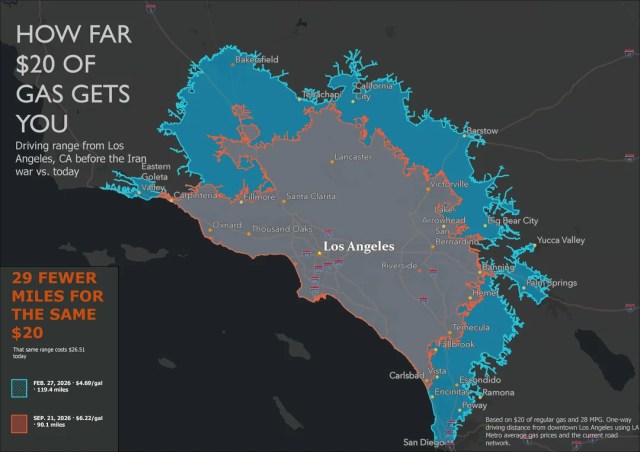
A new map shows how far $20 worth of fuel will get you in Los Angeles — almost 30 miles less than at the beginning of the year.
Here's what to know
As the New York Post relayed, a Redditor created the map by combining gas price with the road network and an assumed fuel economy of 28 miles per gallon.
Using Feb. 27 as a reference point, the map shows how much ground that same amount of money has lost. The difference is 29 miles, or about the distance from downtown Los Angeles to Long Beach.
The discussion focused on whether rising gas prices have made people drive any differently. "Every time I see lifted trucks, speeding to red lights, all the insane behavior of L.A. drivers, I have the same thought: Maybe it's not expensive enough yet," one commenter wrote.
Another added, "I think we won't see any changes to driving habits until stations begin rationing gasoline."
More background
In a sprawling region such as Los Angeles, driving is often less a convenience than a necessity.
TCD Picks » Quince Spotlight
💡These best-sellers from Quince deliver affordable, sustainable luxury for all




State figures cited by the Post show California's average price for regular gasoline was $6.08 after a 19-cent increase in one week. The average for regular gas was up $1.43 over the last year, while diesel was $3.18 higher at a record $8.35 per gallon.
For households facing long commutes, those increases can take a substantial bite out of spending for rent, groceries, and other essentials. "My monthly gas is about to be the same price as my apartment I rented in college," one commenter wrote.
Patrick De Haan, head of petroleum analysis at GasBuddy, told KRON4 that relief could come at the end of October when California switches from a costly summer blend of gasoline to a winter blend, as the Post noted. He also said tensions in the Middle East could push prices higher again before then.
"It's really more contingent on whether or not we'll continue to see the pace of escalations that have contributed to the faster pace," De Haan said.
What can be done?
Users discussed driving habits that can waste fuel, including speeding, rapid acceleration, and idling in drive-thrus.
Practical steps to reduce fuel consumption include combining errands into fewer trips, driving steadily, and avoiding unnecessary idling.
Many households are looking for ways to reduce their dependence on gasoline. Public transit, carpooling, and fuel-efficient or electric vehicles can all reduce exposure to swings in pump prices, particularly in a region where long drives are the norm.
After one user noted they could get from L.A. to San Francisco on $25 of electricity, the original poster wrote, "Making these [maps] has convinced me to get an electric."
Where can I learn more?
Here are more stories on escalating gas prices.
• Across the country, the painful realities of gas prices are shrinking what each fill-up can buy.
• With prices near $5, EVs could make sense even without home charging.
• In Washington, the EV math gets hard to ignore beside $5.35 gasoline.
• In the Bay Area, driving electric costs 7.9 times less per mile than gas.

Get TCD's free newsletters for easy tips, smart advice, and a chance to earn $5,000 toward home upgrades. To see more stories like this one, change your Google preferences here.






