


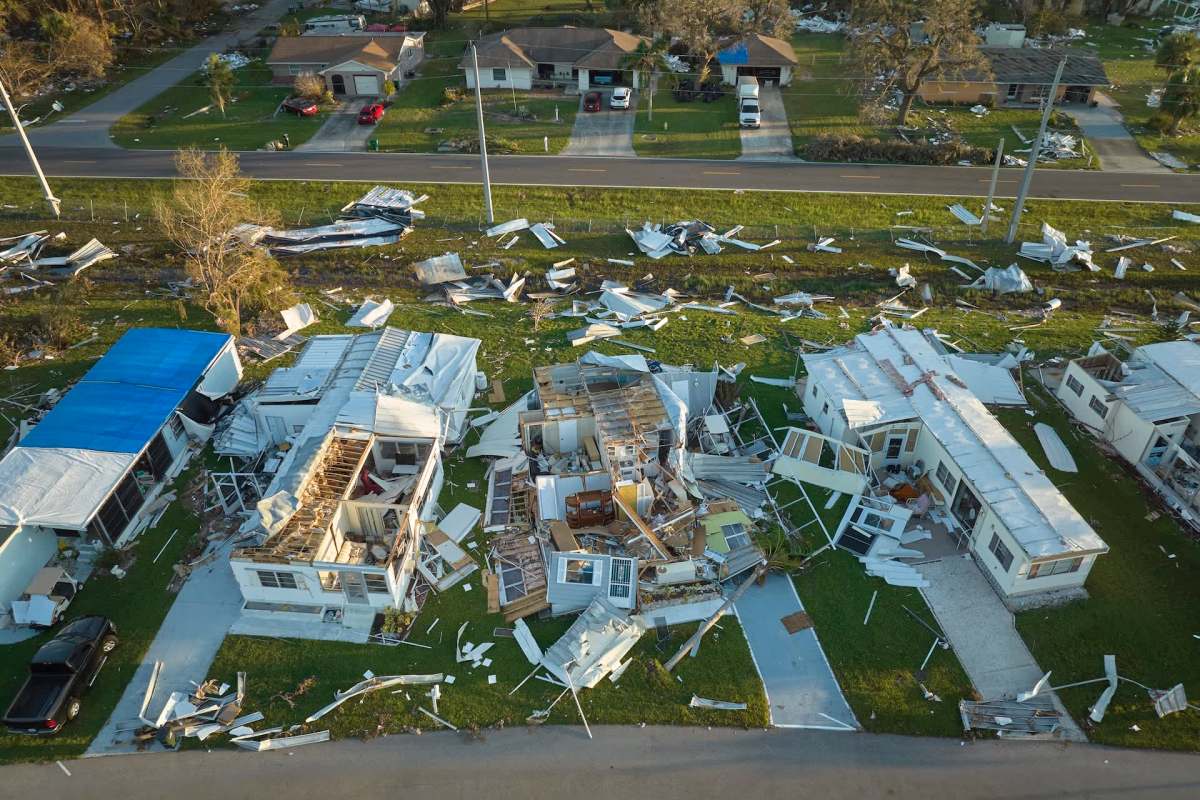
Insurance was supposed to be the safety net for Jen and RJ Garbowicz's St. Petersburg home. Instead, Hurricane Helene flooded the property in September 2024. Then, according to Capital & Main, Hurricane Milton stripped off the roof afterward, leaving the couple without the home they believed was protected.
What remains is a nearly acre-sized bayou lot with little on it besides concrete pilings. They still own the property, and their homeowners policy with a $713,000 limit paid just $2,279.41.
Here's what to know
After demolishing what the storms left behind, the Garbowiczes estimate that rebuilding will cost more than $1.5 million. According to Capital & Main, their flood policy paid its full $250,000, and FEMA provided about $33,000. Meanwhile, their homeowners insurer offered only $2,279.41.
A permit delay has stalled construction, and until work begins, their mortgage company is holding several hundred thousand dollars from the flood insurance payout. The couple is living in their second rental and still paying the mortgage on the destroyed house.
One part of the recovery has been especially draining, Jen Garbowicz explained, because using the Small Business Administration disaster loan they were approved for would send $33,000 straight back to FEMA as a "duplication of benefits," in the government's words, "even though that is a loan," she said.
"There really doesn't seem to be a central place for people to go to navigate that," she continued. "It turns into a full-time job."
TCD Picks » Quince Spotlight
💡These best-sellers from Quince deliver affordable, sustainable luxury for all




Across Florida, property insurance premiums average roughly $4,200 to $5,700 a year, 15 insurers have become insolvent since 2020, and the state has absorbed at least $200 billion in hurricane damage.
More background
After 36 years in Florida, Jen Garbowicz said she has watched insurance costs climb quickly. "We've seen rapid rises, at least over the last 10 years, in insurance premiums. And then these weather events come along and the insurance system doesn't work the way most people think that it does."
Florida's insurance crisis has also become a political issue.
Republican gubernatorial nominee Byron Donalds has sowed doubt about the science linking human activity to rising global temperatures and supports expanding power generation through small modular and micro-nuclear reactors, hydrogen, and another gas pipeline. Democratic nominee David Jolly has "treated climate a critical threat" and supports resilience measures such as raised roads, updated building codes, sea walls, and stormwater drainage investments, according to the paper.
HB 1217 has become another flashpoint. Signed into law on April 22, it bars cities and counties from enforcing policies that reference "net-zero" emissions, affecting places including St. Petersburg, Tampa, Orlando, Sarasota, and Pinellas County that had already committed to cutting emissions and energy costs.
What's being done?
In spring 2025, the couple went to Washington to support the bipartisan FEMA Act, a proposal to overhaul the federal agency. They have also tried to use their experience to push for reforms.
Nearly 100 lawmakers, 53 Republicans and 44 Democrats, back the bill introduced by Rep. Sam Graves, a Missouri Republican, and Rep. Rick Larsen, a Washington state Democrat. The measure would separate FEMA from the Department of Homeland Security, create a single disaster-recovery application, pay homeowners before they rebuild rather than reimbursing them afterward, and fund mitigation before storms hit.
The proposal is also backed by groups including the National League of Cities, the National Association of Counties, and the National Governors Association. Still, it has not reached a floor vote. RJ Garbowicz said Rep. Anna Paulina Luna's chief of staff showed interest in the bill and asked him to draft a white paper with suggested amendments, but he has not heard back.
Competing ideas are also being pushed at the state level.
Lisa Zayas, deputy communications director of Florida Watch, said her organization is questioning candidates on disaster relief, while Jolly is calling for resilience spending and stronger rooftop solar policies. Donalds is proposing more energy development paired with regulation of data centers' power and water use.
As they wait for a permit and watch their rebuild stall, the Garbowiczes say the hardest part may be navigating the system itself. "The whole system is convoluted," RJ Garbowicz said.
Where can I learn more?
Here are a few more stories on the pressures reshaping disaster recovery and home insurance in storm-prone places. They look at tiny claim payouts, post-hurricane risks, rising premiums, and insurers pulling back from vulnerable markets.
• In Florida, some homeowners ended up with roughly $8,000 after storms despite far larger insurance policies.
• After Hurricane Helene, Florida homeowners faced threats to their property even after floodwaters receded.
• In Louisiana, a law could allow insurance companies to flee the flood market.
• Across the U.S., extreme weather has driven insurance price hikes in the most vulnerable states.
• In Texas, severe storms helped insurance companies exit the state, squeezing homeowners seeking coverage.

Get TCD's free newsletters for easy tips, smart advice, and a chance to earn $5,000 toward home upgrades. To see more stories like this one, change your Google preferences here.






