


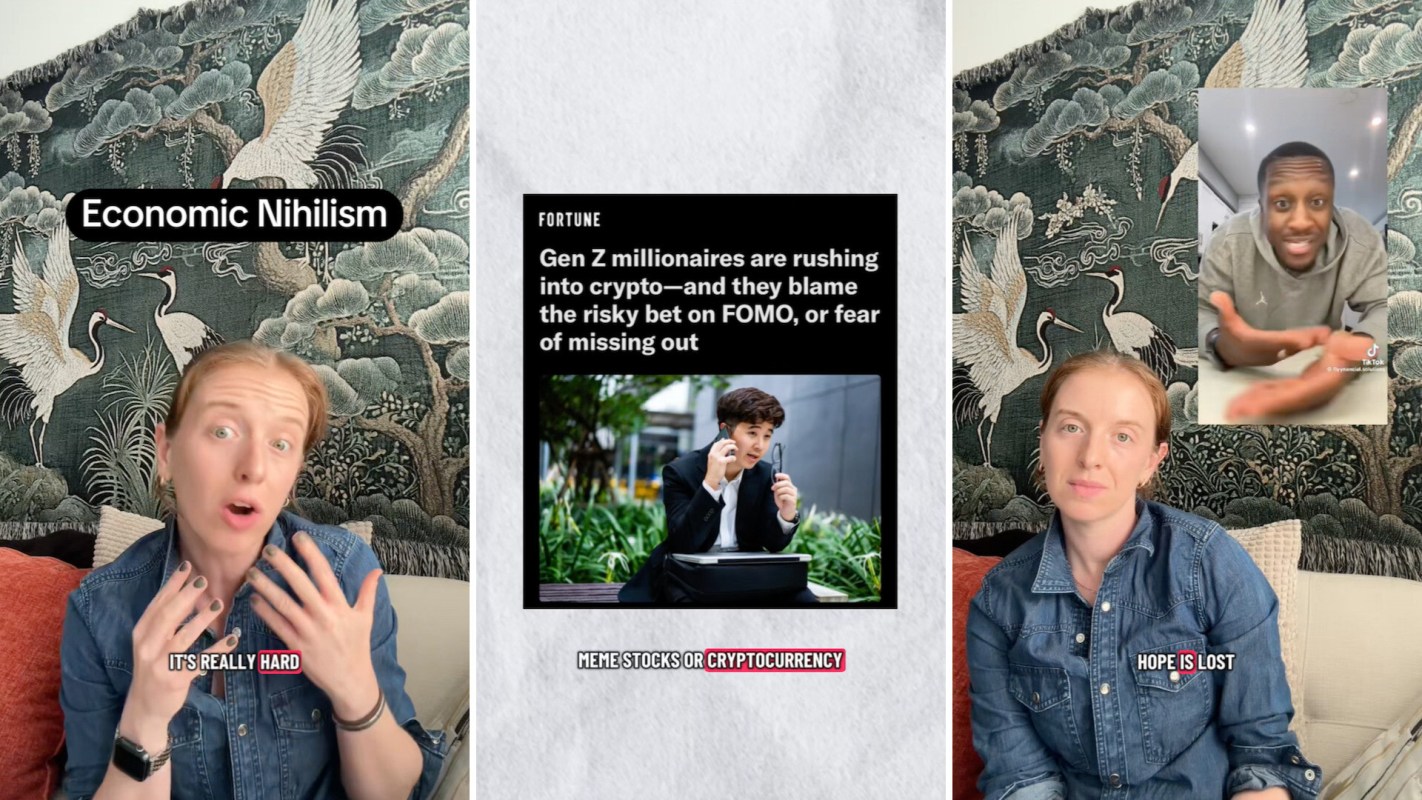
According to one economist on TikTok, many younger Americans are sliding into what she calls "economic nihilism," as higher costs, shakier early-career opportunities, and a dimmer view of the American dream converge.
When buying a home or following the usual financial playbook no longer seems realistic, riskier spending and going into debt are the logical response.
Here's what to know
Sarah (@econwithsarah), a creator with a PhD in Economics, argued in a TikTok video that money choices often criticized in millennials and Gen Z are better understood as a reaction to an economy that no longer seems to reward patience.
@econwithsarah 10/20/2026: OG Video: @Price Match Papi why does the economy feel so hopeless right now, especially for Gen Z and Millenials? Well, the answer has a lot to do with the economics data, including inflation, a stagnant labor market, and policy that seemingly benefits a few. We chat about the details below! #economics #finance #homeownership #genz ♬ original sound - Econ with Sarah, PhD
As evidence, she cited a youth unemployment rate of around 10% for 16- to 24-year-olds, which she said remains elevated. She also argued that college has become a less compelling bargain, with the college wage premium falling from about 80% in 2001 to roughly 75% by 2023 even as college costs rose by nearly 40%.
Housing was another part of her argument. After adjusting for inflation, she said, the home price-to-income ratio has almost doubled since 1980, helping drive a sense among many younger adults that "they don't see the American dream as possible anymore."
One commenter wrote, "Wealth can not be built, just inherited," while another asked, "Why save a future we don't know exists?"
TCD Picks » Quince Spotlight
💡These best-sellers from Quince deliver affordable, sustainable luxury for all




More background
Sarah said that once conventional ways of getting ahead feel blocked, alternatives such as meme stocks, cryptocurrency, and sports gambling apps can take their place. Citing a poll, she added that almost two-thirds of millennial and Gen Z respondents saw crypto or gambling as their only realistic path to wealth.
In her telling, the same pessimism is visible in household finances, too. Credit card balances are nearing $1.5 trillion, and the share of bills at least 90 days delinquent is at its highest since 2011.
She framed the behavior as a psychological response rather than a moral failing.
"When you don't think you have a lot of hope about what the economy looks like in the future, you are going to increase the feeling and the positive benefit you feel right now," she said.
One commenter wrote: "A silly one-time-purchase that brings joy can feel more worthwhile than the other constant costs that are way more of a gamble than people like to acknowledge."
What can be done?
Her point was not that crypto or gambling offer a real answer. Instead, Sarah argued that younger workers need ordinary routes to stability to feel reachable again.
That, she suggested, would mean improving the job market for people ages 16 to 24, strengthening the financial return on a college degree, and addressing housing affordability after decades of rising home price-to-income ratios.
She also challenged the idea that an economy should be considered healthy simply because consumer spending remains high, especially if that spending is being sustained by mounting debt and worsening delinquency rates.
She also cast political leadership as part of the disconnect, noting that U.S. senators are on average about 64 to 65 years old. She said younger Americans need a believable path forward. She said the issue is bigger than personal discipline.
"Unless we give people some sort of hope about the future of their own personal well-being, this economic nihilism will continue to exist," Sarah concluded.
Where can I learn more?
A lot of the same financial strain and uncertainty shows up in other ways.
• Across the U.S., shoppers are filling pantries for the worst while still paying for small comforts.
• Across the U.S., rising insurance costs risk a climate-driven financial death spiral for households and markets.

Get TCD's free newsletters for easy tips, smart advice, and a chance to earn $5,000 toward home upgrades. To see more stories like this one, change your Google preferences here.






