


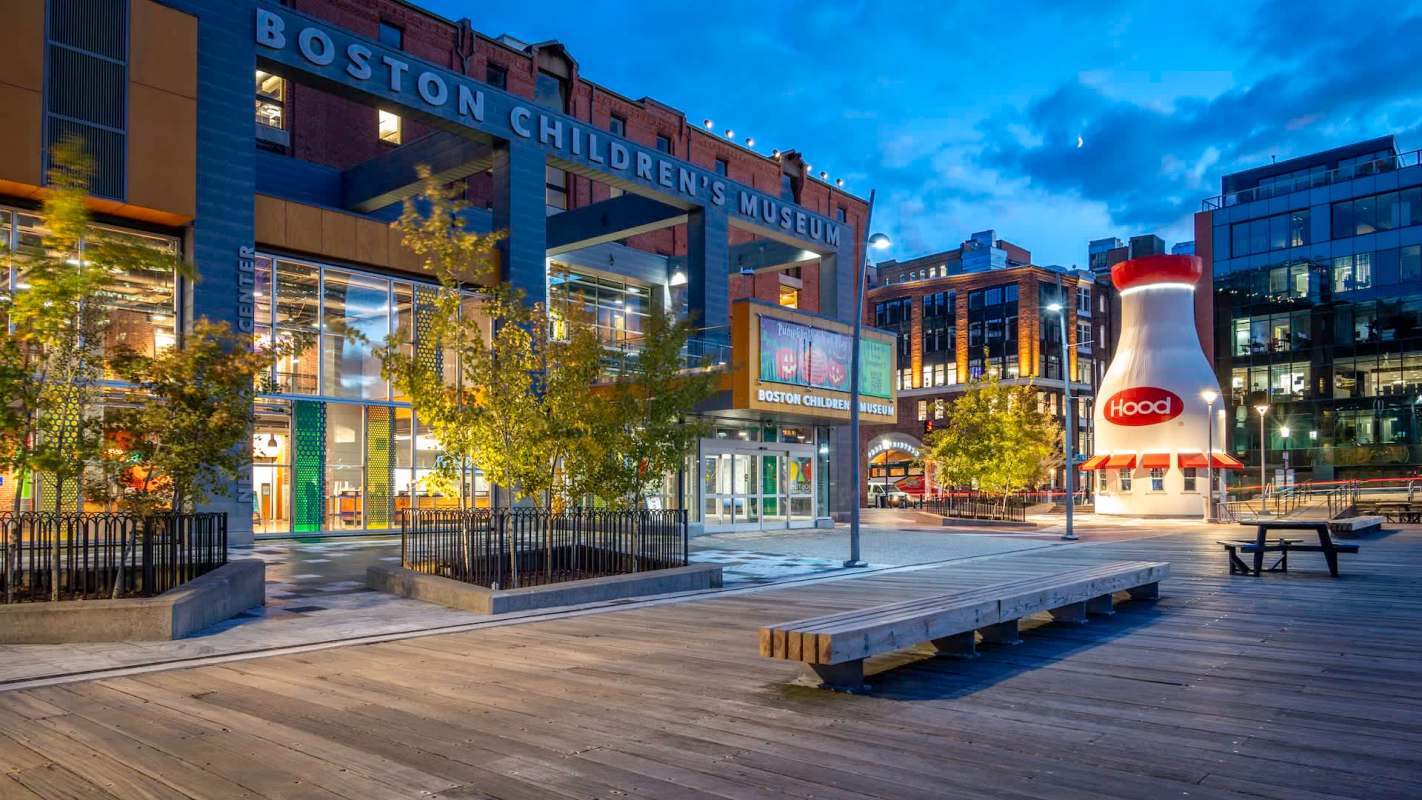
Boston's waterfront has long been one of the city's biggest draws, but it is also among its most exposed areas as flooding becomes more frequent and more costly.
That pressure is becoming especially clear for the area's Boston Children's Museum and New England Aquarium, which are moving ahead with separate projects worth a combined $23 million to better protect their buildings from repeated water-related damage, according to Banker & Tradesman.
Here's what to know
The museum's work will include "installation of a synthetic rubber membrane elevated more than 4 feet along the building base to prevent flood waters from entering the basement," according to Banker & Tradesman. After that, "a cistern will be installed in a current loading dock area with, capacity to store 2,507 cubic feet of flood water and gradually drain it back into the channel." Crucial equipment will also moved to higher floors to prevent damage if water does enter the building.
Design firm Sasaki was enlisted for the $15 million project. Associate Principal Marta Guerra-Pastrian told Banker & Tradesman, "If we don't protect these neighborhoods, there is not going to be a building to protect."
Carole Charnow, the CEO of the museum, spoke to the outlet about the project, which was funded entirely from donations. An anonymous donor helped start the process, with further private donations and $7 million from the New Balance Foundation taking funds past the required amount.
"It did take a while to talk people into [donating]," Charnow told Banker & Tradesman. "What tipped it was they started to see the detailed plans come to life and see that this is achievable."
TCD Picks » Quince Spotlight
💡These best-sellers from Quince deliver affordable, sustainable luxury for all




The aquarium is surrounded by water that is reportedly expected to rise around 40 inches by 2070. It has already had to replace a steam pipe that was damaged by flooding.
Its $8 million project will involve flood barriers that can be put out ahead of storms, while an HVAC system installed in the building's basement will be moved to the roof.
Chief of staff and business operations Kimberly Fontes told Banker & Tradesman, "We're in the center of climate change and flooding and king tides, so this isn't something new for us."
More background
Waterfront neighborhoods have seen rapid development, but their location leaves them especially vulnerable to flooding.
As Banker & Tradesman explained, "Fort Point Channel spilled over the Boston Harborwalk in front of the main entrance during a 2018 coastal storm. Flood water flowed behind the museum on Sleeper Street into a crawl space."
Despite avoiding any major damage, the museum took steps to protect itself after that event.
"It was a warning sign that we were vulnerable, that we had to do something," Charnow said.
What's being done?
One of the major questions asked by potential donors was why the museum was paying for flood defense work when that should be the responsibility of local governments. But while Boston officials have moved to protect the waterfront with the construction of a storm barrier, that work isn't expected to begin until the 2030s at the earliest, leaving properties exposed in the meantime.
"We have gotten so far ahead on this, we are considered a demonstration project by the city and state of how buildings can protect not only themselves, but also their neighbors," Charnow said.
Climate adaptation is increasingly an operations and real estate issue, not just an environmental one. For nonprofits and institutions that serve the public, the stakes are especially high, as a single flood can affect staff, visitors, exhibits, and community access all at once.
Where can I learn more?
The same pressures facing this waterfront institution are forcing tough, expensive decisions elsewhere too. From New York City's East River to Salem and Mill Valley, communities are reworking public spaces, moving historic buildings, and dealing with flooding that can cut off access well before bigger public protections are in place.
• In New York City, an elevated waterfront park is being built to blunt storm surges.
• In Salem, officials are moving historic buildings inland as flood threats make preservation harder.
• In Mill Valley, repeated flooding is threatening school access and disrupting daily life for families.
These stories show how climate risk is changing where public-serving places can safely operate and how much they have to spend to keep their doors open. They also make clear why property-level defenses are becoming more urgent, even in places still waiting on broader protections.

Get TCD's free newsletters for easy tips, smart advice, and a chance to earn $5,000 toward home upgrades. To see more stories like this one, change your Google preferences here.






