


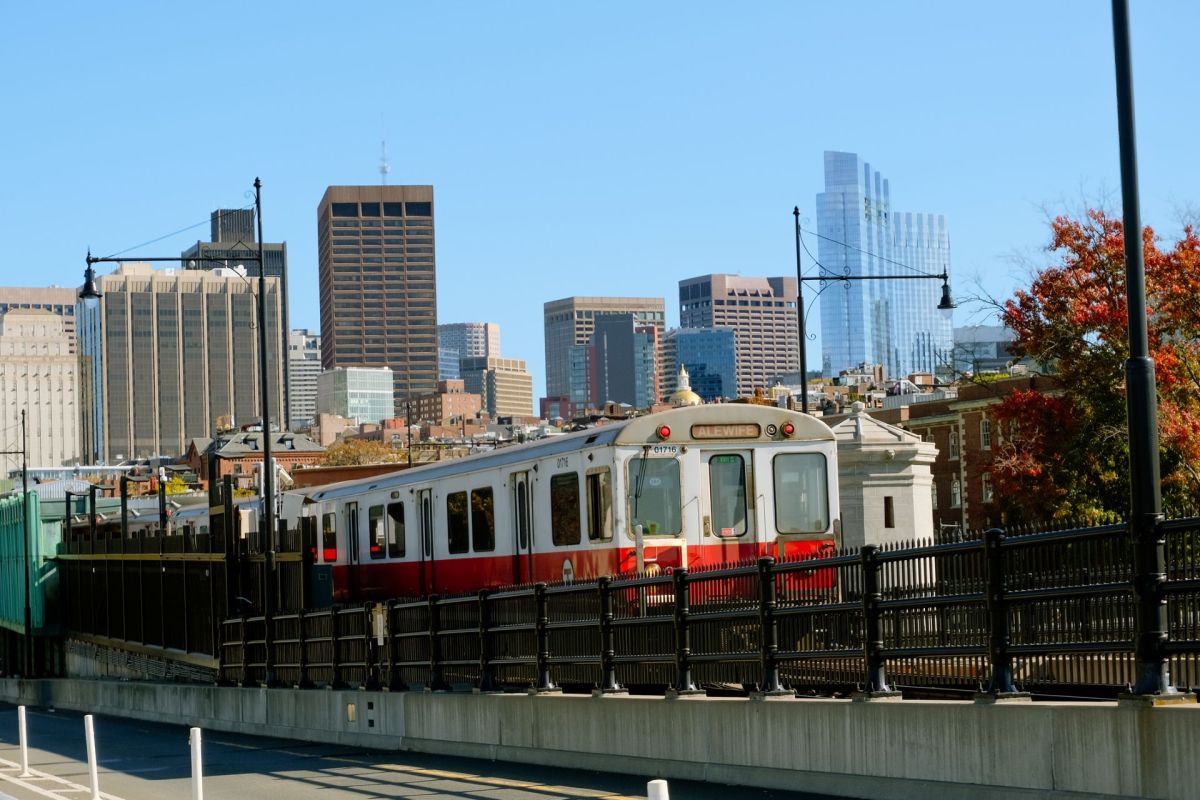
Arlington, Massachusetts, leaders said the suburb's housing growth plans are running up against its transportation limits, and they are pressing to lift a 46-year-old law that blocks the Massachusetts Bay Transportation Authority from moving ahead with a Red Line extension unless lawmakers give specific approval. In their view, adding more homes without better transit would only make traffic worse.
According to State House News Service, Paul Schlichtman — an Arlington Town Meeting member involved with the community group Extend the Red Line — is one of the people pressing the point.
"We'll choke in traffic if we don't get better transit in town," he said.
Here's what to know
Arlington's legislative delegation — Reps. Sean Garballey and David Rogers and Sen. Cindy Friedman — filed a bill to strike the 1980 restriction.
That came after Arlington Town Meeting approved the home rule petition 145-54 in May, according to State House News Service.
Supporters said the discussion is about more than rail access. Schlichtman said Arlington has already taken steps toward greater housing density but that it will become harder if the town remains dependent on cars.
TCD Picks » Quince Spotlight
💡These best-sellers from Quince deliver affordable, sustainable luxury for all




"The town has done a lot in terms of housing density. And if we're going to pull that off, if we're going to build more housing in town, we can't do it with the current infrastructure," he said, per State House News Service.
Garballey said: "It's a goal to provide more services to our constituents. The town of Arlington is made up of around 45,000 people. We are a massive population right outside Boston, and there is no train service that goes through the town of Arlington. There's been a lot of conversations within our community for decades about why that is."
The Red Line stops at Alewife Station in Cambridge, just outside Arlington. State House News Service, citing state data, said the line averaged 107,000 to 146,000 daily riders in 2025, depending on the month.
More background
State House News Service reported that MBTA plans in the 1970s envisioned running the Red Line through Arlington Center to Arlington Heights, with a possible later extension toward Route 128. Those plans were derailed by local opposition in Arlington and Lexington.
Backers want to revisit that planning work instead of starting over. Schlichtman said supporters hope the earlier proposals can be brought back for discussion.
"So, the plans have been drawn, once upon a time, and we're trying to get them to dust them off and move it forward," he said.
Before Town Meeting acted, Arlington's Select Board recommended no action, and State House News Service reported that members said the restriction may have expired after the MBTA finished its Northwest Extension in 1985. The board also said the agency did not appear to see the old wording as a major obstacle.
Still, removing the restriction would only make an extension legally possible; it would not ensure one happens.
Both the MBTA's 2026-30 and 2027-31 capital investment plans note public interest in extending the line, but neither sets aside money for a project.
What's being done?
Supporters say the goal is simply to clear the legal barrier so the idea can move forward.
"While we may not see an extension project in the near future, I don't believe our laws should prohibit it," Friedman said, per State House News Service.
The outlet reported that Garballey and Lexington Rep. Michelle Ciccolo secured a $50,000 fiscal 2027 budget earmark for the MBTA to study the costs and agency capacity involved in either extending the Red Line or creating Bus Rapid Transit from Alewife along Route 2 to the Concord Rotary.
Another proposal, H 3666, would create a commission to review those same transit possibilities for Arlington and Lexington.
"I think Arlington demands adequate public transportation, and I think it was a real missed opportunity decades ago when the Red Line was not extended through Arlington, and I would like to see a comprehensive study in terms of what are the future transportation options from Alewife to better service the constituents of Arlington, Lexington, Concord and the Route 2 corridor," Garballey said.
Where can I learn more?
For more on transportation trade-offs, these stories look at how governments handle traffic, growth, and infrastructure limits.
• In Colorado, a rule limiting highway expansion has reshaped debates over congestion and growth.
• In Los Angeles, transportation authorities canceled an offramp project after decades of neighborhood opposition.
• In Colorado, residents opposed a massive highway expansion that cut through communities.
• Federal officials plan to roll back vehicle pollution rules tied to transportation.

Get TCD's free newsletters for easy tips, smart advice, and a chance to earn $5,000 toward home upgrades. To see more stories like this one, change your Google preferences here.






