


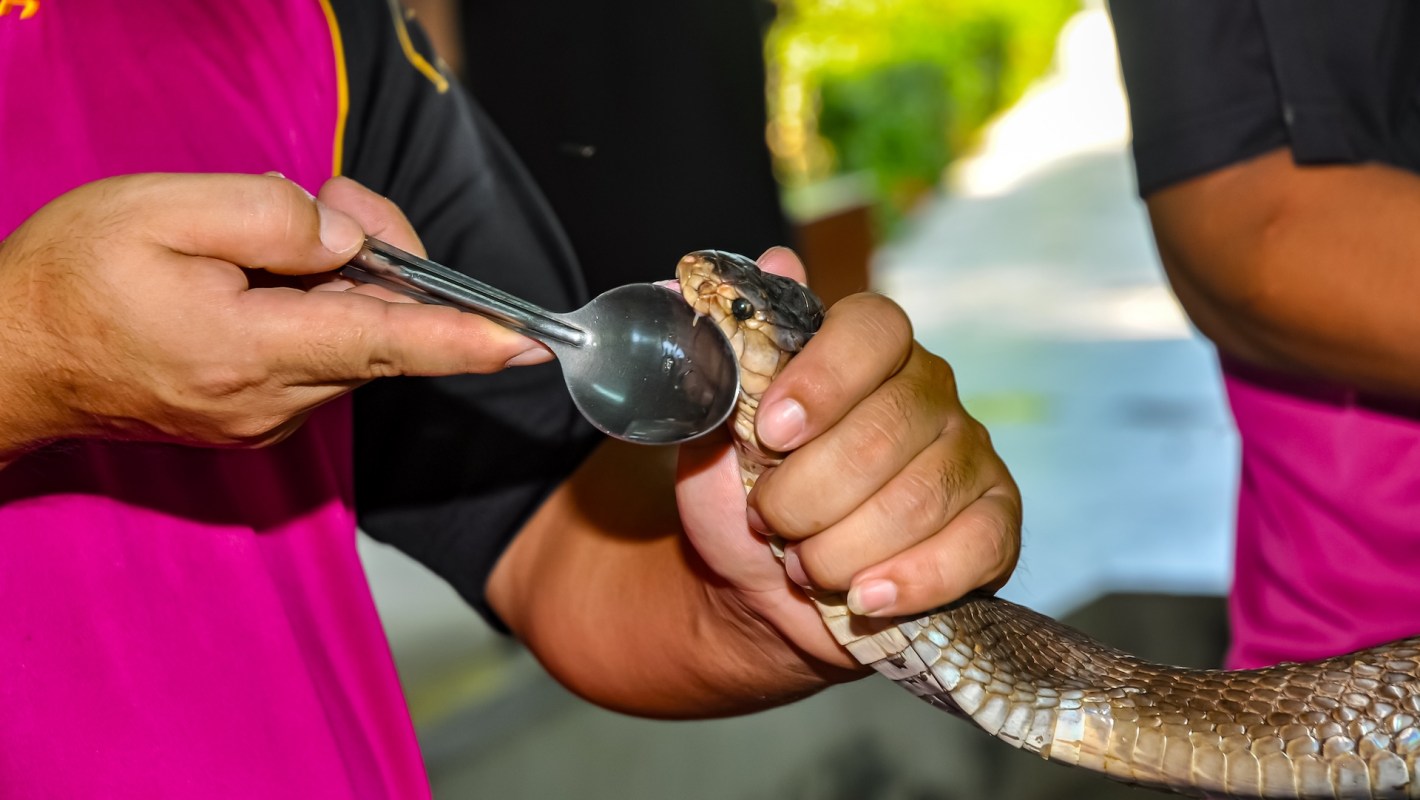
A changing climate has raised concerns that venomous snakes could spread to new regions, but experimental antivenom offers hope for a more broadly effective snakebite treatment.
Here's what to know
Researchers at the Indian Institute of Science (IISc), the Centre for Ecological Sciences, and the Technical University of Denmark (DTU) developed a five-component mixture of tiny antibody fragments known as nanobodies, according to News-Medical.Net.
Mice given venom from monocled cobras, spectacled cobras, or either of the two Indian king cobra species were protected by the cocktail, which prevented toxins from attaching to their target receptor and neutralized venom activity.
The treatment worked even when administered 30 minutes after venom injection. "Even mice that were paralysed or had typical neurotoxic symptoms would revert to a completely asymptomatic state," said Kartik Sunagar, an associate professor at CES, per News-Medical.Net.
Science Translational Medicine published the research.
More background
Snakebite is classified as a neglected tropical disease and leaves hundreds of thousands of people dead or disabled globally each year, News-Medical.Net noted. Nearly 50,000 people die from snakebites in India annually, the highest snakebite death toll of any country.
TCD Picks » Quince Spotlight
💡These best-sellers from Quince deliver affordable, sustainable luxury for all




Collecting venom and repeatedly immunizing animals such as horses makes conventional antivenom production expensive, with a relatively low output of active antibodies.
The resulting animal-derived treatments can also cause side effects, differ from batch to batch, and protect against only a limited range of species.
The nanobodies, on the other hand, could be produced "using microbial and humanized expression systems" without repeated immunizations, per News-Medical.Net.
"Antivenom treatment has virtually not changed for over 100 years. This is the only next-generation antivenom we have now, which could tackle India's snakebite problem," Sunagar said.
What's being done?
Earlier research involving camelids, including alpacas and llamas immunized with African snake venoms, provided antibodies that Sunagar and Andreas Laustsen, a professor at the Technical University of Denmark, set out to adapt together.
In this study, they found that the antibodies were also able to neutralize toxins from Indian snakes. Further research is needed to understand whether the new nanobodies can offer the same protection in humans.

Get TCD's free newsletters for easy tips, smart advice, and a chance to earn $5,000 toward home upgrades. To see more stories like this one, change your Google preferences here.






