


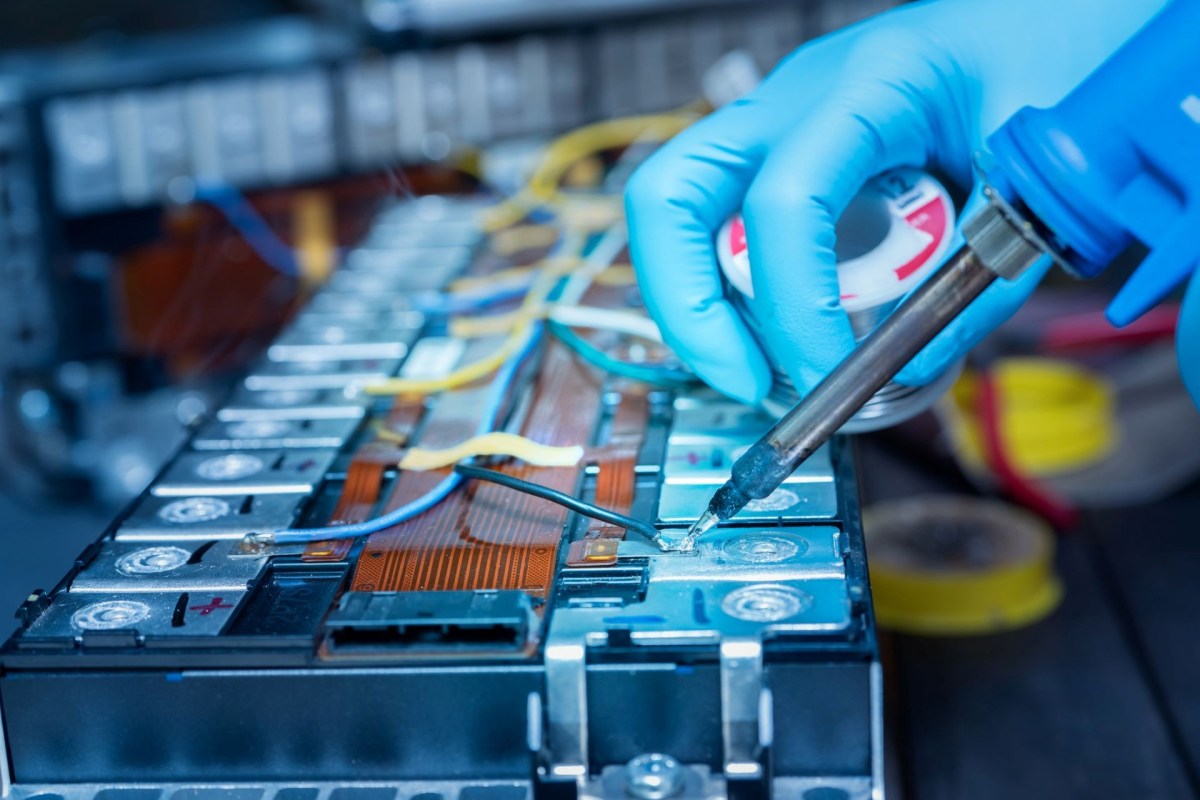
Scientists in China have printed ultra-thin lithium anodes that kept test batteries stable for more than 260 charging cycles. The approach could help electric vehicles carry more energy without heavier batteries, and it could also benefit portable electronics and energy storage systems.
Here's what to know
The mask-assisted screen-printing process deposits lithium microdiscs on copper, Interesting Engineering reported. These ultra-thin anodes could make EV batteries more powerful, expand their energy storage capacity, and lessen their mass.
The Shenzhen Institutes of Advanced Technology, part of the Chinese Academy of Sciences, led the research team that developed it. Researchers from Southern University of Science and Technology and Guilin University of Technology also participated. They published their findings in the journal Nano-Micro Letters.
Previously, producing thin, uniform anodes was difficult because molten lithium tends to form droplets on copper rather than coat the surface evenly. The screen-printing process developed by the researchers uses a patterned mask to place the lithium onto the copper, producing evenly spaced lithium microdiscs.
The team produced lithium arrays with equivalent thicknesses of 10, 20, and 28 micrometers by controlling and adjusting the discs' dimensions and the gaps between them.
Lithium can react with a battery's electrolyte and develop uneven deposits, including needle-like structures called dendrites that affect performance. To help protect the anode, the team introduced a magnesium-based compound into the molten lithium.
TCD Picks » Quince Spotlight
💡These best-sellers from Quince deliver affordable, sustainable luxury for all




The resulting reaction produced lithium-magnesium alloys along with lithium sulfide, lithium nitride, and lithium fluoride. Together, these materials formed a more stable protective layer intended to reduce unwanted chemical reactions and lithium loss during repeated charging.
More background
Conventional lithium metal battery designs often use thick foils. Lithium metal's appeal, though, is its ability to store substantial energy at low weight. With that extra material, a battery stores less energy for its weight.
The researchers' tests suggested a battery stack could store 504 watt-hours per kilogram by weight and 1,071 watt-hours per liter by volume. Those results came from pairing a printed 20-micrometer anode with high-loading, nickel-rich cathodes.
The same benefit could extend to portable electronics, as battery weight and space affect the devices people carry every day.
What's being done?
When paired with lithium iron phosphate cathodes, the modified 10-micrometer anodes maintained stable performance for 260 cycles, demonstrating durability as well as a specific capacity above 130 milliampere-hours per gram. They also achieved Coulombic efficiency exceeding 99.8%, a measure of how effectively charge is recovered.
The approach also showed promise in gel-electrolyte solid-state battery tests, extending the team's testing beyond the nickel-rich cathode design.

Get TCD's free newsletters for easy tips, smart advice, and a chance to earn $5,000 toward home upgrades. To see more stories like this one, change your Google preferences here.






