


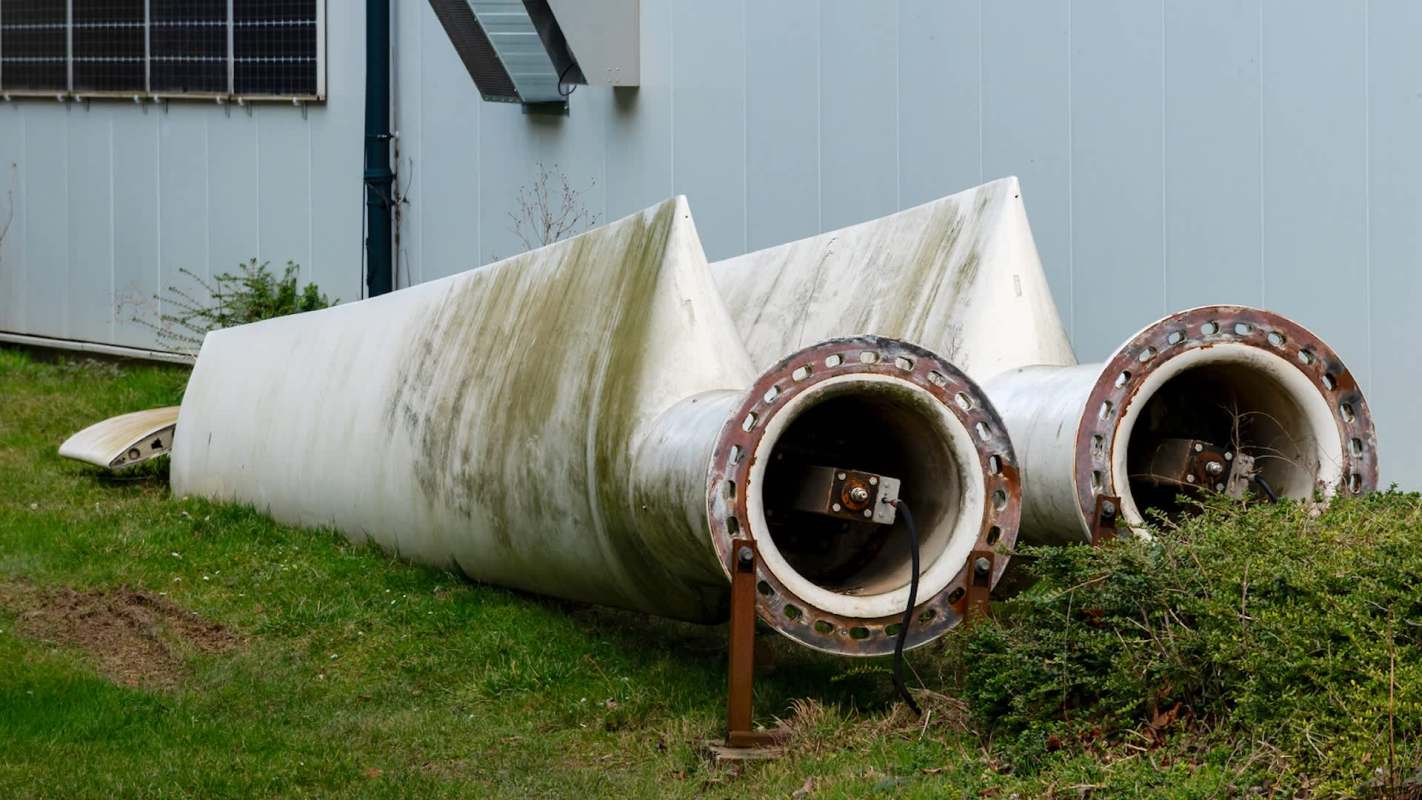
Discarded wind turbine blades could help make their replacements stronger, thanks to a new technique developed by researchers in China. The team developed a half-second heat treatment that turns hard-to-recycle blade materials into valuable ingredients for industrial use, including manufacturing new wind blades.
Here's what to know
Graphene and silicon carbide are useful in advanced technologies because of their mechanical, thermal, and electrical properties. Researchers at Tsinghua University have developed a way to produce both from blade waste, according to Noticias Ambientales.
The researchers' method used powerful electrical pulses to heat a mixture of conductive carbon and ground-up blade particles, a technique known as flash Joule heating. In just half a second, the mixture reached about 3,632 degrees Fahrenheit (2,000 degrees Celsius).
Under the intense heat, some carbon in the blades' polymer resins reorganized into graphene. The process also converted silica in their glass fibers into silicon carbide.
More background
To date, wind blades have been difficult to process after retirement because their composites were built to endure years of wind, moisture, sunlight, and temperature changes. Much of the rest of a turbine can be recycled conventionally.
The growing volume of discarded blades has been driving demand for alternatives. Industry estimates cited by Noticias Ambientales put Europe's potential annual blade waste at roughly 55,000 tons by 2030. Meanwhile, Europe's wind industry committed to ending landfill disposal of blade waste in 2026.
TCD Picks » Quince Spotlight
💡These best-sellers from Quince deliver affordable, sustainable luxury for all




The researchers' experimental assessments indicated that recovered materials could deliver an economic benefit of about $80 for each ton processed, according to Noticias Ambientales. They also estimated that the process could produce 83% to 92% less planet-warming pollution compared with some traditional waste-treatment methods.
What's being done?
The team next assessed the strength of resins for new blades after adding the recovered materials. Resistance to tensile deformation rose 27%, and flexural strength — the ability to withstand bending — improved 9% when recycled material made up just 0.3% of the resins.
The modified resins also showed improved heat dissipation and distribution. This could prove particularly useful in cold regions, where ice buildup on turbine blades can reduce electricity generation efficiency and create additional maintenance work.
Bringing the process into industrial use, however, would require further testing. Researchers need to determine whether the process remains efficient and economically viable when handling much larger quantities of materials. They will also need to evaluate how the recovered ingredients perform in real industrial applications and whether manufacturers can effectively incorporate them into new turbines.

Get TCD's free newsletters for easy tips, smart advice, and a chance to earn $5,000 toward home upgrades. To see more stories like this one, change your Google preferences here.






