


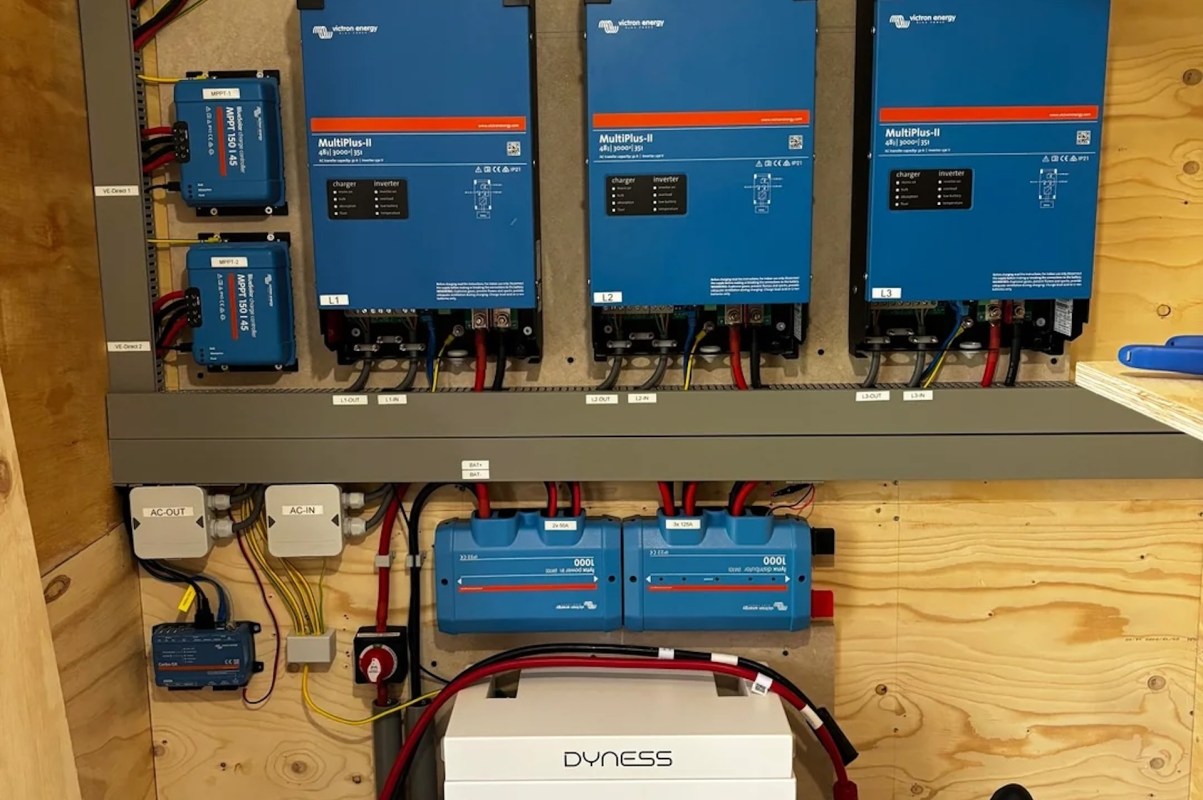
A Redditor doing a DIY Victron home battery project added grounding, storage, electrical fuses, and humidity-controlled ventilation.
The DIY installer asked: "Any suggestions or advice?"
Here's what to know
In an update shared on Reddit, the builder detailed installing a Dyness Powerbrick Plus battery, along with separate fuses for the battery, solar charge controllers, and Multiplus units.
Three 125-amp Mega fuses protect the Multiplus units, while two 60-amp Mega fuses cover the MPPT charge controllers. The battery has its own 225-amp Mega fuse.
For homeowners who are exploring storage and don't want to assemble a system themselves, EnergySage offers a resource for researching battery products and comparing competitive installation estimates.
EnergySage also partners with electrification company Qmerit to help homeowners secure the best available battery-storage pricing.
More background
Drywall sits behind the battery. For grounding, the connection to the main ground bar uses 2.5-square-millimeter cable, while all other grounding connections use 6-square-millimeter cable.
The equipment connects to a network switch via a LAN connection. Humidity-controlled ventilation is also in place.
Crushed by your bills? See instant solar savings from vetted installers in just a few clicks With energy prices through the roof, there's never been a better time to go solar — and EasyHome can help you find the best prices from the best installers in your area. EasyHome takes the guesswork and headaches out of energy upgrades by showing you estimated savings from a network of vetted local partners. To get started, just enter your ZIP and share a few details about your home — seeing your estimate is really that easy. |

For homeowners, a suitably configured solar-and-storage system can provide backup power during outages and potentially lower electricity costs by saving solar energy for later use.
With the appropriate design, these systems can also support off-grid use.
What can be done?
Electricity generation remains a future addition to the storage project: the builder plans to install and connect six JA Solar panels with a combined rated capacity of 3,000 watts.
The remaining electrical work includes installing a Victron Energy VM-3P75CT meter and fitting residual-current devices, or RCDs, on both the AC input and output.
For readers interested in a simpler backup option than the equipment-heavy build, Pila offers a plug-and-play battery alternative at a substantially lower price point than whole-home backup systems.
With the battery in place and several steps still ahead, the builder turned to the Reddit community for input.
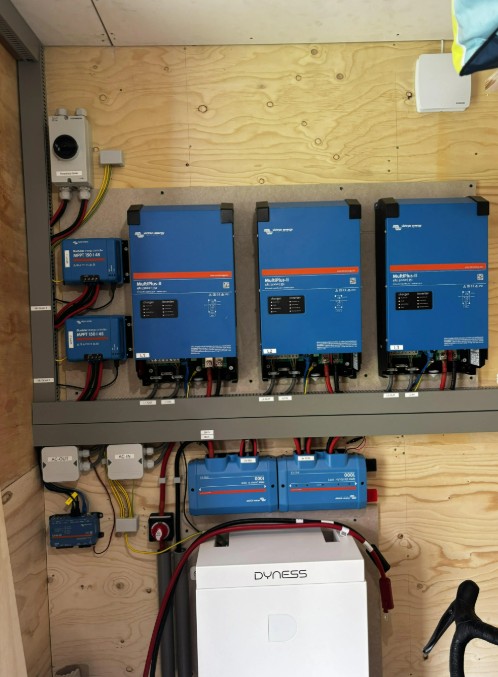
One commenter pointed out: "The charge controllers should really be turned so the heat can naturally rise thru the fins better. Otherwise it looks good i like the labeling." The poster then shared a photo of the fix.
Where can I learn more?
Other homeowners are weighing similar equipment costs and wiring decisions as they build solar-and-storage systems. These stories follow panel purchases, battery installations, electricity savings, and DIY wiring questions.
• A Tennessee homeowner bought nine $195 panels and considered a battery-and-inverter bundle.
• A homeowner's $18,000 battery bank stores 216 kWh inside its own concrete bunker.
• In Australia, an electrician's $10,500 home battery turned a $250 bill into $14 in credit.
• A U.S. DIYer asked whether balcony solar batteries could power a 1,200-watt system continuously.
• A DIY builder revealed 40-panel solar pyramid wiring, prompting commenters to flag inverter heat.

Get TCD's free newsletters for easy tips, smart advice, and a chance to earn $5,000 toward home upgrades. To see more stories like this one, change your Google preferences here.
Cool Picks






