


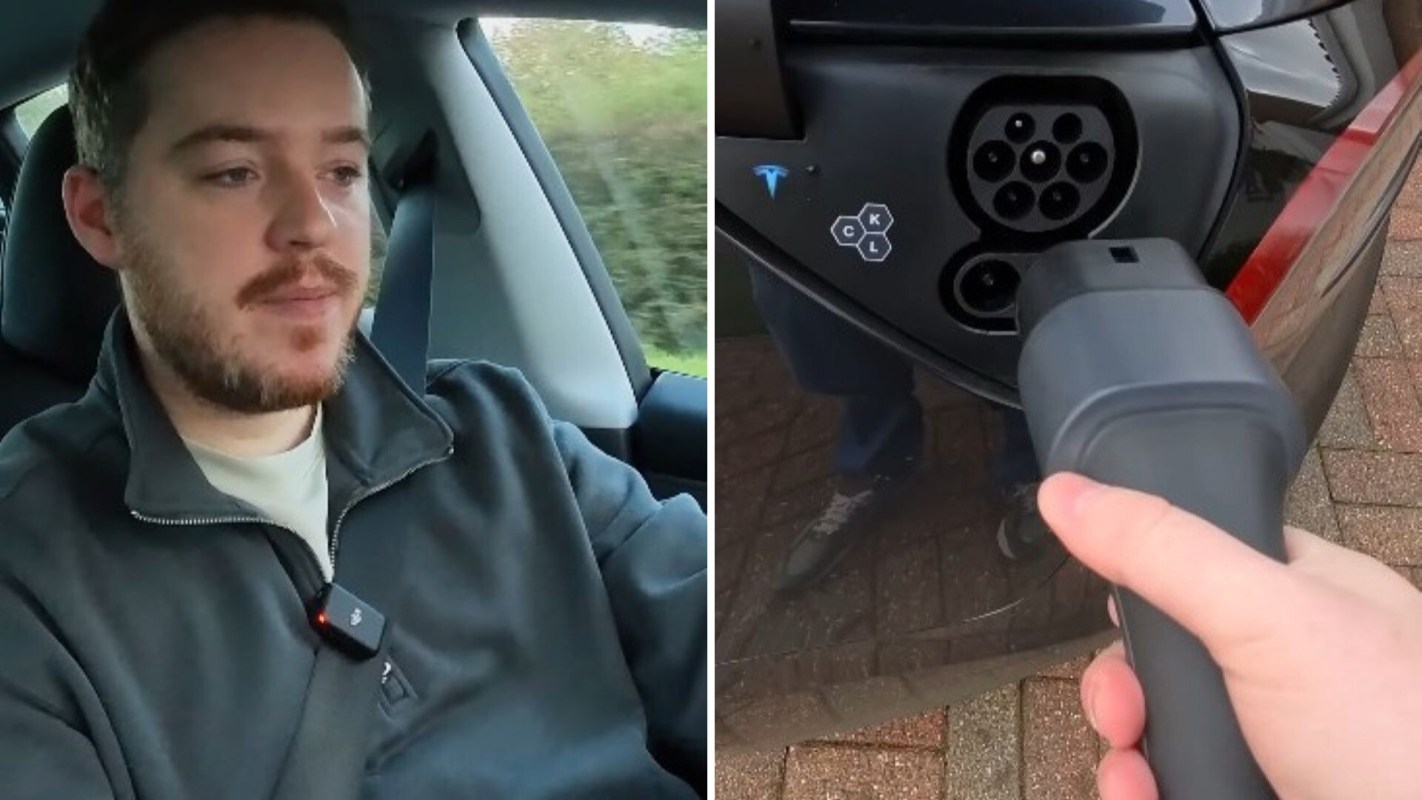
An electric car owner in the United Kingdom found that a three-pin "granny" charger could replenish the energy used on his roughly 100-mile daily commute overnight for about £6 (~$8 USD at the current exchange rate).
Here's what to know
UK driver and content creator Alex Carter (@ItsAlexCarter) tested a dé charger with his 2026 Tesla Model 3, configured as the Long Range Rear-Wheel Drive version, and documented the results in a YouTube video.
The company supplied the charger free for the test. He plugged in just after 6 p.m., and by just after 6 a.m., the battery had reached 74%. Carter left home with 70% battery and returned with 43%.
Over slightly more than 12 hours, he reported adding 26 kilowatt-hours, which was enough to replenish the energy used on his commute, with some charge to spare. Although the charger can deliver about 3 kilowatts at 13 amps, Carter selected a 230-volt supply at 10 amps, yielding roughly 2.3 kilowatts, he said.
The reported £6 cost did not include a special EV electricity tariff.
More background
Viewers suggested a three-pin charger could meet his daily driving needs. Carter had driven more than 2,800 miles in just over a month of ownership, relying exclusively on Superchargers because he lacked a home charging setup.
TCD Picks » Quince Spotlight
💡These best-sellers from Quince deliver affordable, sustainable luxury for all




His Tesla came with a Type 2-to-Type 2 cable, but charging from a household socket required another purchase. He outlined two home charging options, including a professionally installed 7-kilowatt wall charger or a portable three-pin charger.
The dé unit also offered app control and delayed charging, features Carter associated with wall chargers. Its adjustable current, ranging from 6 to 13 amps, allowed him to choose the charging rate for his overnight test.
Beyond the savings, home charging meant Carter could replenish his battery while parked, saving him trips to Superchargers. He described the roughly £6 electricity cost for his commute as substantially cheaper than making the same journey in a petrol or diesel car.
"I have been using a granny charger since I bought the car, 5 years and 100,000 km ago…" a commenter wrote. "Never had any problems with it and always at 100% in the morning…"
What can be done?
The safety guidance Carter shared from Electrical Safety First states: "The extended load and duration of charging an EV are likely to exceed what a standard socket-outlet and standard wiring is designed for. 13A sockets for EV charging are constructed/tested to be more robust and are marked 'BS1363/EV' to identify them. They should be supplied by dedicated circuits."
He chose to charge at 10 amps and emphasized the importance of having appropriate equipment before using the charger's maximum output. For anyone uncertain about their setup, Carter recommended getting professional advice.
The dé charger comes in lengths from 23 to 82 feet (7 to 25 meters), and Carter received a 49-foot (15-meter) version. He chose a charging cable long enough to reach the car directly.
One YouTube commenter proposed an alternative.
"You CAN use an extension lead with a granny charger so long it's specific for EV charging," they chimed in. "Tough Leads specialize in EV charging solutions and I bought a 20m (~65 feet) extension lead with a built in RCD. I had it for 2 months and had no problems whatsoever."
Where can I learn more?
Carter's test shows what a household socket can deliver overnight, as well as what it costs.
• A Chevy Bolt owner received a $71-a-month charging cost formula for Level 1 charging.
• In Germany, testing showed slower EV charging can waste more electricity without benefiting batteries.
• EV owners say home charging speed should not determine which electric car drivers buy.

Get TCD's free newsletters for easy tips, smart advice, and a chance to earn $5,000 toward home upgrades. To see more stories like this one, change your Google preferences here.
Cool Picks






