


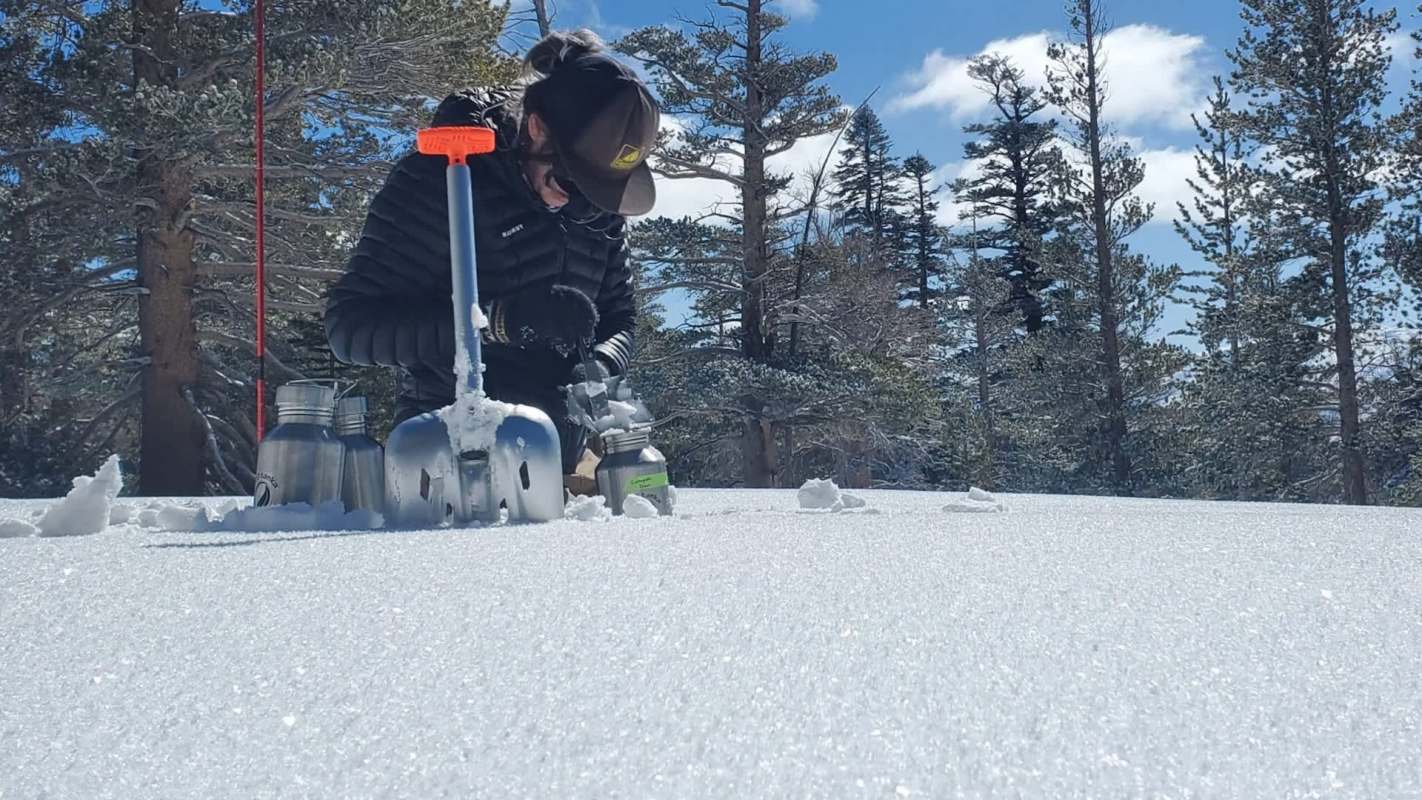
Scientists testing fresh snowfall across the Sierra Nevada discovered tiny plastic particles at all seven sites they sampled, including remote areas of the mountain range.
The findings point to pollution in a snowpack that supplies about 60% of northern Nevada's freshwater.
Here's what to know
A University of California, Riverside team collected and tested snowfall over six months and found microplastic levels at populated sites were approximately triple those at remote ones, according to the Nevada Current. The study appeared in the journal Environmental Science & Technology.
At remote sites, researchers measured deposition rates ranging from about 25 to 297 plastic particles per square foot per day (270 to 3,200 per square meter per day) following snowstorms. Busier locations, including a ski area, received up to 697 particles per square foot per day (7,500 per square meter per day).
Plastics commonly used for packaging and clothing turned up as tiny fragments at every sampling location.
The investigation began with remote skiing trips Aleksandra Karapetrov, an environmental toxicologist at UC Riverside, took over the years.
TCD Picks » Quince Spotlight
💡These best-sellers from Quince deliver affordable, sustainable luxury for all




"It was surprising the consistency at which we found microplastics everywhere," Karapetrov said, according to the Current.
More background
Snow delivers airborne plastic to the ground when flakes collect particles suspended in the atmosphere, a process called scavenging. Those particles originate as fibers shed by plastic products or fragments left as the products break down, and wind can transport them into the mountains.
About 70% of the storms researchers tracked passed over California's San Joaquin Valley, suggesting the region could be contributing particles.
The team also found that smaller microplastics, which can travel greater distances, were more abundant, according to the Current. Karapetrov described transport from towns within 10 to 20 miles, as well as regional transport over distances of less than 50 miles.
Snowfall after longer dry periods tended to contain more microplastics, potentially because the particles had accumulated in the atmosphere, according to Karapetrov.
What's being done?
The UC Riverside team examined plastic deposition during individual storms, allowing researchers to link their readings to particular weather events.
This storm-by-storm approach builds on earlier research that detected microplastics in snowpacks across the western United States and elsewhere.
"We're reporting the amount of microplastics coming out in a single storm, and that's like what the novelty here is. We can calculate the rate of microplastics that were deposited in a storm, and so that time point resolution is what's really unique," Karapetrov said, according to the Current.
Still, Karapetrov said, tracing the particles to their exact origins will require further study. Researchers also need standardized testing methods and verifiable techniques for measuring even smaller nanoplastics.
Researchers are investigating both how the particles travel and their health implications. According to the Current, certain chemicals in plastics can disrupt hormones, cause inflammation, and damage cells.
Karapetrov points to the contamination as evidence that remote mountain snow is not pollution-free.
"It's kind of disrupting this narrative of pristineness," she said, per the Current. "I hope it brings awareness to the circularity and widespreadness of pollution. There's this boomerang effect, and it's important we recognize that."
Where can I learn more?
Airborne plastic pollution is one of several pressures on snow and water supplies.
• In Switzerland, 219 tons of microplastics fall onto soil and water annually.
• New England scientists are monitoring winter snowpack as warming winters bring drought and flash floods.
• California's potential super El Niño could bring flooding while leaving farms short on snowpack.

Get TCD's free newsletters for easy tips, smart advice, and a chance to earn $5,000 toward home upgrades. To see more stories like this one, change your Google preferences here.
Cool Picks






