


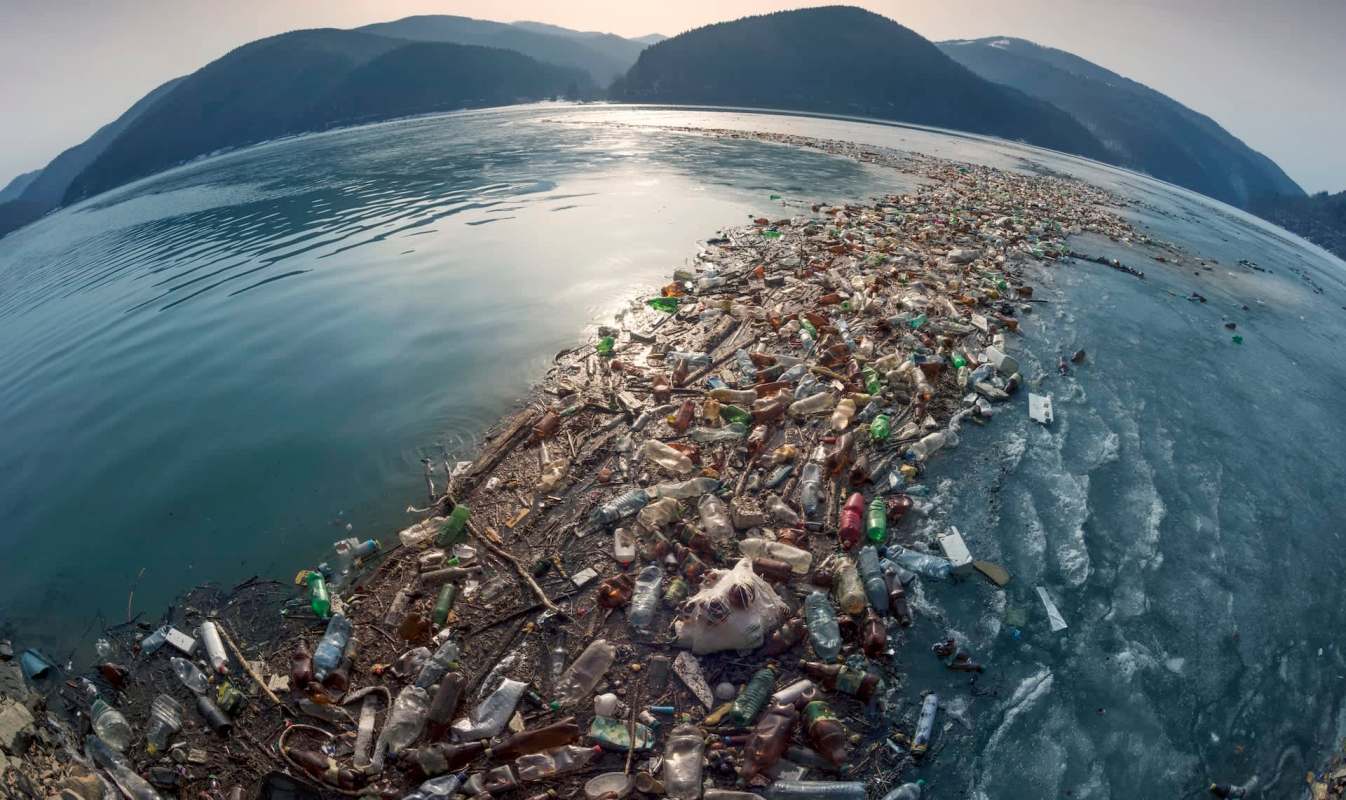
Scientists investigating the Great Pacific Garbage Patch discovered an unexpected change in the surrounding ocean — a subtle shift in color. The researchers examined three satellite datasets, raising the possibility that microplastic pollution is changing the water's color.
Here's what to know
University of Bergen optical oceanography researchers Shea Cheatham, Daniel Koestner, and Børge Hamre identified statistically significant brightening at blue and green wavelengths in satellite observations from 2002 to 2022, according to ScienceAlert.
Natural substances, including phytoplankton and minerals, served as benchmarks for microplastics' light absorption and scattering in the laboratory work that launched the investigation.
Their models suggested that plastic fragments could produce a detectable signal at concentrations potentially present in the patch.
"We were shocked, excited, and a little alarmed to see the same shift in ocean color on the map after we analyzed the first satellite dataset of the garbage patch," Cheatham told ScienceAlert. "Our first reaction was disbelief, which is what led us to check two other satellite datasets just to convince ourselves that it was even remotely possible that we could be seeing the same signature evident in our models."
Across the observations, the researchers found simultaneous brightening at blue and green wavelengths, potentially caused by microplastics scattering sunlight.
TCD Picks » Quince Spotlight
💡These best-sellers from Quince deliver affordable, sustainable luxury for all




More background
According to ScienceAlert, the Great Pacific Garbage Patch covers a region about twice the size of Texas within a vast circular current system in the North Pacific. A 2018 survey put the patch's contents at 1.8 trillion plastic pieces weighing about 87,000 tons.
A later study linked fishing industries in the United States, Taiwan, South Korea, China, and Japan to a substantial share of large debris. Discarded fishing equipment makes up much of the patch's plastic weight.
Microplastics, meanwhile, represent an estimated 94% of the patch's plastic pieces and 8% of its plastic mass, according to ScienceAlert.
Cheatham explained that the smallest plastics examined in the study are the most likely to be ingested at the bottom of marine food chains, eventually reaching people's plates. Their small size also makes them exceptionally difficult to remove from the water.
What's being done?
Cheatham and her colleagues hope to test seawater directly in the garbage patch to determine what is causing the color shift.
"To fully answer the question of whether microplastics themselves are the root cause of this ocean color shift, we will need to go to the garbage patch to make optical measurements of water samples and quantify the microplastics present," Cheatham said, according to ScienceAlert. "We're hopeful that we can do this work in the future."
Cleanup efforts have already removed large debris from the patch. Small fragments, however, present a much greater challenge, with Cheatham describing their removal from the water column as essentially impossible.
"At present, the only way to reduce microplastic pollution is to prevent them from entering the water in the first place," Cheatham said.
Where can I learn more?
Plastic can build up far offshore or harm marine life closer to land.
• In Guatemala, Interceptor 006 stopped 210,000 kilograms of trash before it reached the sea.
• In Panama and beyond, wind and rain carry street plastic into rivers and eventually the ocean.
• On Okinawa beaches, researchers found plastic fused with coral, creating material dubbed "plasticoral."
• In Argentina, even small bites of plastic can alter southern giant petrel chicks.

Get TCD's free newsletters for easy tips, smart advice, and a chance to earn $5,000 toward home upgrades. To see more stories like this one, change your Google preferences here.
Cool Picks






