


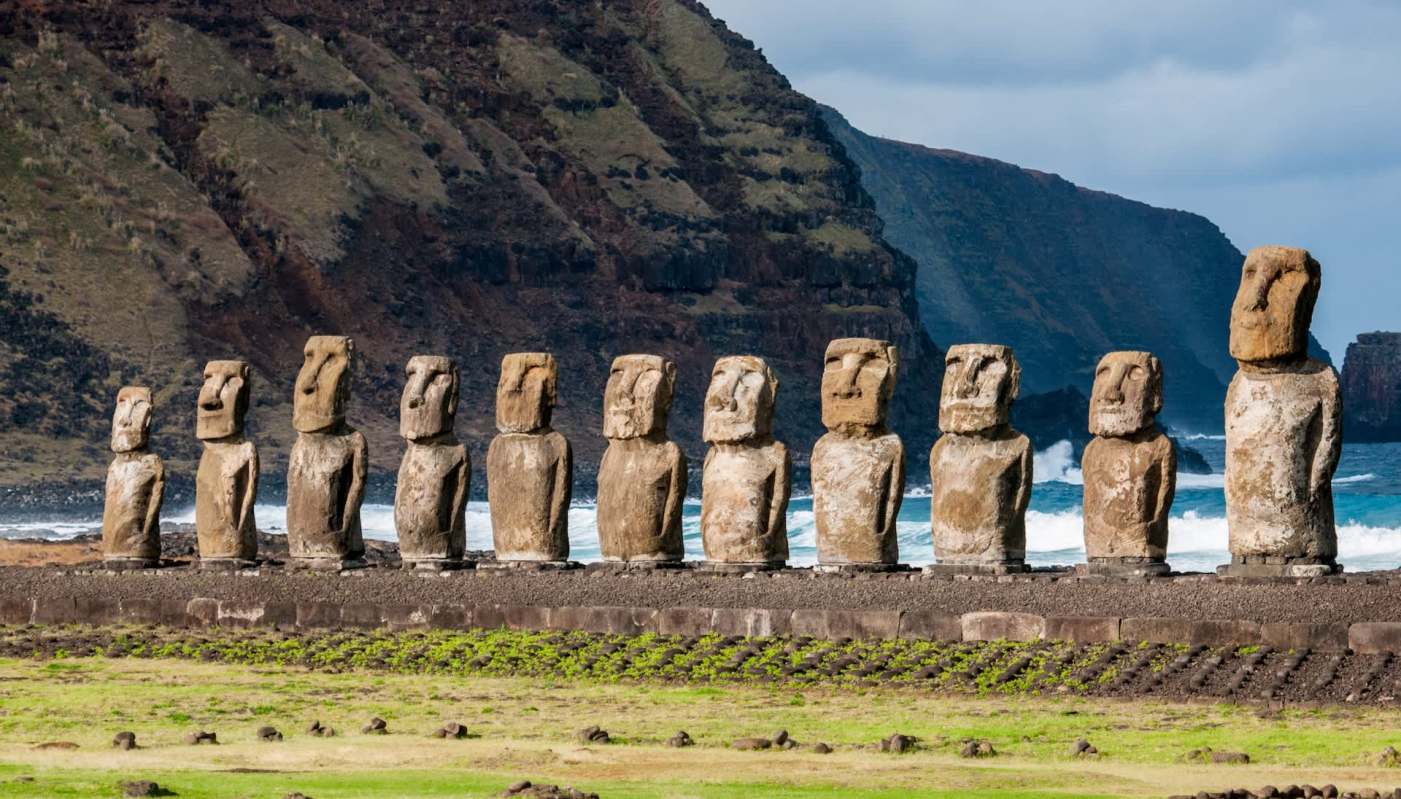
A stone statue discovered in a dried-up lake basin on Rapa Nui, also known as Easter Island, could help researchers understand the beginnings of the island's famous carving tradition.
Here's what to know
According to Popular Mechanics, no moai had previously been reported in the lakebed inside Rano Raraku. The one discovered there in February 2023 was lying face-up among reeds.
Islanders used the volcanic crater to carve many of their statues. Before reaching its eventual discovery site, the figure had been transported from the adjacent crater wall, where it was carved from bedrock, said Terry Hunt, an archaeologist and anthropology professor at the University of Arizona.
The roughly five-foot moai still has no established age, and there has not yet been a follow-up investigation.
"The statue was a completed one meant for an ahu platform," Hunt added, describing a ceremonial structure.
According to Popular Mechanics, Hunt said in a 2023 account published by the University of Arizona that a later carving date remains possible despite the statue's small size. He nevertheless suggested that its size might place it early in the carving tradition, between the Polynesians' arrival around 1200 and Europeans' arrival in 1722.
TCD Picks » Quince Spotlight
💡These best-sellers from Quince deliver affordable, sustainable luxury for all




More background
Questions about activities around the lake and differences in carving styles could be explored if researchers found more early statues.
Popular Mechanics reported that a 2020 Journal of Archaeological Science study investigated the construction chronology of ahu across 11 locations, combining radiocarbon measurements, platform evidence, and accounts from European visitors.
Hunt and his colleagues found that islanders maintained monument construction and use for 150 years or more beyond 1600, when the society was thought to have already collapsed.
The finding challenged the claim that monument-building stopped before Europeans arrived.
What's being done?
The lakebed was of particular interest for a potential search for buried architecture or statues: Hunt was considering ground-penetrating radar in 2023, according to Popular Mechanics.
Geophysical surveying could locate moai without disturbing the ground. It would, however, leave their ages and carving details unknown.
Hunt saw quarry rubble as a likelier place to find buried statues than the sediments beneath the lakebed. Yet he said excavating the quarry is highly improbable because of conservation concerns and islanders' feelings about the site.
The Easter Island Statue Project's discovery report urged efforts to stabilize the newly found moai and safeguard its delicate surface.
Hunt also noted that the soft volcanic tuff continues to erode, leaving researchers to balance access to evidence with preservation of the stone itself.
"Buried statues could be associated with new radiocarbon dates and give us a better idea of the early quarrying activities," Hunt told Popular Mechanics.
Where can I learn more?
Finding the moai was only the beginning, as researchers still face questions about how to study and protect them.
• In Egypt, a homeowner's discovery of an inscribed stone led archaeologists to two royal statues.
• In Florida, archaeologists found three ships from 1559, but search methods miss more wrecks.
• In Egypt, a newly discovered tomb reveals Ramesside burial rites as flash floods threaten paintings.

Get TCD's free newsletters for easy tips, smart advice, and a chance to earn $5,000 toward home upgrades. To see more stories like this one, change your Google preferences here.






