


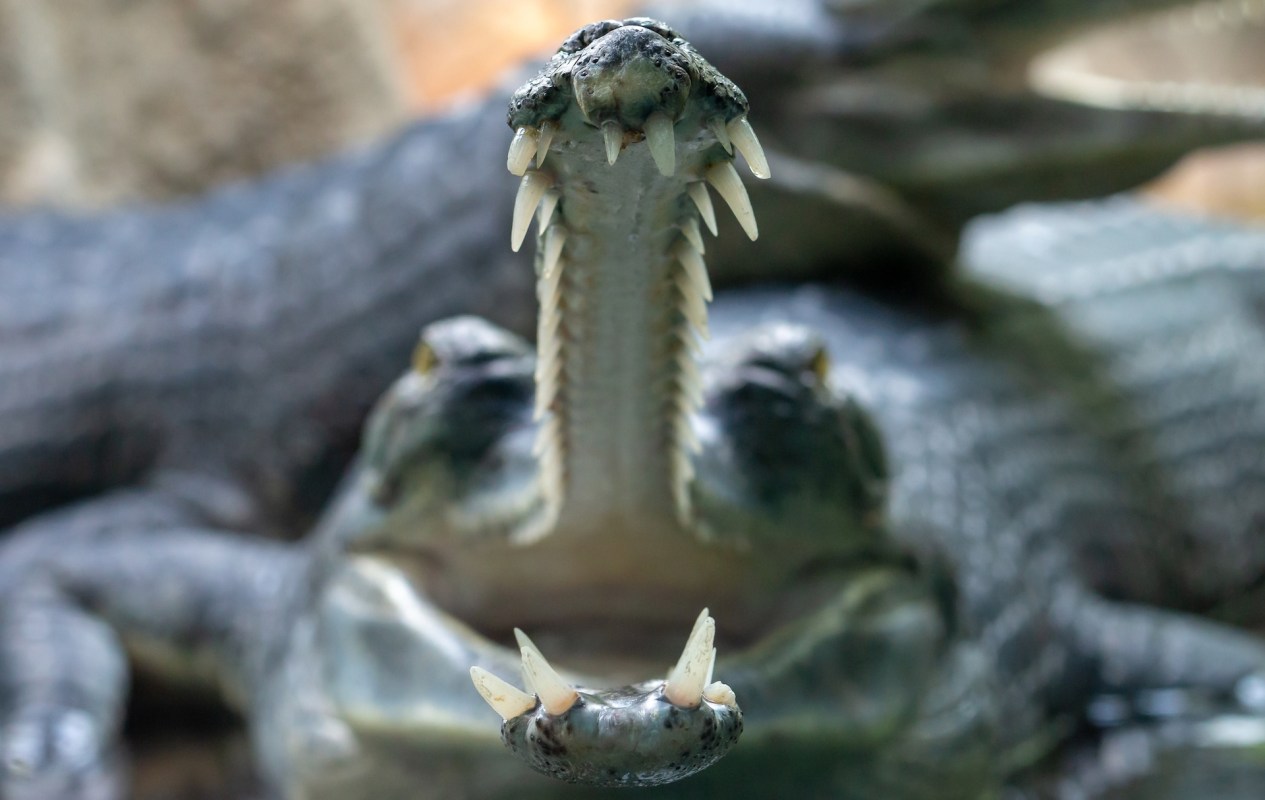
Researchers who identified a crocodile fossil in Egypt as a distinct species also uncovered an unexpected link to the nation's Great Sphinx.
Here's what to know
CT scans helped scientists distinguish the 45-million-year-old reptile from a living relative, correcting a classification that had stood since the 1920s.
A resemblance to today's false gharial, a type of freshwater crocodile, originally led scientists to assign the fossils to its genus, Tomistoma. The remains excavated a century ago included a nearly complete skull.
But the skull's interior became the focus of a fresh examination using CT scans. Paul Burke of the Swedish Museum of Natural History in Stockholm led the international team that reconsidered the classification.
The newly described Herugavialis cairensis hunted in a warm, shallow sea in northern Egypt, according to Mongabay. Remarkably, limestone for the Sphinx came from the Mokattam Formation, where the animal's fossils were found.
Published in the journal Royal Society Open Science, the findings identified features visible in the scans that distinguished the ancient reptile from the false gharial.
TCD Picks » Quince Spotlight
💡These best-sellers from Quince deliver affordable, sustainable luxury for all




Neither the monument nor the fossil retains the tip of its nose.
"Given this coincidence with the famously missing nose of the Great Sphinx, we decided to name the new crocodile after the Egyptian god Heru, who was possibly the inspiration for this iconic monument," Philip Mannion, a paleontologist at University College London who co-led the study, said in a press release, per Mongabay.
More background
Shallow seas were home to many gavials, and fossils place this group of long-snouted crocodilians across much of the world. Herugavialis was one member of that group.
Crocodiles disappeared from the Mediterranean roughly 6 million years ago, however, during the sea's near-total drying, Burke explained to Mongabay.
Only two gavial species survive, both living in freshwater habitats across southern and southeastern Asia. The International Union for Conservation of Nature lists the false gharial as endangered and the gharial, which survives only in India and Nepal, as critically endangered.
Changes to river habitats threaten these animals, along with hunting and collection for traditional remedies.
Charlie Manolis, co-chair of the IUCN's Crocodile Specialist Group, said habitat loss is the leading threat to five of the seven crocodilian species at greatest risk. For the remaining two, hunting for bushmeat poses a major threat.
What's being done?
When the IUCN's Crocodile Specialist Group was founded in 1971, all crocodilian species were classified as threatened or endangered. More than half hold least-concern status.
India started its gharial breeding efforts during the 1970s and established the National Chambal Sanctuary. A 2025 survey by forest staff recorded over 2,000 gharials in one section of the sanctuary, a record for conservation efforts there, according to the Times of India, as reported by Mongabay.
Egypt also prohibits the killing, capture, or trade of crocodiles or their eggs, although poaching and smuggling remain problems, according to Egypt Independent, as reported by Mongabay.
Crocodile Specialist Group co-chair Alejandro Larriera emphasized the role of local communities in crocodilians' recovery.
"This is mainly thanks to the conservation programs based on creating economic incentives among the local inhabitants, through the sustainable use of the crocodilians there," he told Mongabay.
Where can I learn more?
A new look at an old fossil revealed the Egyptian crocodile as a distinct species, and other discoveries have broadened our knowledge of ancient creatures.
• In Wales, an amateur's fish jaw discovery helped resolve 200 years of fossil confusion across Europe.
• In northeastern China, a fossil revealed a giant-clawed dinosaur species that may have resembled a feathered bear.
• In India, a new seahorse species surfaced in discarded bycatch after a century without scientific recognition.

Get TCD's free newsletters for easy tips, smart advice, and a chance to earn $5,000 toward home upgrades. To see more stories like this one, change your Google preferences here.






