


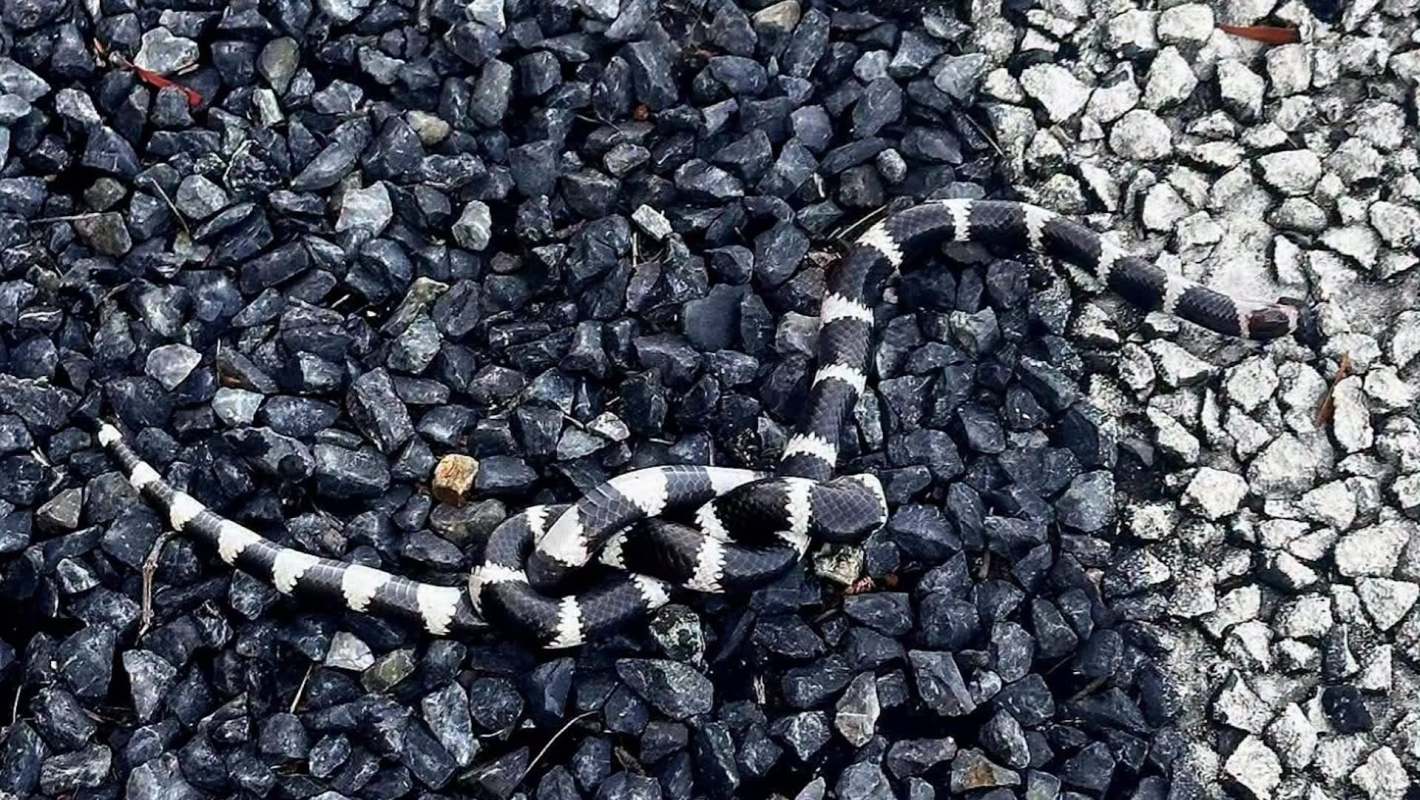
How did a snake found dead beside a Queensland road end up knotted in its own body? Veteran snake catchers have no answer.
Someone may have deliberately tied the animal into a knot. The other troubling possibility is that it became tangled after suffering an injury.
Here's what to know
A photograph posted to Facebook and Instagram by Sunshine Coast Snake Catchers invited followers to explain the animal's position. It showed a venomous, black-and-white bandy-bandy found beside a road in southeast Queensland, Yahoo News Australia reported.
The team had only a family member's photograph of the snake they found, snake catcher and team member Tanieka said, per Yahoo News Australia. The knot's origin remained a mystery to the catchers.
"It may have been run over, and whilst in pain, it may have been rolling around and ended up in a knot," the organization wrote. "Or someone found it dead and then tied it in a knot, which seems a bit ridiculous. Either way, we haven't seen something like this before."
One commenter wrote, "I have seen this before and it's widely believed that a snake can knot itself up when in pain/dying."
TCD Picks » Quince Spotlight
💡These best-sellers from Quince deliver affordable, sustainable luxury for all




"Human intervention, sadly, I'm thinking not in a good way," one Facebook commenter wrote.
Neither possibility has been confirmed, though given the complexity of the knot, the unfortunate possibility that it was caused by a person with bad intentions — even if the snake had already died — must be taken seriously as a sign of disrespect for wildlife.
More background
Bandy-bandies can grow to about 31 inches and live in several northern and eastern regions of Australia's mainland.
The roadside snake's condition is not explained by the species' defensive response, in which it lifts its midsection into a loop when threatened.
Chris Williams, who leads the Australian Herpetological Society, offered Yahoo News Australia a possible explanation for the roadside discovery.
"Snakes, when they're injured, do contort often quite extensively. And if it was writhing in pain for a prolonged period of time, it's conceivable that something like this could happen."
Museum of Central Australia representative Michael Barritt also told Yahoo News Australia he had observed snakes "twisted up in pain" after being run over. This knot, however, "seems rather complex" to have been self-imposed, he said.
As warmer spring weather in Australia increases reptile activity, Australian snakes are appearing in bathrooms, mailboxes, and roof cavities. In some instances, this can lead these wild animals to attack humans, but this encounter centers on possible harm to wildlife instead.
What can be done?
While the roadside death remains unexplained officially, Sunshine Coast Snake Catchers identified another human-related threat to wildlife that households can address: rat poison.
"Rat baits, they do a good job at killing rats and mice, but they can also do a really good job at killing our native wildlife," Patrick Brabant, a snake catcher with the organization, told Yahoo News Australia.
Brabant advised choosing traps rather than poison whenever feasible. He also said snakes help control rat and mouse populations naturally, despite being vulnerable to the very products people use to eliminate those pests.

Get TCD's free newsletters for easy tips, smart advice, and a chance to earn $5,000 toward home upgrades. To see more stories like this one, change your Google preferences here.







