


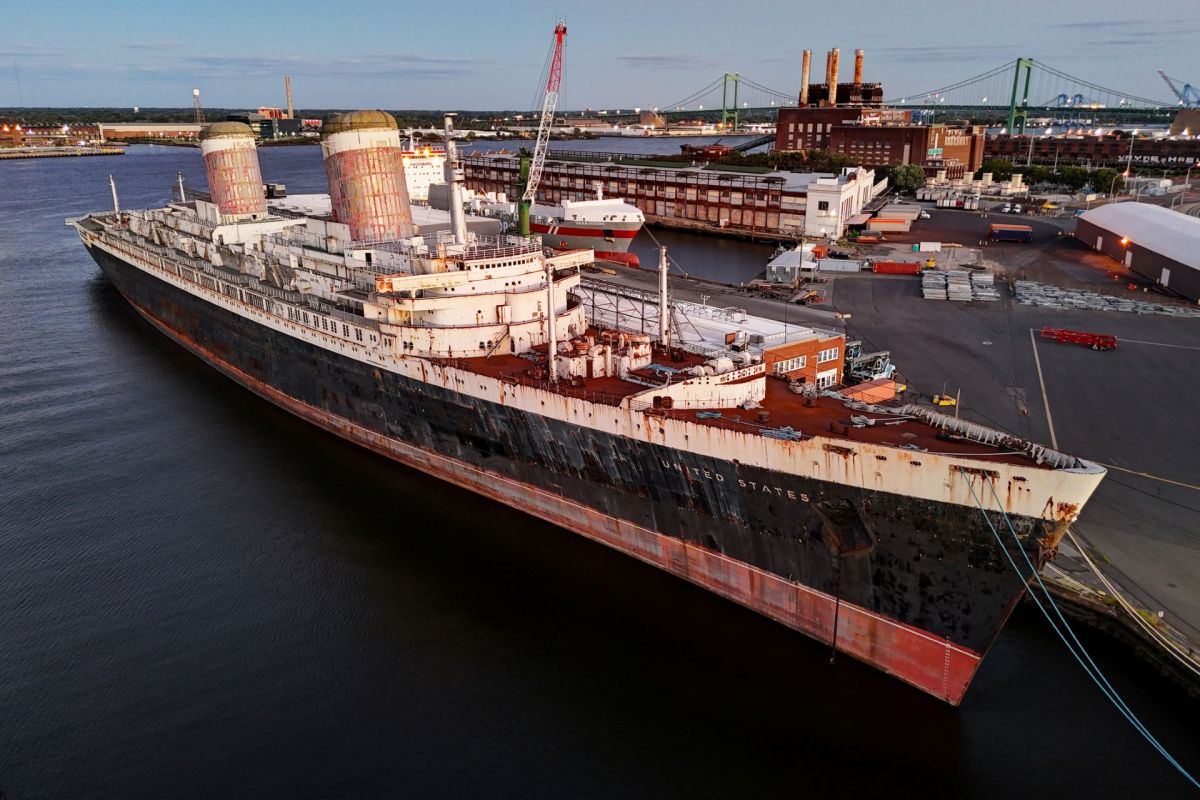
The ocean liner that once carried the Mona Lisa across the Atlantic is set to take on an unexpected role: providing shelter for marine life.
Okaloosa County plans to sink the 990-foot SS United States to create the world's largest artificial reef, giving the historic vessel a new purpose and divers a new underwater landmark.
Here's what to know
Sea conditions will determine the exact sinking date. Okaloosa County plans to sink the ship roughly 22 nautical miles southwest of Destin, Florida, with the Gulf of Mexico deployment scheduled for the second week of November, according to Oceanographic Magazine.
On its first voyage, in July 1952, the liner crossed the Atlantic in 82 hours and 40 minutes, beating the Queen Mary's record by roughly 10 hours. That passenger-ship speed record still belongs to the SS United States, also known as the "Big U."
A future president, 22-year-old Bill Clinton, also traveled aboard the vessel to study at Oxford. Other presidents who sailed on the liner included John F. Kennedy, Harry Truman, and Dwight Eisenhower.
The Mona Lisa traveled aboard the liner in 1963. Its passenger lists also featured cultural icons Grace Kelly, Salvador Dalí, Coco Chanel, Marilyn Monroe, and Walt Disney.
TCD Picks » Quince Spotlight
💡These best-sellers from Quince deliver affordable, sustainable luxury for all




More background
Restoration proved too expensive, and the failed efforts left the vessel's future uncertain. Passenger service ended in 1969, when air travel displaced ocean crossings.
Scrapping the ship was the county's only alternative to creating a reef. Oceanographic Magazine reported that the county said it made the purchase only after "all other options" had been exhausted.
Fish are drawn to the marine life that settles on steel wrecks. For algae, corals, and other animals, the steel supplies a hard surface for attachment where the surrounding seabed is otherwise sandy.
Open-water species such as tuna, mackerel, and amberjack could be drawn to the liner because of its enormous size. The county also expects the habitat to support grouper and red snapper.
What's being done?
Preparations for the sinking have put contractors to work on the SS United States. They have drained and cleaned all 128 fuel and lubricant tanks and stripped away PCB-containing paint and deck coverings, according to Oceanographic Magazine.
For Coastal Conservation Association Florida, the prospect of new marine habitat was a reason to help fund the project. The organization contributed $500,000, its biggest contribution in four decades, to help make the reef project possible.
The liner will join Okaloosa County's existing artificial reef network, which includes more than 500 sites and 12 smaller shipwrecks.
Once in place, the historic liner will replace the USS Oriskany as the world's largest deliberately sunk reef. The SS United States will rest about 12 nautical miles from the USS Oriskany, an aircraft carrier sunk near Pensacola in 2006.
Where can I learn more?
These stories explore other significant boat and reef efforts and discoveries.
• Florida archaeologists discovered three ships from 1559, but current search methods may miss more wrecks.
• New York has returned 180 million oyster shells to its harbor to build reefs.
• A New York nonprofit turned 3.2 million pounds of discarded oyster shells into harbor reefs.

Get TCD's free newsletters for easy tips, smart advice, and a chance to earn $5,000 toward home upgrades. To see more stories like this one, change your Google preferences here.







