


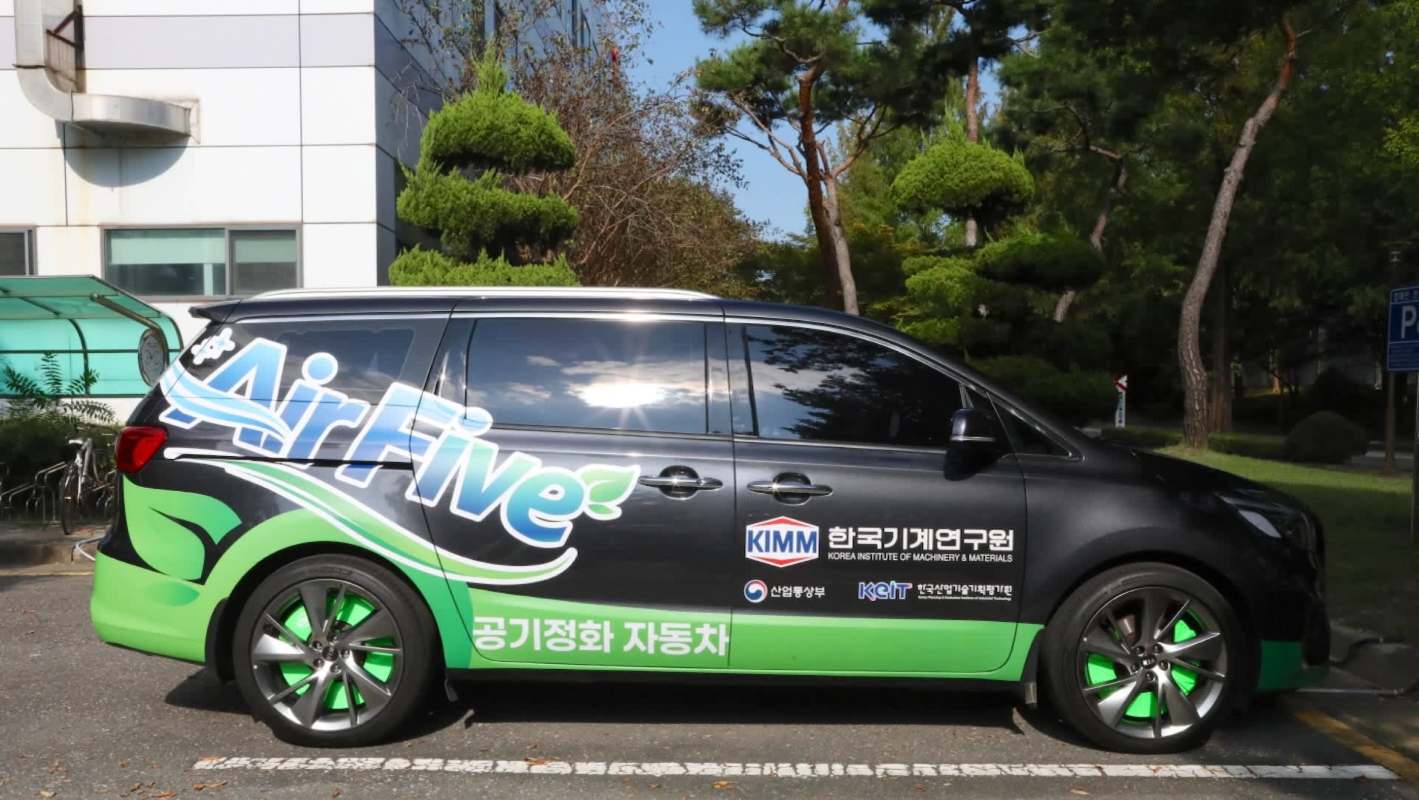
South Korean researchers have equipped ordinary cars with air-cleaning grilles that capture at least 95% of fine particles passing through them.
The grilles, developed by the Korea Institute of Machinery and Materials, might help tackle traffic pollution. A companion device collects brake dust, and together, the two technologies could make the air cleaner.
Here's what to know
Existing components allow the equipment to work without a specially built vehicle. The Korea Institute of Machinery and Materials (KIMM) installed the equipment on Kia's Carnival minivan and Hyundai's Sonata sedan, according to New Atlas.
KIMM says the grille's low-current carbon filaments help minimize ozone, a potential byproduct. Charged plates inside the grille attract airborne particles after the microscopic filaments give them the opposite electrical charge.
At test speeds of 19 and 31 mph, the system captured 95% or more of PM2.5 particles, plus 99% of particles between 0.000098 and 0.00039 inches (2.5 and 10 microns). PM2.5 is particularly concerning because its tiny size allows it to reach the lungs.
According to KIMM, each equipped car's hourly air-processing capacity would be about 63,600 cubic feet. Fuel efficiency varied by 1% or less during testing.
TCD Picks » Quince Spotlight
💡These best-sellers from Quince deliver affordable, sustainable luxury for all




More background
KIMM's second device targets another source of traffic pollution: brakes.
Positioned behind the brake caliper, the device uses electrically charged plates to capture particles released when brake pads rub against discs.
Because these particles already carry an electrical charge, the collector requires neither its own charging unit nor a suction pump. During a standardized driving test, KIMM reported collecting 0.00126 ounces of dust per mile (22.2 milligrams per kilometer), roughly 0.35 ounces every 280 miles. A peer-reviewed study cited by New Atlas found that the device's average capture efficiency was about 61%.
What's being done?
The radiator fan lets the grille keep cleaning nearby air even when the car is parked, as long as it's above a wireless charging pad, according to New Atlas. When moving, no dedicated fan is needed: KIMM says the car's motion supplies the airflow.
Mercedes-Benz is testing enclosed "in-drive brakes" that retain dust inside the drivetrain. The Ventra concept from Dutch student group TU/ecomotive, meanwhile, captures tire and brake particles using static electricity. In simulations reported by New Atlas, the team estimated a 42% capture rate for tire particles.
The 95% capture rate measures particles removed from air entering the grille, and it doesn't reflect an improvement in overall street air quality. Costs, cleaning intervals, and carmaker partners haven't been announced.
KIMM senior researcher Gun Hee Lee emphasized the need for further testing. "Having verified the technology through vehicle testing, we plan to further validate its performance and long-term durability under real-world driving conditions," he said.
Where can I learn more?
Researchers worldwide are making efforts to tackle air pollution.
• In Revere, Massachusetts, researchers plan to monitor ultrafine pollution near Logan Airport with a new air monitor.
• New Delhi has banned construction for six weeks and doubled parking fees to combat winter smog.
• Utah cut vehicle pollution by 73% even as driving increased 30% and its population grew 20%.
• Louisiana residents and clean-air groups are pushing to slow Hyundai's steel mill permit.
• DIY classroom air filters cut particles by 61% while costing a fraction of the price of commercial purifiers.

Get TCD's free newsletters for easy tips, smart advice, and a chance to earn $5,000 toward home upgrades. To see more stories like this one, change your Google preferences here.






