


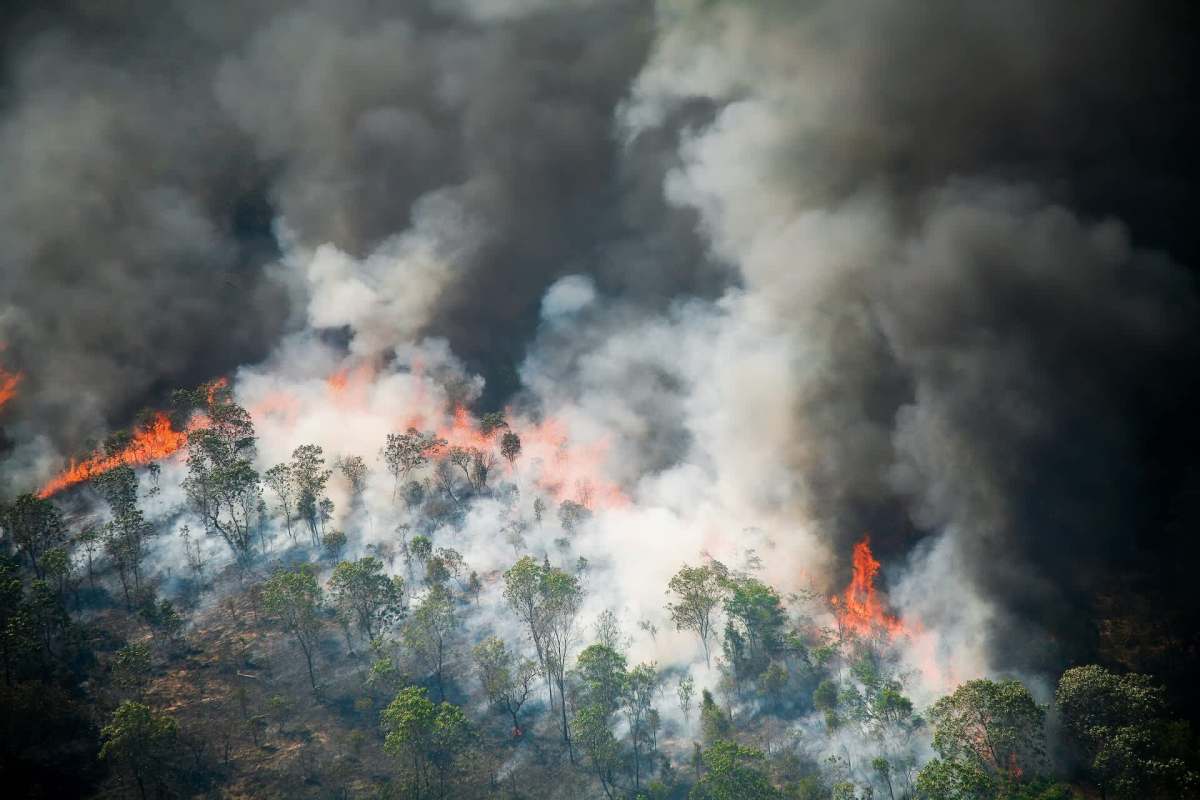
For years, drought has been the go-to explanation when the Amazon fails to behave like a vast carbon sink.
But a new study shows that wildfires and deforestation have been big forces behind the shift.
Here's what to know
Rather than absorbing more carbon than it releases, the Amazon is emitting roughly 1.3 billion more tons of carbon dioxide each year than it takes in, according to the study, recently published in Nature.
Lead author Luciana Gatti, a climate scientist who leads the Greenhouse Gas Laboratory at Brazil's National Institute for Space Research, headed a team that sampled air over the Amazon twice a month from 2010 to 2024 using small aircraft, according to Earth.com.
In six wetter years — 2011 through 2014, plus 2017 and 2018 — the forest absorbed about 64% as much carbon as fires emitted, leaving the basin close to overall balance.
From 2019 to 2022, temperatures resembled those in the wetter years and rainfall fell by just 6%, but even though the weather was "ordinary," as Earth.com described, yearly deforestation ran 97% higher and emissions approached four times the wet-year level.
TCD Picks » Quince Spotlight
💡These best-sellers from Quince deliver affordable, sustainable luxury for all




More background
Emissions were highest in the hot and dry years, "when El Niño or a warm tropical North Atlantic cut rain and raised temperatures," Earth.com explained. In 2010, 2015, 2016, 2023, and 2024, the Amazon saw less rain and 92% more burned land.
The study found that drought worsened wildfire damage, but it wasn't the whole story.
"The main message of the study is shocking: The problem in the Amazon is human activity," Gatti said in a press release. "We're losing the forest because the region's development model has been based on destruction."
What's being done?
Changes in the Amazon matter globally because its trees and soils store such a vast quantity of carbon.
Because trees recycle as much as half the region's rainfall, losing them also means less moisture, a longer dry season, and land that catches fire more easily.
The study calls for protecting intact forests before more of the basin shifts from climate buffer to climate source. Gatti put it plainly: "We need public policies that value the standing forest."
Where can I learn more?
For a closer look at how these pressures are playing out across the Amazon, check out these stories:
• Across Latin America, Interpol linked 161 firms to Amazon clearing as 233 arrests hit deforestation networks.
• In Brazil, Indigenous groups warned that a planned Amazon gold mine could cause irrevocable damage.
• In Ecuador, Indigenous Amazon lands conserved forest better than state-protected areas.
• In tropical forests, cash payments to communities sharply reduced tree loss where enforcement alone fell short.

Get TCD's free newsletters for easy tips, smart advice, and a chance to earn $5,000 toward home upgrades. To see more stories like this one, change your Google preferences here.






