


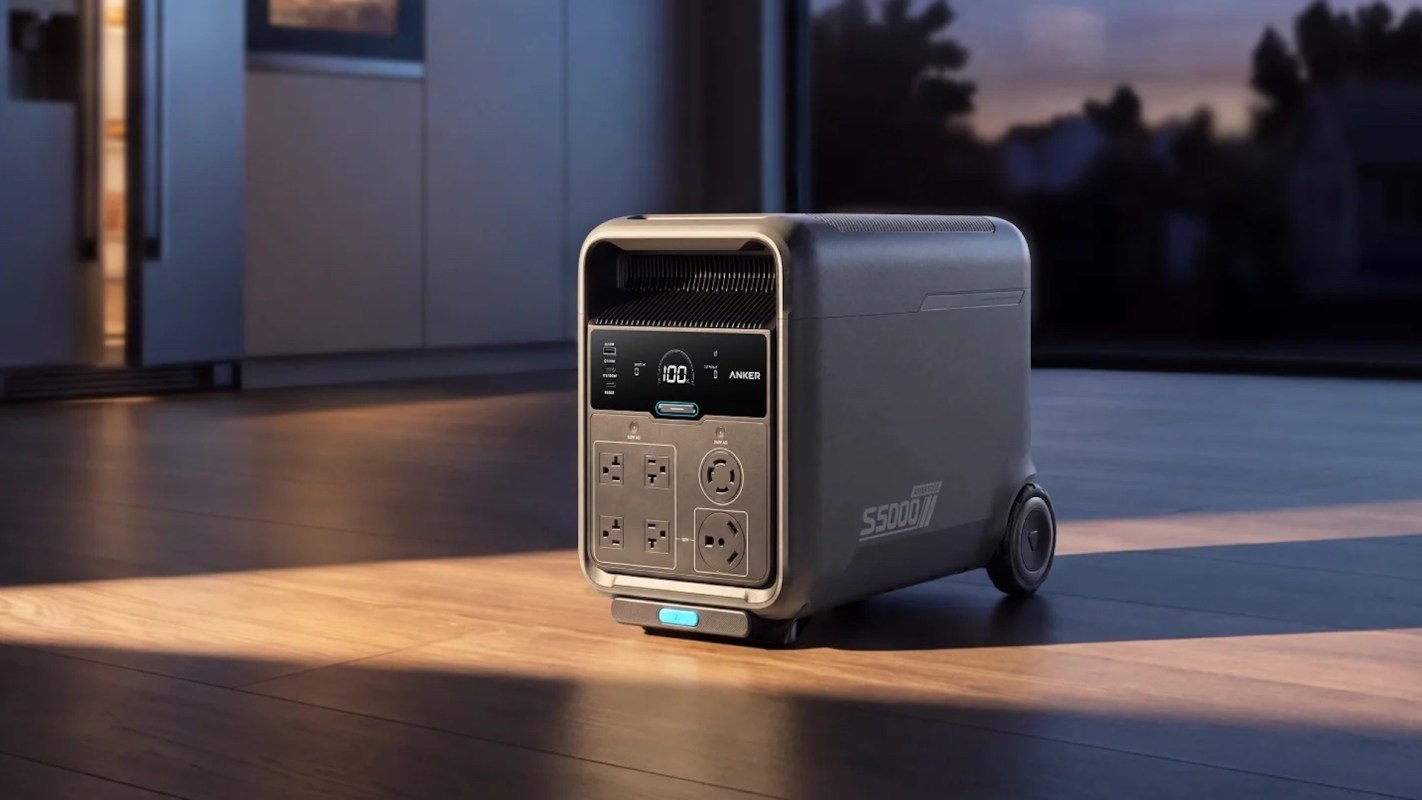
A wheeled backup battery kept a refrigerator and small devices running for 61.5 hours during a wildfire-related power outage, and the unit still had 18% charge left at the end.
A Northern California family put the battery to the test during the blackout, and the results suggest a 5-kilowatt-hour portable battery can do more than charge small electronics. In the right scenario, it can keep food cold through three straight nights.
Here's what to know
Engineer Andrew, a Northern California-based home-energy enthusiast, got his hands on a pre-release Anker Solix S5000 shortly after the company unveiled it on October 9. As ESS News reported, the portable power station features 5,024 watt-hours of LFP storage and a 4,500-watt inverter that outputs both 120 and 240 volts.
During a PG&E Public Safety Power Shutoff, the unit went from 100% charge to 18% while keeping a large refrigerator running, along with phones and a handful of smaller devices, for 61.5 hours. In a separate full-discharge test, the app logged 4.87 kilowatt-hours delivered, or about 97% of the battery's rated capacity.
From a standard 120-volt outlet, the S5000 reached a full charge in 3 hours and 40 minutes at the 1,800-watt setting, or 6 hours and 3 minutes at 1,000 watts.
More background
PG&E's Public Safety Power Shutoffs aim to reduce wildfire risk, so households can lose power even when their homes are otherwise unaffected. In that situation, backup power can preserve refrigerated food, charge phones, and keep basic household functions running.
TCD Picks » Quince Spotlight
💡These best-sellers from Quince deliver affordable, sustainable luxury for all




ESS News noted that a shop vac at roughly the same load ran without problems and reported more than four hours of runtime for a portable air conditioner drawing about 1 kilowatt.
With the battery full and still plugged in, ESS News measured about 7 watts coming from the wall. Andrew estimated that would add up to roughly 60 kilowatt-hours per year, or about $18 annually at an electricity price of 30 cents per kilowatt-hour.
Andrew calculated that buyers effectively pay about $500 per kilowatt-hour of capacity at the $2,499.99 launch price, and about $720 at the $3,599.99 suggested retail price.
What can be done?
Andrew noted that the battery can power basic essentials straight from its outlets or send electricity to specific circuits in the house through an inlet box wired to its 240-volt L14-30R outlet. For people who need longer runtime, Anker says expansion batteries can increase total storage to 30 kilowatt-hours.
Andrew tested both wall charging and solar power. Two 400-watt Anker Solix PS400 panels wired in series reached a peak of 680 watts on a sunny October day, and he found the lower 1,000-watt setting made more sense on a circuit shared with other appliances or when running off a small generator.
Andrew said the unit's narrow 10.6-inch (27-centimeter) width made it easy to tip over on uneven ground. At 97 pounds (44 kilograms), he found it easier to move on flat surfaces than on grass.
According to Andrew, the Smart Generator cable from Anker's E10 system didn't fully connect to his pre-release S5000, so he couldn't test generator charging. He also said buyers who don't need 240-volt output or a single 4,500-watt load might want to compare it with two smaller S2000 units.
Where can I learn more?
Backup batteries are increasingly being used to keep refrigerators and other essentials running during outages.
• One homeowner learned that an EcoFlow battery could run a 28-cubic-foot fridge for about 22 hours.
• After a blackout hit, a Jackery Explorer 1000 saved $300 worth of groceries from spoiling.
• In the Chicago area, a Jackery 5000 kept a home's food safe through nine days.
• Anker says the SOLIX E10 can deliver whole-home backup while trimming bills and charging EVs.

Get TCD's free newsletters for easy tips, smart advice, and a chance to earn $5,000 toward home upgrades. To see more stories like this one, change your Google preferences here.






