


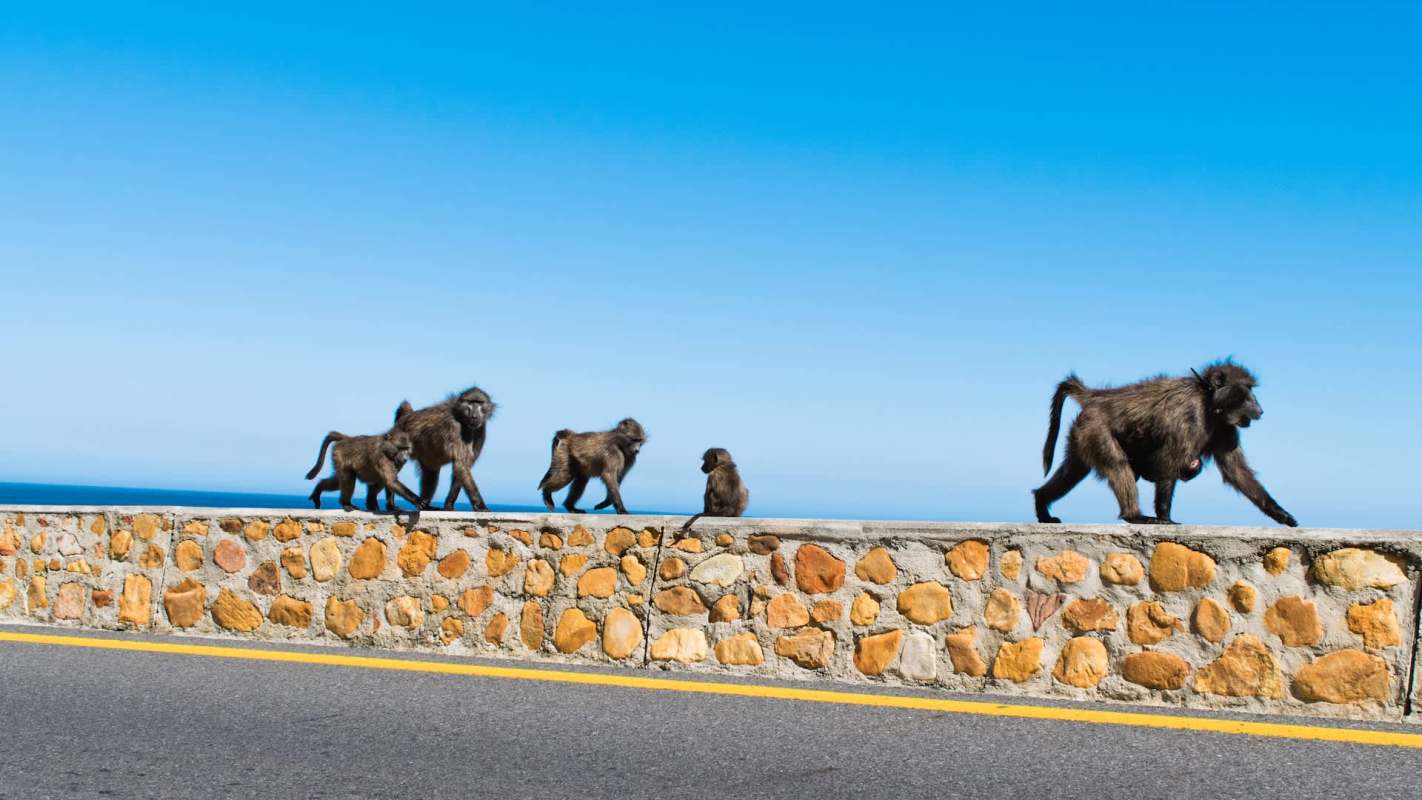
Cape Town officials are preparing to permanently remove two chacma baboon troops after one of them was recorded raiding a naval base 25 times in a single month near Simon's Town.
Under the proposal, the baboons would be captured and moved into fenced enclosures, where they would spend the rest of their lives.
Here's what to know
Mongabay reported that the Cape Peninsula Baboon Management Joint Task Team — made up of the City of Cape Town, South African National Parks, and CapeNature — planned to capture the 44-member Waterfall troop and the 16-member Seaforth troop, both of which range near Simon's Town.
The spike in raids between June 11 and July 11 helped drive the change in strategy. A Cape Baboon Partnership WhatsApp group that alerts residents to the troop's whereabouts recorded 25 raids between June 11 and July 11. Officials described the shift as a "hard reset" after years of trying to keep baboons out of urban areas.
Officials also tied the plan to population targets for the peninsula. The executive summary of the Cape Peninsula Baboon Management Action Plan said the wider baboon population grew from about 360 animals across Table Mountain National Park in 2000 to about 600 in 2025.
The latest Cape Peninsula Baboon Annual Census said the southern population stood at 222 in December 2025, not including around 100 baboons inside Cape Point Nature Reserve. Removing the two Simon's Town troops would reduce that number to about 160.
TCD Picks » Quince Spotlight
💡These best-sellers from Quince deliver affordable, sustainable luxury for all




Cost is part of the city's argument for changing course. Cape Town coastal manager Gregg Oelofse told Mongabay that the ranger program costs between 17 million and 20 million South African rand per year (about $1 million to $1.2 million), with the city covering about 85% of that total, even as managers "spend more with no real change in the outcomes."
More background
Researchers and advocates have said the conflict was shaped by people as much as by baboons. Issues include unsecured bins, open windows, and hand-feeding, while urban development has cut the animals off from lower-lying foraging habitat and left easy, calorie-dense food close at hand.
According to Jenni Trethowan, who founded Baboon Matters, the Waterfall troop split from the larger Smitswinkel troop around 2005 and went largely unmanaged until about 2012. Human-wildlife conflict expert Justin O'Riain said the baboons came down each day to Happy Valley Home, a shelter for homeless people, where residents fed them leftovers.
Even among people who support keeping baboons out of town, the enclosure proposal is contested. Belinda Abraham, communications manager at the Cape of Good Hope SPCA, said relocation should be a "final option" only after alternatives have "demonstrably failed."
Field biologist Dave Gaynor argued that the troops are not separate from other baboons and instead proposed a roughly 6-mile baboon-proof fence around Simon's Town.
What's being done?
The animals would be housed away from their current range if the project proceeds. The city planned to build two enclosures on city-owned land at Kogelfontein, about 1.6 miles east-southeast of Admiral's Kloof.
The Waterfall troop would receive an 8.6-acre enclosure, while the Seaforth troop would be placed in a 4.7-acre space. Oelofse said the baboons would remain with their social groups and be provisioned with food so they do not strip the vegetation.
The enclosure proposal is only part of the reset. Oelofse said it would include a new fence in another part of the Cape Peninsula and 6,000 baboon-proof bins, part of an effort to reduce attractants in residential areas. According to the action plan, baboon numbers are to be reviewed every six months.
Critics are still pushing for stronger waste management, fertility control, strategic fencing, and public education, even as the city said enclosure life is preferable to culling. Oelofse said Cape Town has budgeted 10 million South African rand (about $603,000) over the first three years for the enclosures and expected the site to be ready before the end of 2026.
"They weren't a separate class of abnormal baboons," Gaynor told Mongabay. "They were ordinary baboons exploiting a highly rewarding opportunity."
Where can I learn more?
Similar conflicts have played out between people and wildlife, especially primates living close to cities.
• In South Africa, violence against baboons has left lasting behavioral scars in urban troops.
• In a South African city, a rescued lone baboon later regained health and freedom.
• In an Indian sanctuary, macaques damaging property pushed officials to warn that management delays would worsen conditions.
• Across expanding suburbs, the potential for conflict keeps rising as wildlife returns to cities.

Get TCD's free newsletters for easy tips, smart advice, and a chance to earn $5,000 toward home upgrades. To see more stories like this one, change your Google preferences here.







