


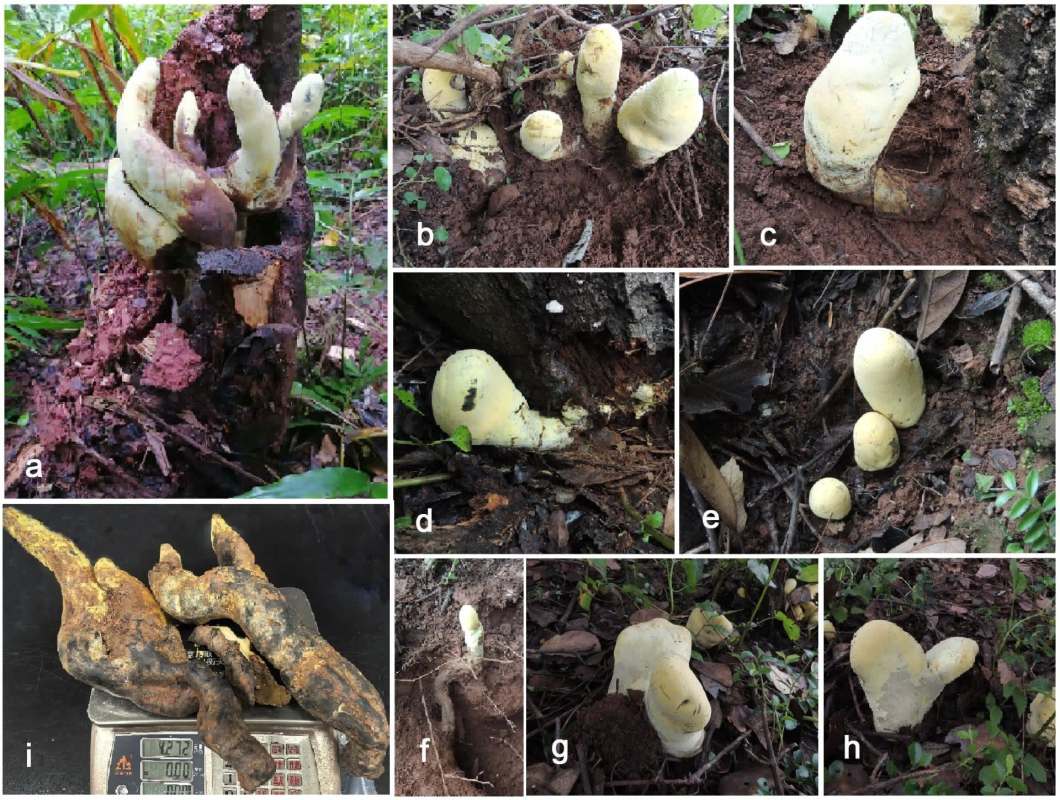
Under trees in China, researchers found a towering yellow fungus so distinct that it became the basis for a newly established fungal family.
The largest specimens of Dianjunus rex weighed about 4.9 pounds and measured roughly 20 inches from the buried stalk to the tip.
Here's what to know
In a study published in Frontiers in Fungal Biology, Jing Song and Zhuyue Yan of the Kunming Institute of Botany drew on five specimens collected at three sites in Yunnan, concluding the organism was both a new species and the only known member of a newly named family, according to Earth.com.
Only part of D. rex is visible above the soil: It forms stout, pale yellow columns about eight inches tall, while a long black stalk remains buried underground and accounts for much of the fruiting body's full size.
With age, the pale, rounded tops become darker and split into narrow, finger-shaped branches that release spores.
Genetic evidence showed that the fungus doesn't fit neatly with known relatives. After analyzing hundreds of genes, the researchers concluded that it belongs on its own branch of the fungal tree of life, distinct enough to justify the creation of a new family.
TCD Picks » Quince Spotlight
💡These best-sellers from Quince deliver affordable, sustainable luxury for all




Indunil C. Senanayake, an associate professor at the institute's Germplasm Bank of Wild Species, said the discovery shows how much remains unknown in the region.
"The discovery illustrates how much fungus biodiversity remains to be discovered in East Asian forests," Senanayake said, per Earth.com.
More background
Even though it was a large, soft-bodied forest fungus, it had never been formally described by science.
Fungi play a major role in forest ecosystems. They help break down dead plant matter, cycle nutrients through the soil, and influence overall forest health.
The researchers estimated, as Earth.com reported, that the new family diverged from its closest known relatives roughly 65 million years ago, with a possible range of 50 million to 80 million years ago. That places its deeper evolutionary history near the dinosaur-ending extinction event, though the study doesn't suggest that D. rex itself is that old.
The team also found signs that the fungus may spend part of its life hidden inside living trees. It carries unusually few genes for the enzymes that break down plant tissue, a pattern shared with some fungi that live inside plants without harming them.
Yunnan's records already include more than 6,000 named fungal species, and the authors cite estimates putting the real total above 100,000.
What's being done?
Scientists are still trying to determine where D. rex lives, how often it appears, and what it is doing underground when its yellow columns are nowhere in sight.
Only a few collections from a single Chinese province have turned up so far, not enough to map the fungus's full range.
Researchers are also testing theories about how it survives and spreads. One idea is that its height lets spores catch wind currents above the forest's low-growing plants and leaf litter, aiding dispersal. Another is that making do with fewer enzymes for digesting plant tissue frees up energy the fungus can put toward its unusually large structure.
To confirm whether D. rex lives inside living roots before later consuming material after the tree dies, scientists would need to detect it in living trees before the visible columns emerge. Senanayake said fieldwork like that is difficult, since fungi don't always fruit on a predictable schedule and research has often focused more on commercially valuable species.
Formally naming and describing the fungus gives forest researchers, conservationists, and local institutions a clearer target for future surveys in Yunnan.
As Senanayake put it, "A fruiting body which towers above surrounding vegetation and debris could have better dispersal of spores by wind in dense forests. However, such a large structure requires substantial energy investment, suggesting that this strategy likely evolved only where the ecological benefits outweighed the costs."

Get TCD's free newsletters for easy tips, smart advice, and a chance to earn $5,000 toward home upgrades. To see more stories like this one, change your Google preferences here.






