


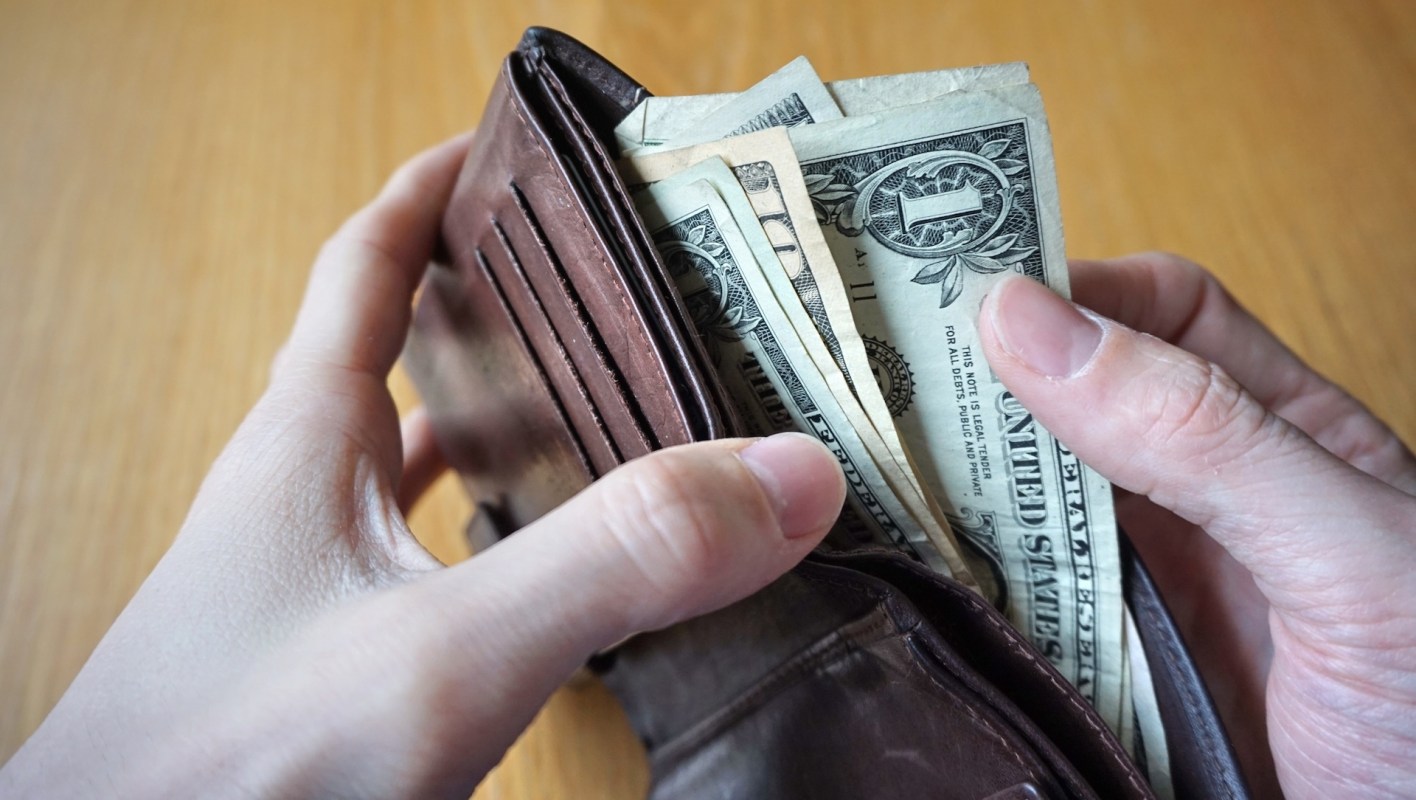
A Reddit user in r/preppers said they have landed on $400 as their daily emergency cash amount. They described it as enough for "a full tank of gas, emergency provisions, and any small service/favor," while still being a sum they would not find devastating to lose.
That led to a discussion about how much cash is worth carrying in an emergency.
Here's what to know
In the Reddit post, the original poster said they carry $400 for situations where "debit/credit/POS/internet goes down." They presented it as a balance between usefulness and risk, and asked others how much cash they keep, where they store it, and which denominations are most practical.
One response suggested the exact total matters less than whether the money is easy to use when something goes wrong. That commenter said they keep a couple hundred dollars spread between a wallet, a car, a get-home bag, and a safe at home.
They wrote: "You can always put cash into a bank. Getting it back out is sometimes the tricky bit."
Bill size also came up repeatedly. The original poster wrote, "I always assume any cash transaction might need to be exact change," while another commenter said they keep about $60 in a wallet and hide the rest in a zippered pocket inside a bag, "mostly in fives and tens because nobody ever has change when you actually need it."
TCD Picks » Quince Spotlight
💡These best-sellers from Quince deliver affordable, sustainable luxury for all




More background
Much of the thread centered on concrete situations rather than abstract disaster planning. A self-employed plumber said that paying dump fees in cash with the exact amount gets them through faster, and added that during card outages, having cash for diesel or gas has meant the difference between getting home or not.
Asked about $100 bills, one commenter said many places in Canada don't take $100s because of counterfeit concerns. The original poster replied that they would rather carry two $50s along with a mix of $20s, $10s, and $5s than rely on a single large bill.
One commenter used a past emergency to illustrate the point, recalling life in San Francisco during the 1989 Loma Prieta earthquake, often called the World Series earthquake, when a neighborhood store stayed open by totaling purchases with a flashlight and accepting cash only.
What can be done?
A recurring theme was to divide cash across locations and keep at least some of it in easy-to-spend bills. One commenter said they leave $50 in each vehicle, withdraw $100 from the ATM whenever their wallet falls below $40, and keep "several hundred dollars in $5's" at home. Another said the remainder of their cash stays concealed in a zippered pocket inside a bag instead of all being carried in a wallet.
People also kept returning to the tradeoff between convenience and the chance of losing the money. One commenter said $1,000 "would be enough to do quite a lot," but they would not want to carry more than $200 day-to-day because "it's [statistically] more likely you'll get robbed than a cash only emergency that you need more than 200 bucks for."
For their own setup, the original poster said they prefer denominations that still work when change is imperfect. They wrote that they avoid hundreds because "there will not be perfect change so there will be rounding up or down," and view two $50s as almost as convenient as one $100.
Where can I learn more?
For more practical, budget-friendly preparedness advice, these stories cover the same real-world concerns.
• Long-time preppers say you don't need thousands of dollars in gear to evacuate safely.
• In the prepping community, beginners swap ways to cover emergencies without breaking the bank.
• During hurricane season, families keep power outage essentials ready for when stores and ATMs fail.
• Households with dietary restrictions build cheap and easy food reserves before emergencies hit.

Get TCD's free newsletters for easy tips, smart advice, and a chance to earn $5,000 toward home upgrades. To see more stories like this one, change your Google preferences here.






