


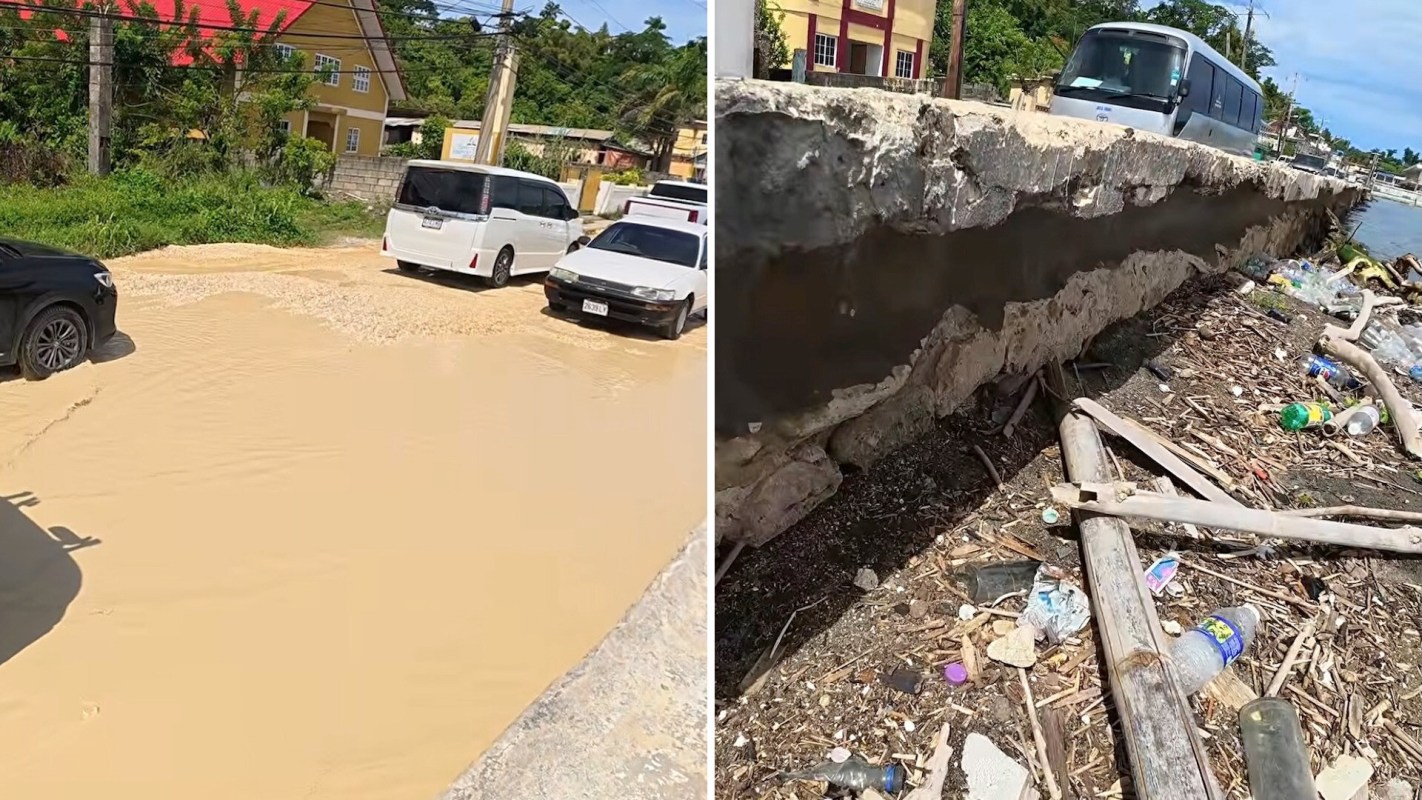
Standing water covers part of Seaview Drive in Lucea, Hanover, after wave action and erosion wore away the seawall, forcing motorists, buses, and tour buses to drive through floodwater on an important route between Montego Bay and Negril.
Here's what to know
A YouTube tour from Good Life in Jamaica (@GoodLifeInJamaicaOfficial) focused on road damage along the Lucea Seawall stretch of Seaview Drive and said the National Works Agency had plans to start SPARK Project work there on October 5, 2026.
According to the video, personnel from the China harbor engineering team were already on site, aggregate had been spread as a temporary measure to keep traffic moving, and the proposal being discussed called for about 656 feet (200 meters) of concrete pavement, roughly 8 inches thick, over five to six months.
Water can be seen pooled on the roadway beside the damaged seawall, and the narrator said while walking the area, "Look at the amount of water here. Nowhere for the water to run off." He also said some sections seem to sit at or below sea level.
Among the comments, one viewer argued, "This roadway should be a temporary fix then start building a more modern road system inland; the coastline won't last and also the pollution is unsightly."
More background
The narrator described the stretch as a common route for travelers heading toward Negril and the Princess Hotel in Green Island, and the video showed both a JUTC bus and tour buses inching through the flooded section.
TCD Picks » Quince Spotlight
💡These best-sellers from Quince deliver affordable, sustainable luxury for all




With police sirens sounding near the bottleneck, the narrator said, "Emergency vehicles having problem to come through these parts." He also said pedestrians were being squeezed between standing water and a crumbling edge.
The narrator said runoff areas were clogged with bamboo, debris, and plastics, and he pointed to sections of seawall that appeared to be breaking apart. "The base of the road is very grossly unstable," he said, adding that nearby buildings and a church along the stretch are vulnerable during high tide or heavy rainfall.
What's being done?
The planned SPARK Project rehabilitation focuses on a stronger concrete roadway, which the narrator said is expected to span about 656 feet (200 meters) at 8 inches thick.
He said the work may involve more than laying new pavement, suggesting that utilities beneath the roadway may need attention, the seawall itself may need repair, and parts of the road may also need to be raised.
Aggregate has been spread to help traffic move while technical teams assess the site, the narrator said. He added that broader works are also expected on alternate routes into and out of Lucea, including the DAS route and another road by the primary school.
Some viewers are also thinking beyond the current repair plans. One commenter wrote, "The road perhaps could be raised to the height of the sea wall if practical, then repair old wall and add a new wall and heavy boulders to the coastline in that area if possible similar to Mobay. If possible, precast concrete could be made and attached to the old wall."
Where can I learn more?
These stories look at how coastal erosion, flooding, and extreme weather are putting roads and other public infrastructure at risk.
• In Carlsbad, California, erosion threatens an iconic coastal highway as sea levels keep rising.
• Across the U.S., public infrastructure crumbles as extreme weather drives mounting repair costs.
• In Jamaica, catastrophic flooding swamped communities after Hurricane Melissa overwhelmed roads and neighborhoods.

Get TCD's free newsletters for easy tips, smart advice, and a chance to earn $5,000 toward home upgrades. To see more stories like this one, change your Google preferences here.






