


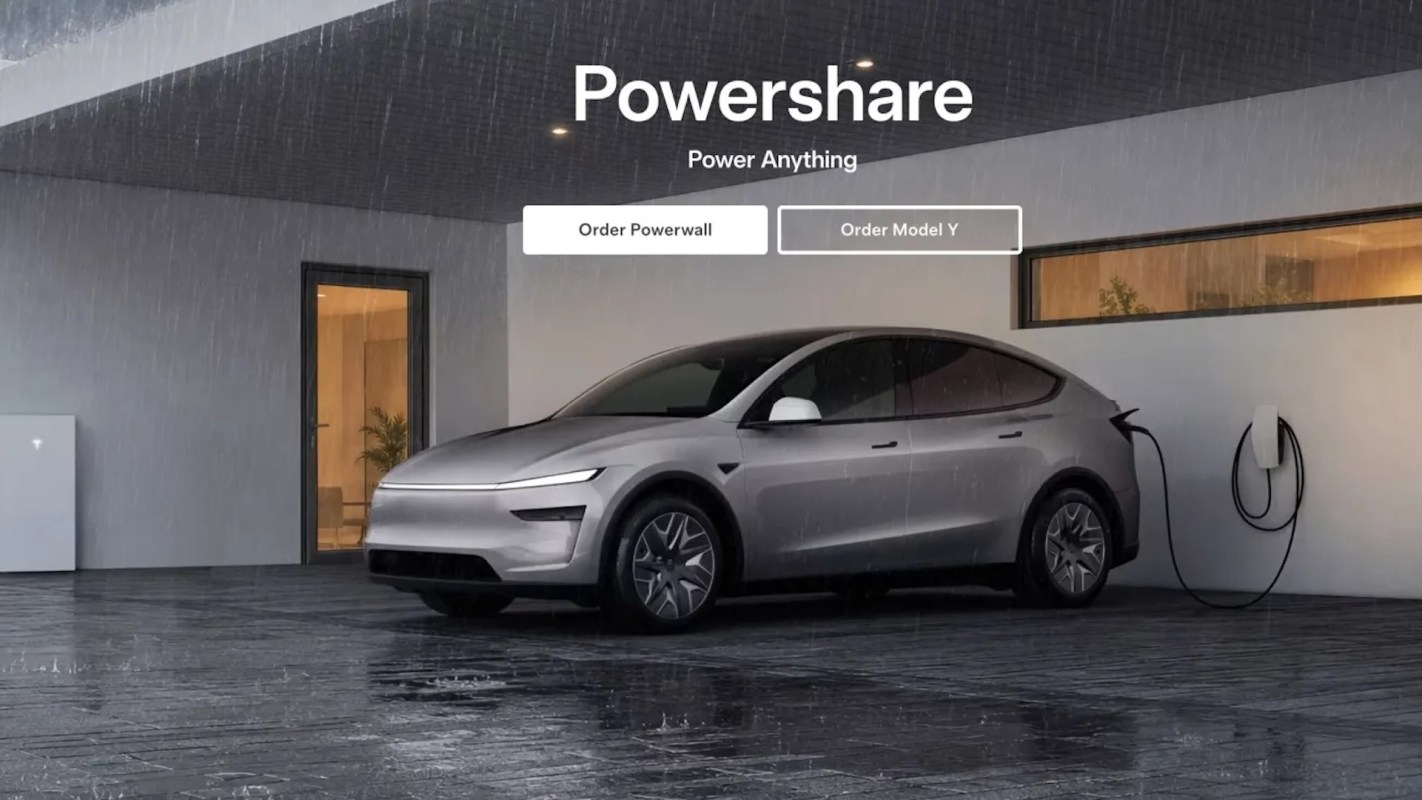
Tesla is finally letting its two most popular electric cars send power back into the house during an outage.
New Model 3 and Model Y buyers in the U.S. and Puerto Rico can tap the feature, as long as the home also has a Powerwall 3.
Until now, Tesla only offered that capability on the Cybertruck.
Here's what to know
According to Tesla's revised PowerShare page, the feature is "currently available for all Cybertruck vehicles, and all new Model 3 and Model Y vehicles ordered on October 1, 2026 or later," Electrek reported.
That means outage backup depends on more than the vehicle alone. The setup also needs a compatible charger and a home with Powerwall 3.
Powershare Home Backup is now available for new Model 3 & Model Y with Powerwall 3 Extend your home backup by over 2 days with your vehicle https://t.co/a0codvZ2yH
— Tesla Energy (@teslaenergy) October 6, 2026
For a home that uses 30 kilowatt-hours per day, Tesla says a Model 3 or Model Y starting at 90% charge can provide "over two days" of added backup, while standard trims offer "up to two days." The company rates the setup for a maximum continuous output of 11.52 kilowatts. To make that work, drivers need to plug the vehicle into either a Wall Connector or a Universal Wall Connector so the battery can support the home if the grid goes down.
The feature isn't guaranteed for every owner. Per Tesla's footnote, that guarantee applies only to orders placed in the U.S. and Puerto Rico after October 1, while existing owners must contact Tesla support to turn on the capability.
Adding battery storage is one of the best ways to protect your home during outages, save money on energy, and gain more energy independence. Homeowners who want to compare backup options and installation prices can explore EnergySage, which has teamed up with electrification brand Qmerit to help homeowners get the best price on home battery storage solutions. Charging an electric vehicle at home is also significantly cheaper than using public chargers, and Qmerit is helping homeowners interested in installing Level 2 EV chargers with free, instant installation estimates.
Save $10,000 on solar panels without even sharing your phone number Want to go solar but not sure who to trust? EnergySage has your back with free and transparent quotes from fully vetted providers in your area. To get started, just answer a few questions about your home — no phone number required. Within a day or two, EnergySage will email you the best options for your needs, and their expert advisers can help you compare quotes and pick a winner. Solar panels can save you more than $50k over their 25-year lifespan, and EnergySage can help you save as much as $10k on installation. Which begs the question — isn't that worth an email or two? |

More background
Tesla has been slower than some competitors to expand vehicle-to-home backup beyond a single model.
Ford has offered home backup on the F-150 Lightning since 2022, rated at 9.6 kilowatts, and GM has had similar vehicle-to-home capability across its lineup for years.
Older Teslas also carry uncertainty around the required parts. Tesla has pointed to a bidirectional inverter called PCS2 Lite as the key Model 3 and Model Y component, without saying which trims or model years got it first. As a result, some earlier vehicles may qualify, but buyers can't assume they will.
The rollout also follows some mixed signals from Tesla. Electrek reported that Tesla equipped the Model Y Premium with a 2.4-kilowatt outlet adapter back in August, even as the company's site continued to list Powershare as "not available" for either model. Cybertruck PowerShare didn't reach Powerwall 3 compatibility until after repeated delays.
What can be done?
Tesla says households that already have a Powerwall 3 and a Wall Connector won't need to buy anything else. However, owners still have to contact Tesla support to activate the feature.
Owners of older Model 3 and Model Y vehicles can verify compatibility through the car's touchscreen. Tesla says the path is Software, then Additional Vehicle Information; if "Powershare Support" is enabled, the vehicle has the needed capability.
For households that want outage protection even without a whole-home EV setup, adding battery storage is still one of the best ways to protect essential appliances, lower some energy costs, and build more independence from the grid. Pila is another company offering strong battery backup options, and its plug-and-play batteries cost a fraction of a whole-home backup system.
For shoppers still comparing backup-friendly vehicles, the equipment checklist is a qualifying car, a compatible charger, and Powerwall 3. If you're still weighing the switch, making your next car an EV can also open the door to lower fueling costs and home charging options.
Tesla is still cautioning buyers not to assume every earlier vehicle makes the cut. Earlier builds are a mixed bag. Tesla's footnote says only "some, but not all" Model 3 and Model Y vehicles include the capability.
Where can I learn more?
For more context on the hardware behind Tesla's backup setup, these stories explore the broader home energy picture. They cover Powerwall alternatives, Tesla's growing installation base, and home charging setups that shape how owners use EVs at home.
• A master electrician is now installing next-gen alternatives to Tesla's home battery systems.
• Tesla has already pushed half a million installations worldwide, underscoring how fast Powerwall adoption is growing.
• One Tesla owner drew scrutiny after using a cheap at-home alternative to charge an EV.
• New EV owners are being pitched an easy tech swap for smarter home charging.
• Another Tesla driver sparked outrage by using a kitchen outlet to charge at home.

Get TCD's free newsletters for easy tips, smart advice, and a chance to earn $5,000 toward home upgrades. To see more stories like this one, change your Google preferences here.






