


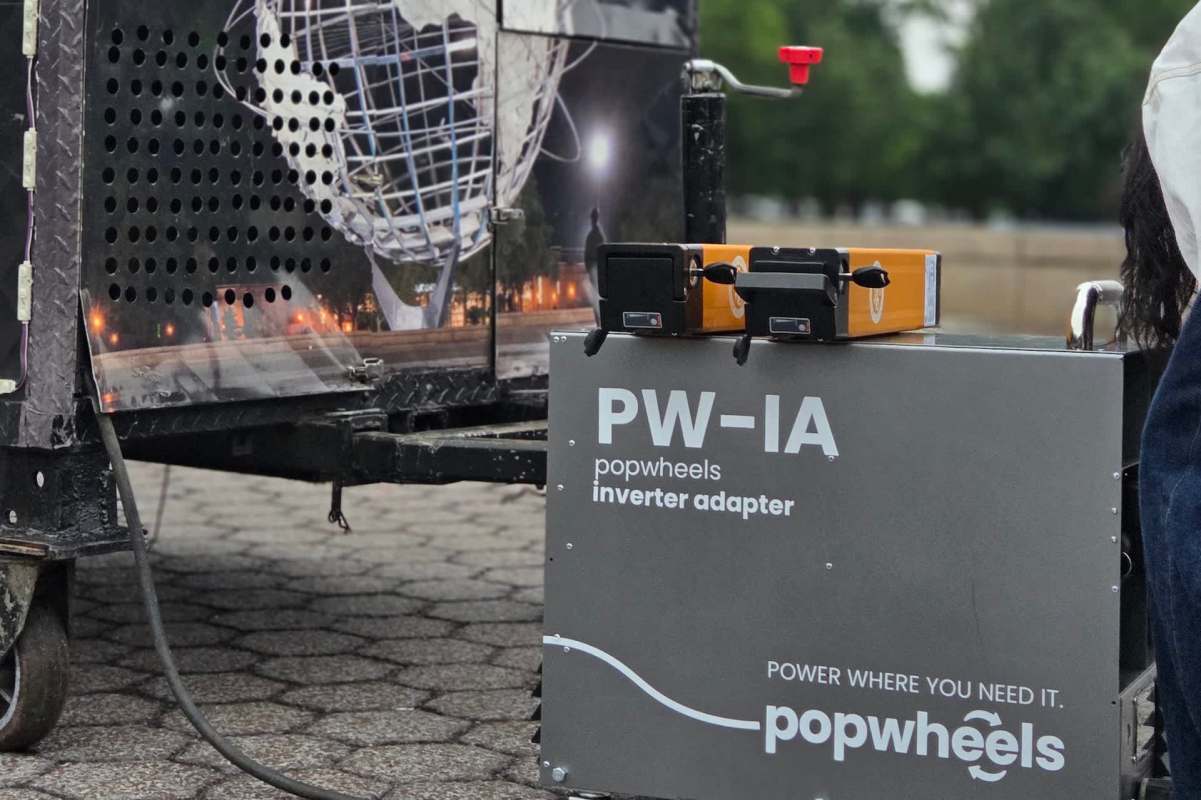
New York City's food carts are known for serving quick, affordable meals on busy streets and in crowded parks. They're also known for the loud, smoky generators that often keep them running.
A Brooklyn company says swappable batteries could offer a quieter, cleaner way to power that kind of street food service.
Here's what to know
PopWheels launched a six-month pilot near Flushing Meadows Corona Park in Queens in July, placing two battery-swapping cabinets there for 10 food vendors to use, Canary Media reported.
The setup lets vendors trade depleted batteries for fully charged ones during the day instead of relying on a generator they have to buy and keep fueled. Because the batteries are silent and pollution-free at the point of use, the system could reduce noise for customers and lower exhaust exposure for workers who spend hours next to the carts.
Participating vendors are using the service at no cost because the pilot received $46,000 from the City Parks Foundation and $30,900 from Resilient Cities Catalyst. PopWheels wants vendors to pay a monthly subscription, along with the cost of buying or leasing the inverter mounted in the cart.
"We understand that this only works if we meet not just our green needs but also the economic needs and the logistic needs of these vendors," said Ben Rosenn, PopWheels' director of deployments. "They're not going to want to switch if it's more expensive."
TCD Picks » Quince Spotlight
💡These best-sellers from Quince deliver affordable, sustainable luxury for all




More background
The pilot extends a system PopWheels already operates for e-bike delivery workers in New York City. Those users pay $65 to $95 per month to use batteries from more than 45 cabinets around the city, and the same batteries can also power food carts.
Using one battery type for both groups could make the network easier to use and expand. PopWheels is also paying some delivery workers who already rely on its service to bring batteries to vendors located farther from the charging cabinets.
William Arevalo, who owns one of the participating carts, said generator fuel costs him roughly $500 to $600 each month, before repairs and maintenance. He told Canary Media he would pay for a battery subscription if it meant fewer operating hassles for vendors and a quieter experience for customers.
"Little by little, there can be damage to the lungs. I have a lot of friends who have this problem," he said.
What's being done?
PopWheels' pilot is one of several ideas cities are considering as they look for alternatives to generators. Some vendors already buy their own batteries and recharge them at home, at depots, or at commissaries. However, Isabelle Thomas, policy adviser for living streets and public spaces at the NYC Mayor's Office of Climate and Environmental Justice, said those facilities vary widely and that some would need electrical upgrades.
The nonprofit Street Vendor Project has also tested batteries in New York. Andrew Conca-Cheng, the group's programs manager, said batteries small enough to comply with cart rules didn't offer enough capacity for as many vendors as the group had expected.
Grid power is another option being considered. As Canary Media reported, a 2013 pilot in Union Square used a street pedestal from startup Simply Grid, and Thomas said the city is "exploring a range of options," with grid connections potentially working well in parks and plazas. Outside New York, Canary Media reported that Washington, D.C., committed $60,000 to help four food trucks switch to batteries, while the Denver-area Regional Air Quality Council offers grants of up to $20,000.
In Queens, PopWheels is using the test run to sort out practical issues such as maintenance, battery supply, and multilingual tech support before expanding to more vendors and possibly to other cities where it already has cabinets, including D.C., Philadelphia, and Toronto.
As Conca-Cheng put it, "This is kind of like a trust-building exercise with the vendors. We're trying to show them this technology can and will be reliable."
Where can I learn more?
Generators aren't the only item cities are rethinking. Other projects are swapping in cleaner battery storage, too.
• In the U.S., a startup is deploying second-life EV batteries for large storage projects.
• In South Korea, a company plans to use old EV batteries to power farms.
• Zendure is selling portable clean energy storage that can run homes without installation.
• In Texas, Base Power offers home battery backup through a subscription-style model.
• Sonnen is building a virtual power plant by linking household batteries together.

Get TCD's free newsletters for easy tips, smart advice, and a chance to earn $5,000 toward home upgrades. To see more stories like this one, change your Google preferences here.






