


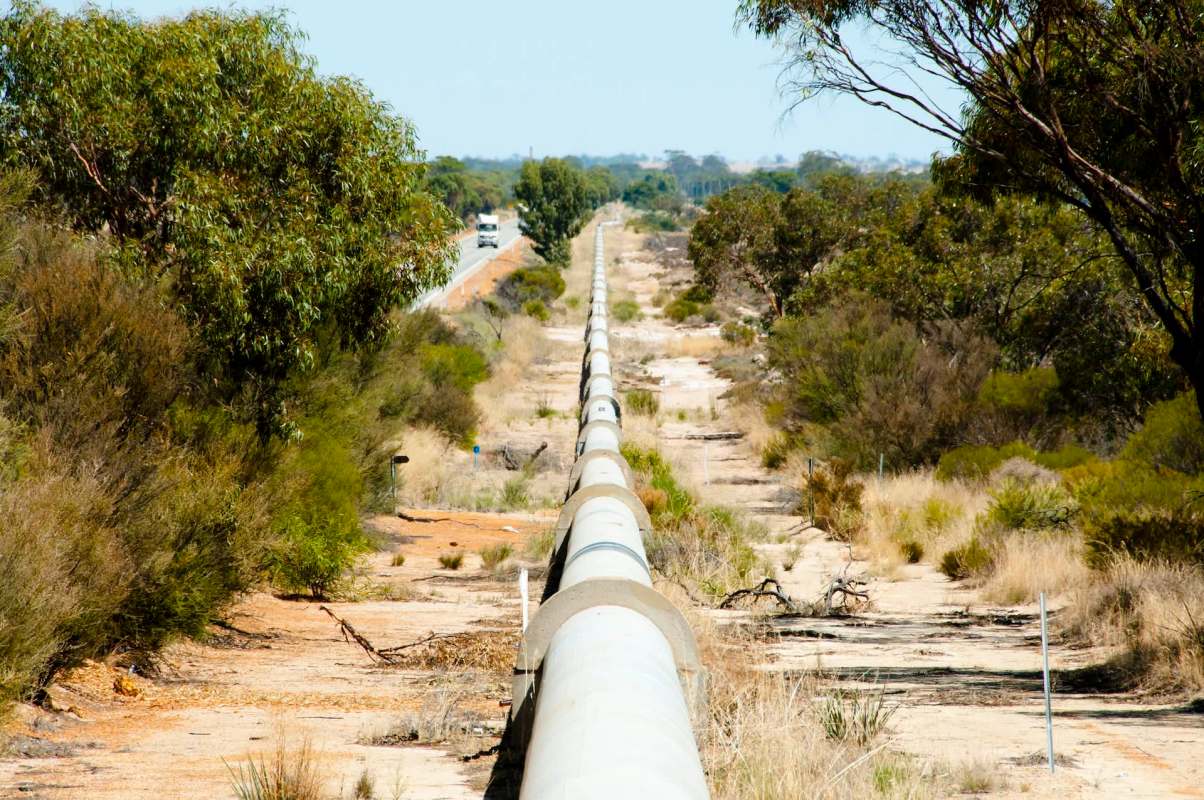
A previously criticized desalination proposal is back under consideration in Western Australia as the state presses ahead with a $543 million upgrade of the historic Goldfields water pipeline.
The two-track approach reflects mounting pressures: growing inland demand and a drying climate that is forcing officials to rethink how water reaches some of the state's most remote communities.
Here's what to know
At Mt. Charlotte Reservoir in Kalgoorlie, Premier Roger Cook framed the pipeline project as part of the state's water security effort, the Australian Broadcasting Corp. reported.
He described the upgrades as a way to "future-proof" the Goldfields and Wheatbelt for generations while conceding that Esperance could still need its own desalination plant.
Now 123 years old, the 566-kilometer (352-mile) Goldfields Water Supply Scheme gives more than 100,000 Wheatbelt and Goldfields residents drinking water. Two contracts worth $170 million were awarded to expand its capacity, per the ABC.
Water Minister Daniel Pastorelli said work had started on replacing 44.5 kilometers (27.7 miles) of pipe across the Wheatbelt shires of Merredin, Westonia, and Yilgarn. He said the project was expected to add 7.2 million liters a day, roughly 10% of capacity, by late 2027.
TCD Picks » Quince Spotlight
💡These best-sellers from Quince deliver affordable, sustainable luxury for all




Pastorelli said water use in the Goldfields has climbed 16% since 2021, which he attributed to the booming resources sector. Under projections, he told the ABC, the upgrades should satisfy demand for some time.
More background
That leaves the Esperance proposal as a notable shift in the state's position.
The WA Nationals pledged $100 million for an Esperance desalination plant to supply Kalgoorlie-Boulder. Then-water minister Simone McGurk dismissed the proposal as "unviable" and a "thought bubble," the ABC reported.
Cook said the state had given that option close consideration.
"We looked very closely at the idea of a desal plant at Esperance and then piping it up to Kalgoorlie," he said, per the ABC. "It was decided, through engineering design, that we were better off increasing the capacity of the Goldfields pipeline rather than building a whole new pipeline up from Esperance."
Still, he suggested desalination is becoming increasingly necessary across Western Australia.
"We will need desalination plants the length and breadth of this state, both as part of a growing economy and drying planet, so that's going to be an important piece of work," Cook said, as the ABC noted. "Whether you ultimately see a desalination plant in Esperance feeding the Goldfields region more generally or simply meeting the needs of the growing Esperance community, I think you will need desal there."
Elsewhere, work is moving ahead on the $2.8 billion Alkimos desalination plant near Perth and a $1.1 billion facility in the Pilbara at Dampier, while Albany in the Great Southern is slated for another facility.
What's being done?
Pastorelli said the replacement pipes were being manufactured locally and "will last for up to 150 years," the ABC reported.
A stage near Kalgoorlie-Boulder is also being prepared. He explained that tenders should be issued for Binduli Reservoir work that would raise capacity from 400 million liters to 800 million liters.
Meanwhile, Water Corporation is in the early planning stages of an Esperance desalination project.
Kalgoorlie-Boulder Mayor Glenn Wilson said the spending is overdue after years of limited attention.
"Water is a precious commodity here. … None of us would be in Kalgoorlie without [the pipeline]," Wilson noted, per the ABC. "After many years where there wasn't much maintenance or love for the pipeline, it's great to see that investment. … It will help grow our economy."
Where can I learn more?
These stories help explain why Western Australia is weighing desalination alongside large-scale pipeline upgrades.
• As communities face drier conditions, desalination for drinking water is moving into long-term planning.
• Scientists are pursuing highly convenient and cost-effective fixes for desalination's heavy energy demands.
• In Texas, officials are turning to state-of-the-art water treatment to drought-proof future drinking supplies.
• A new global tool maps how climate change will impact water supplies for coming generations.
• In Florida, an Everglades project is designed to protect clean drinking water while reshaping regional flows.






