


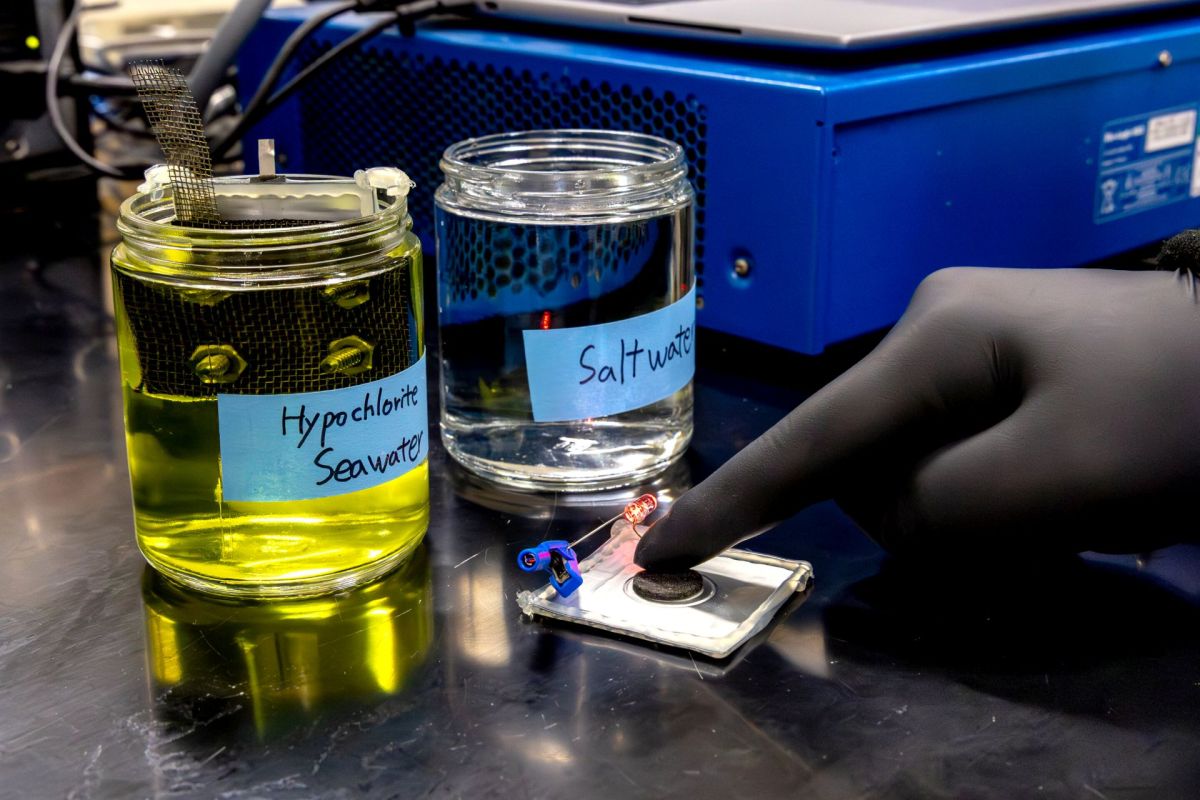
Researchers at Oak Ridge National Laboratory made a battery that uses salt water rather than rare metals like lithium and cobalt.
The breakthrough discovery could reshape how utilities store electricity for blackouts, peak demand, and renewable energy.
Here's what to know
Tech Xplore reported that the ORNL researchers also found that a side reaction to the saltwater batteries is that they can make bleach that works better than the main oxygen reaction most batteries normally rely on.
By adding about 5% more bleach, researchers realized they could double peak power and bring voltage close to lithium-ion levels, which are basically giant versions of the batteries used in EVs. While these lithium-ion systems can perform very well, they need cooling to reduce fire danger and rely on materials such as lithium and cobalt that are often brought in from other countries.
ORNL is pursuing a different route, one built around materials that are common, less expensive, and safer by nature. The batteries also do not need a catalyst or a slow gas-conversion step, since the chlorine reaction happens in liquid.
If researchers are able to scale the chemistry successfully, utilities could get a cheaper way to store electricity for longer stretches while also dealing with outages and shifting demand.
If you're also wondering what battery backup could look like at home, EnergySage can help you explore home battery storage options and compare competitive installation estimates. EnergySage has also teamed up with the electrification brand Qmerit to guarantee you get the best price on home battery storage solutions.
More background
The development turns a common research problem into an advantage.
Save $10,000 on solar panels without even sharing your phone number Want to go solar but not sure who to trust? EnergySage has your back with free and transparent quotes from fully vetted providers in your area. To get started, just answer a few questions about your home — no phone number required. Within a day or two, EnergySage will email you the best options for your needs, and their expert advisers can help you compare quotes and pick a winner. Solar panels can save you more than $50k over their 25-year lifespan, and EnergySage can help you save as much as $10k on installation. Which begs the question — isn't that worth an email or two? |

Rather than keep pushing on a weaker oxygen reaction, ORNL scientists realized the stronger side reaction they had been trying to avoid was actually the better fit for doing the battery's main work.
When utilities can rely on storage that is cheaper and safer, they can hold electricity for longer periods, cut energy costs, and stay more resilient when storms or other disruptions shut the grid down.
Systems based on salt water and commodity ingredients such as salt and bleach may offer one of the clearest ways to build storage that is both low-cost and nonflammable.
That, in turn, could make home backup batteries more affordable.
It can also help save money on energy by storing power for later use and make it easier to keep key devices running if you want a more off-grid setup.
What can be done?
ORNL and Coulomb Technology are working together to move the battery closer to use in the real world.
Whole-home systems are still a major investment, but tools that help compare pricing and installers can make the decision clearer, especially in places where outages or high time-of-use rates are a concern.
There are also lower-cost entry points. Pila offers battery backup options, and its plug-and-play batteries are priced at a fraction of what a whole-home backup system would cost.

Get TCD's free newsletters for easy tips, smart advice, and a chance to earn $5,000 toward home upgrades. To see more stories like this one, change your Google preferences here.






