


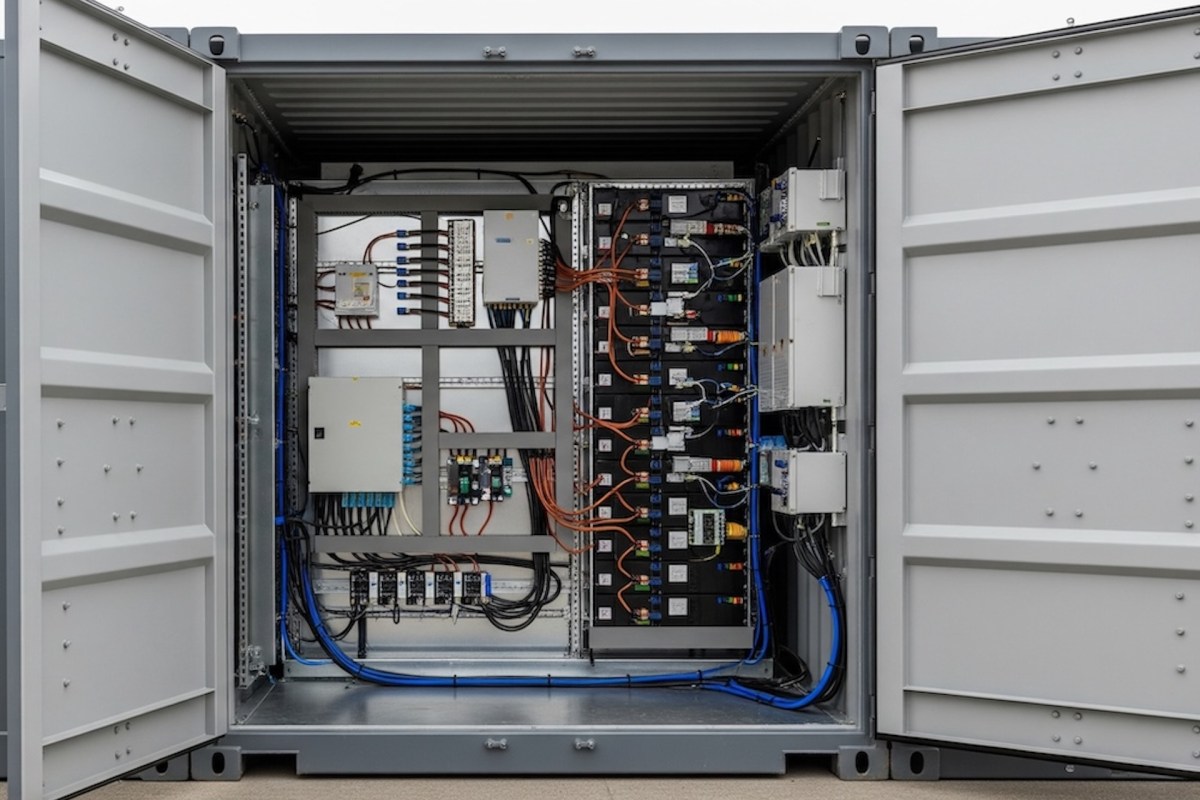
Texas Instruments has developed a chip that gives operators of large battery storage systems earlier warning of trouble by directly assessing conditions inside individual cells.
Safer, more reliable battery storage can help cities, utilities, and businesses avoid costly failures while making clean energy more dependable during power outages.
Here's what to know
According to ESS News in pv magazine, Texas Instruments has unveiled a battery management chip for grid-scale storage that checks cell condition directly rather than inferring it mostly from voltage.
Called the BQ79826Z-Q1, the device builds electrochemical impedance spectroscopy into the silicon itself. With that capability, a storage system can gather more detailed information from each cell and spot developing issues before they escalate into a larger safety concern.
Henrik Mannesson, Texas Instruments' general manager for grid infrastructure and power delivery, told ESS News that the capability matters in particular for lithium iron phosphate cells, a common choice in stationary storage.
"The voltage curve of LFP batteries is flat in the mid-region," Mannesson said. "When measuring in this region, it is difficult to determine from a standard voltage reading if a slightly lower voltage is due to permanent cell aging or simply a temporary state of charge. Standard systems rely on cycle-counting algorithms to estimate health rather than exact models."
TCD Picks » Quince Spotlight
💡These best-sellers from Quince deliver affordable, sustainable luxury for all




Instead of relying on voltage alone, the technique sends a small alternating signal through each cell at different frequencies and tracks how the cell responds. That gives designers more data to work from.
"By creating an exact electrical model of each cell, we can separate state of charge from permanent chemical degradation, such as lithium plating or chemical changes," Mannesson said.
More background
Battery storage is becoming a more important part of daily life as more solar and wind power come online and communities seek backup power that can keep critical systems running during disruptions.
At the same time, large battery installations face growing pressure to improve fire safety and keep costs in check.
By moving the diagnostics onto the chip, Texas Instruments says system makers may be able to skip some extra hardware and build simpler designs. For manufacturers assembling large storage modules, that could mean smaller boards, fewer parts, and lower overall costs.
The chip can also monitor up to 26 cells wired in series, which may fit newer 104-cell battery modules more neatly. Per ESS News, four of the chips can cover a full 104-cell module, which helps keep designs compact and costs down.
What's being done?
Texas Instruments is already offering early samples, and ESS News reported that Mannesson expects mass production by year's end. The first commercial storage systems built around the chip could reach the market in 2027 at the earliest, depending on how quickly customers integrate it.
Texas Instruments is also helping engineers get clean readings because outside factors can throw off impedance measurements.
Mannesson explained, "Wiring, connectors, and internal resistance all affect the measurement. To ensure a clean setup, we provide reference designs, evaluation modules, and graphical user interfaces. We want to ensure customers have accurate data before running multi-week thermal and degradation tests."
Better data matters to the people funding these projects, too. As Mannesson put it, "These large systems are funded by pension and infrastructure funds looking for secure returns. Providing reliable thermal runaway and aging data directly improves project bankability."

Get TCD's free newsletters for easy tips, smart advice, and a chance to earn $5,000 toward home upgrades. To see more stories like this one, change your Google preferences here.






