


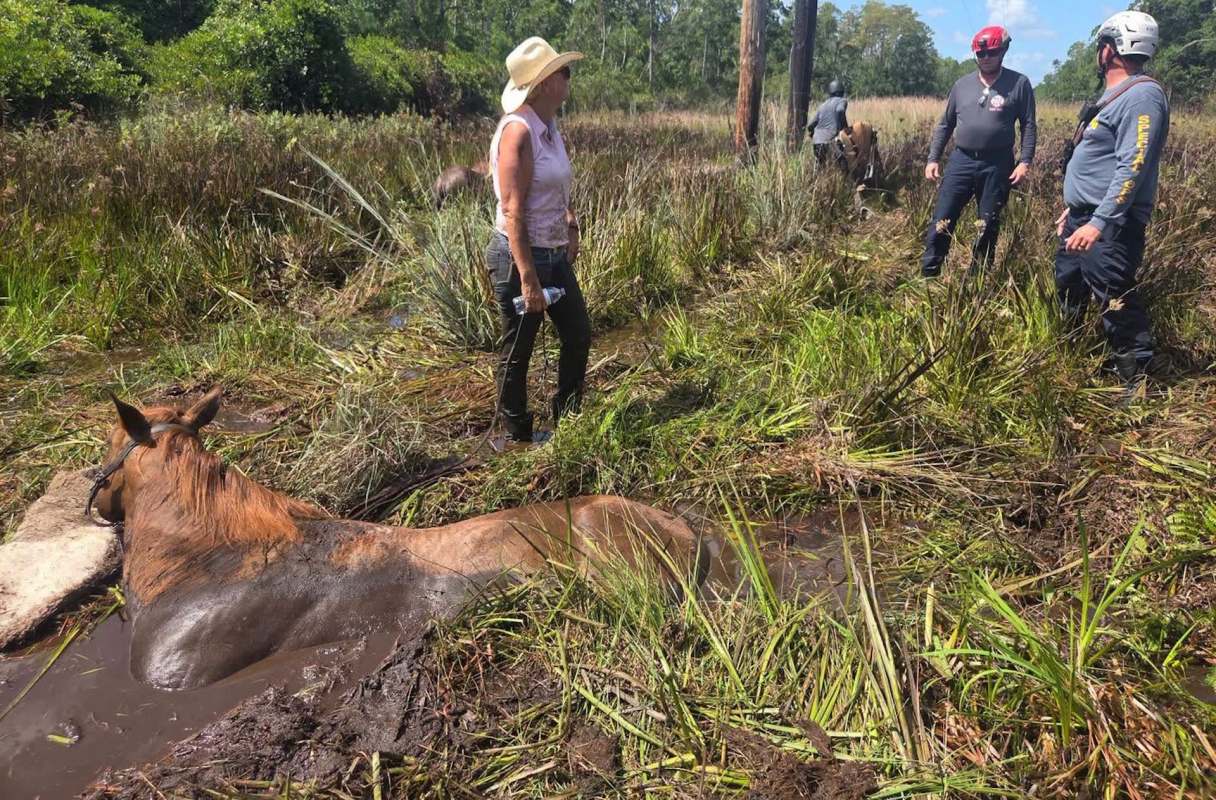
A training exercise intended to prepare search-and-rescue horses for emergencies took an unexpected turn in Flagler County, Florida, when two of the animals had to be rescued after becoming stuck neck-deep in mud.
Here's what to know
According to WOFL, the rescue happened during a grid-search exercise involving the Flagler County Sheriff's Office Mounted Posse.
The posse is a volunteer group that uses the members' own horses to help the sheriff's office with searches and other operations. During the drill, the horses moved onto ground that appeared firm but gave way into deep mud. When Flagler County Fire Rescue arrived, crews found the horses stuck.
"They were about three and a half to four feet deep of mud and muck," fire chief Michael Tucker recalled.
The training was intended to prepare the mounted unit to help find missing people in wooded areas. Search-and-rescue operations often depend on teams being able to move through difficult terrain, but the same landscapes that make horses useful can also hide serious hazards.
Despite the scare, neither horse was injured. Both animals walked away safely after being pulled from the mud.
TCD Picks » Quince Spotlight
💡These best-sellers from Quince deliver affordable, sustainable luxury for all




More background
Mounted search teams can be an important part of public safety operations, especially in rural or heavily wooded areas where vehicles may struggle to reach remote terrain.
Horses can cover ground efficiently, and volunteer units can expand a sheriff's office's response capability.
The Flagler County incident showed how unpredictable natural terrain can be, even during a controlled training exercise.
Mud that appears solid on the surface can behave more like a trap underneath, putting large animals at risk of panic, exhaustion, or injury if they cannot regain their footing.
Training is meant to reduce risk before a real emergency unfolds.
When an exercise itself becomes dangerous, coordination among law enforcement, fire rescue crews, and volunteers is essential.
What's being done?
In this rescue, firefighters used ropes to improve the horses' traction so the animals could work themselves free.
Tucker said crews focused on helping them get enough footing rather than trying to force them out.
"It was a matter of getting some ropes around them and getting them just a little bit of traction," he explained.
After they got moving, the horses were able to do much of the work themselves.
Volunteer groups such as mounted posses can play a key role in community safety, but they also need support from trained emergency personnel when conditions change quickly. In this case, that cooperation helped prevent what could have become a much more serious situation.
"They are pretty amazing animals," Tucker observed. "When they decide to do something, you're just trying to guide them as opposed to make them."
Where can I learn more?
Animal rescues can turn dangerous fast when terrain, fire, or equipment creates new risks.
• Near a Florida shoreline, officials saved a distressed manatee that could not submerge.
• In Gulf Breeze, police freed an osprey trapped in sailboat rigging at a marina.
• In San Dimas, firefighters rescued an owl suspended 50 feet in the air.

Get TCD's free newsletters for easy tips, smart advice, and a chance to earn $5,000 toward home upgrades. To see more stories like this one, change your Google preferences here.







