


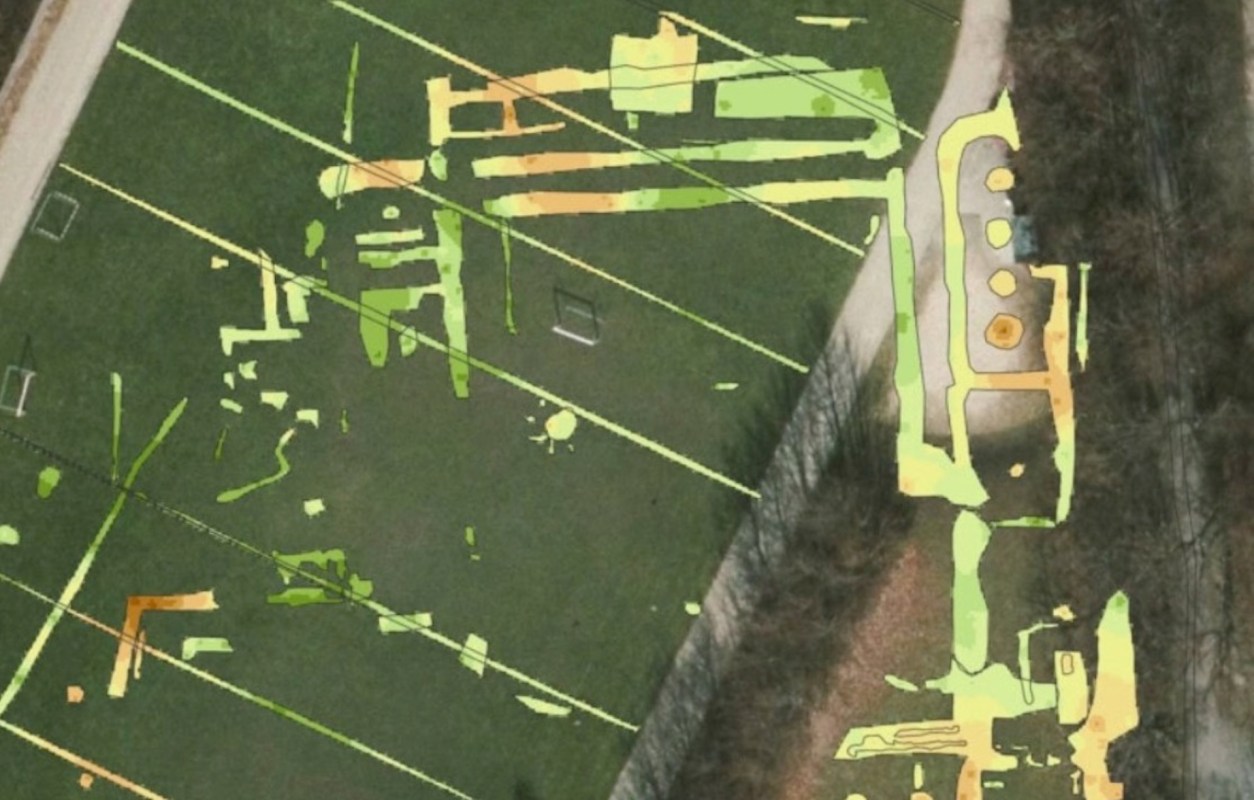
A soccer field in Roskilde, Denmark, turned out to be hiding something far older than goalposts and painted sidelines: the remains of St. Clare's Convent, a monastery dating to the mid-13th century.
Here's what to know
Ground-penetrating radar, which sends electromagnetic waves into the soil and measures signals that bounce back from buried features, helped researchers locate the long-lost convent about six feet below the field, according to Fox Weather.
The scan revealed an unusually detailed picture of the monastery, showing room divisions, cloister areas, and a church along the southern side. Arne Abel Stamnes of the Norwegian Institute for Cultural Heritage Research said that kind of clarity is uncommon.
"The results are simply impressive," Stamnes said. "GPR data do not always provide such clear images and often the interpretation requires extensive analytical work."
Many had assumed the monastery was largely gone. St. Clare's Convent was founded in 1256, counted among Roskilde's five monasteries, and was later closed and demolished after the 16th-century Protestant Reformation.
The surviving remains beneath the surface may now give archaeologists a rare opportunity to examine a well-preserved monastic complex that had effectively vanished from sight.
TCD Picks » Quince Spotlight
💡These best-sellers from Quince deliver affordable, sustainable luxury for all




More background
Fox Weather noted that even with the radar images, researchers still cannot say exactly how many rooms the monastery had, partly because the complex likely extended to two stories.
The images, together with what historians would expect at a site like this, suggest there may have been a refectory, a chapter house used for formal meetings, a parlor for outside visitors, a kitchen, storage spaces, and rooms such as a library and scriptorium where books and manuscripts were written or copied.
Saint Clare, born Clare Offreduccio in 1194, gave up her wealth, clothing, and jewelry to devote herself to caring for the poor, sick, and dying. Monasteries like this one were not only religious spaces, but also places for learning, record-keeping, food preparation, and care work.
As work continues, the site could offer historians a better sense of how the convent evolved over time and of the people who lived, worked, and were buried there.
What's being done?
Archaeologists are planning a careful excavation linked to the construction of a parking facility near the field, but digging will be limited to the part of the monastery directly affected by that project.
The opening phase is expected to target the eastern half of the complex and may take six to 12 months.
Since the radar method is non-destructive, teams are able to map buried remains before any excavation begins, which helps avoid unnecessary disturbance and lets planners safeguard important historic areas while development moves ahead.
Jesper Langkilde, a specialist in medieval archaeology, said the team hopes the excavation will lead to a much deeper understanding of life at the convent.
"We hope to find lots of well-preserved artifacts and organic remains which can tell us about the daily life at the convent," Langkilde said, according to Fox Weather. "Also, we expect to find a lot of burials which can tell us about whom the nuns were and who else was buried at the monastery."
Where can I learn more?
Archaeologists have made similarly surprising finds elsewhere, whether beneath major landmarks or in places that now seem entirely modern.
• In Denmark, archaeologists recreated Iron Age hole belts to test their ancient defensive purpose.
• Beneath Notre Dame, archaeologists uncovered 2,000-year-old Paris hidden just below the cathedral plaza.
• In Barcelona, women and children emerged from monastery tombs once attributed to a nobleman.

Get TCD's free newsletters for easy tips, smart advice, and a chance to earn $5,000 toward home upgrades. To see more stories like this one, change your Google preferences here.






