


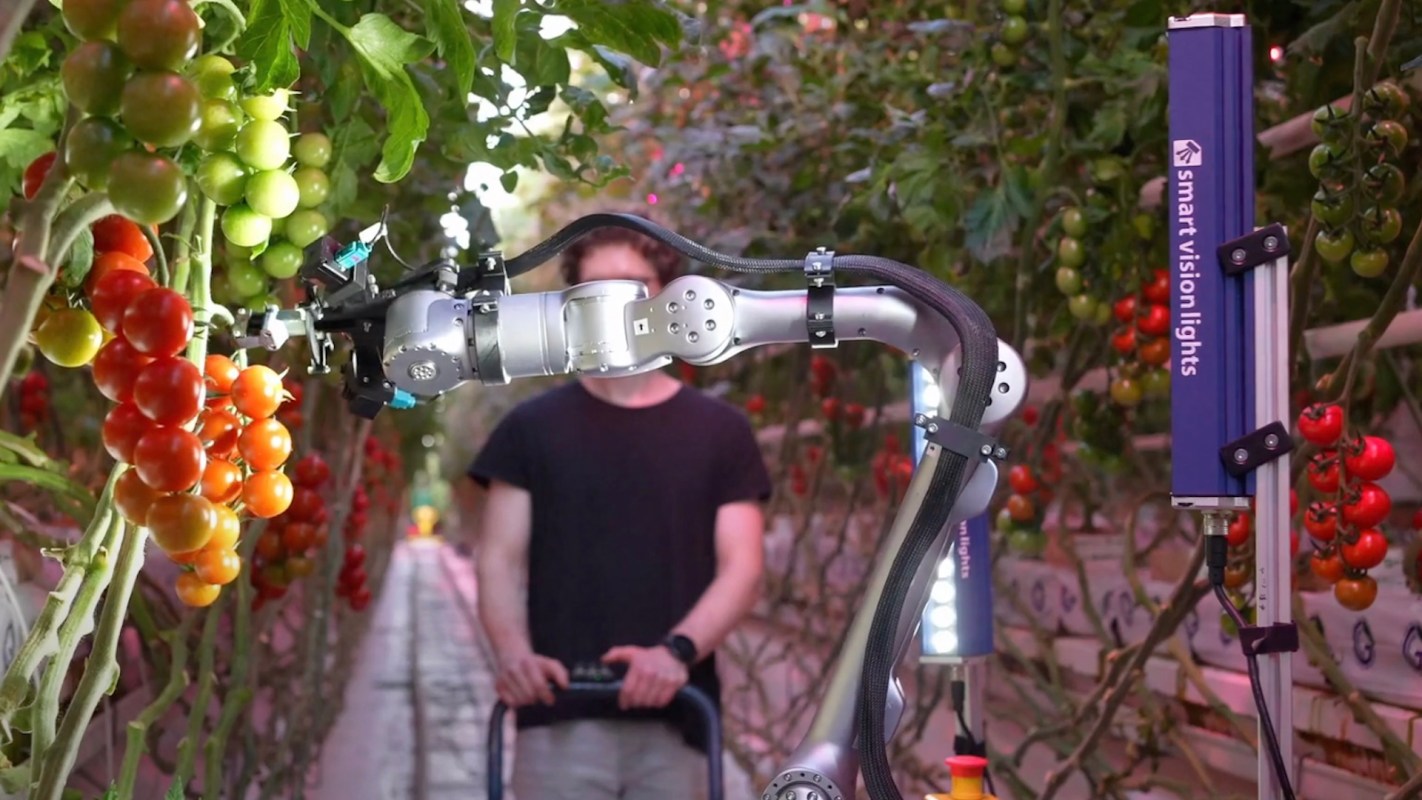
Polybot, a Tübingen startup spun out of the ELLIS Institute and the Max Planck Institute for Intelligent Systems, is developing a tomato-picking robot that learns by watching humans and is already moving beyond the lab and into real greenhouse rows. That makes this more than a flashy demonstration — it is an early sign that agricultural automation may be becoming practical for one of the food system's most delicate jobs.
According to Interesting Engineering, Polybot is developing a fully autonomous harvester for truss tomatoes. The system is trained end-to-end on human demonstrations instead of hand-coded rules.
Here's what to know
Its progress has been rapid: in May 2025, the machine completed its first tomato pick on its own, and by December 2025 it was harvesting full greenhouse rows. A full pilot was planned for summer 2026, and deliveries to growers could begin in early 2027.
Harvesting truss tomatoes is far from a simple factory-style task. The fruit must be handled carefully, and the robot has to navigate the natural variation of living plants rather than identical products moving down an assembly line.
Rather than depending on engineers to manually program each step, Polybot trains on examples from human workers. That approach could help the system adapt more effectively in complex growing environments.
For growers, that could mean support with one of the most repetitive and physically demanding parts of food production. For shoppers, better harvest timing and more consistent picking could eventually help support steadier produce availability and less waste.
TCD Picks » Quince Spotlight
💡These best-sellers from Quince deliver affordable, sustainable luxury for all




More background
The company emerged from advanced artificial intelligence and robotics research that was connected to the ELLIS Institute and the Max Planck Institute for Intelligent Systems.
Greenhouse agriculture depends on careful, repeatable work, and tomatoes are a high-value crop where even small mistakes can add up quickly.
A robot that can learn directly from people may also be easier to improve over time. In agriculture, where plant spacing, fruit position, and growing conditions can all vary, that kind of adaptability is a major advantage.
If systems like this work at scale, they could potentially make food production more resilient all while allowing human workers to focus on oversight, maintenance, and other tasks that are less repetitive and physically demanding.
What's being done?
The next big test is the full pilot, which was scheduled to run in summer 2026. More than the early demonstrations, it should show whether the harvester can operate reliably under real production demands.
If the pilot goes well, the first systems could reach growers in early 2027.
Technologies that help growers harvest more efficiently can support reliable produce supplies and reduce losses before food ever reaches a store shelf.
In food production, that kind of partnership could make daily life a little easier for growers — and a little more reliable for everyone who depends on fresh produce.
Where can I learn more?
Agricultural robotics is moving beyond demos and into day-to-day farm work. These stories look at machines that weed fields, tend vineyards, sense crops, and take on other labor-intensive jobs.
• Across modern farms, high-tech robots are changing how growers plant, monitor, and harvest food.
• In student labs, an autonomous weeding robot is pushing low-chemical organic farming forward.
• Using crop acoustics, scientists can guide agricultural robots without a camera in cluttered rows.
• In vineyards, an AI machine tends grapes through labor shortages and delicate fieldwork.

Get TCD's free newsletters for easy tips, smart advice, and a chance to earn $5,000 toward home upgrades. To see more stories like this one, change your Google preferences here.






