


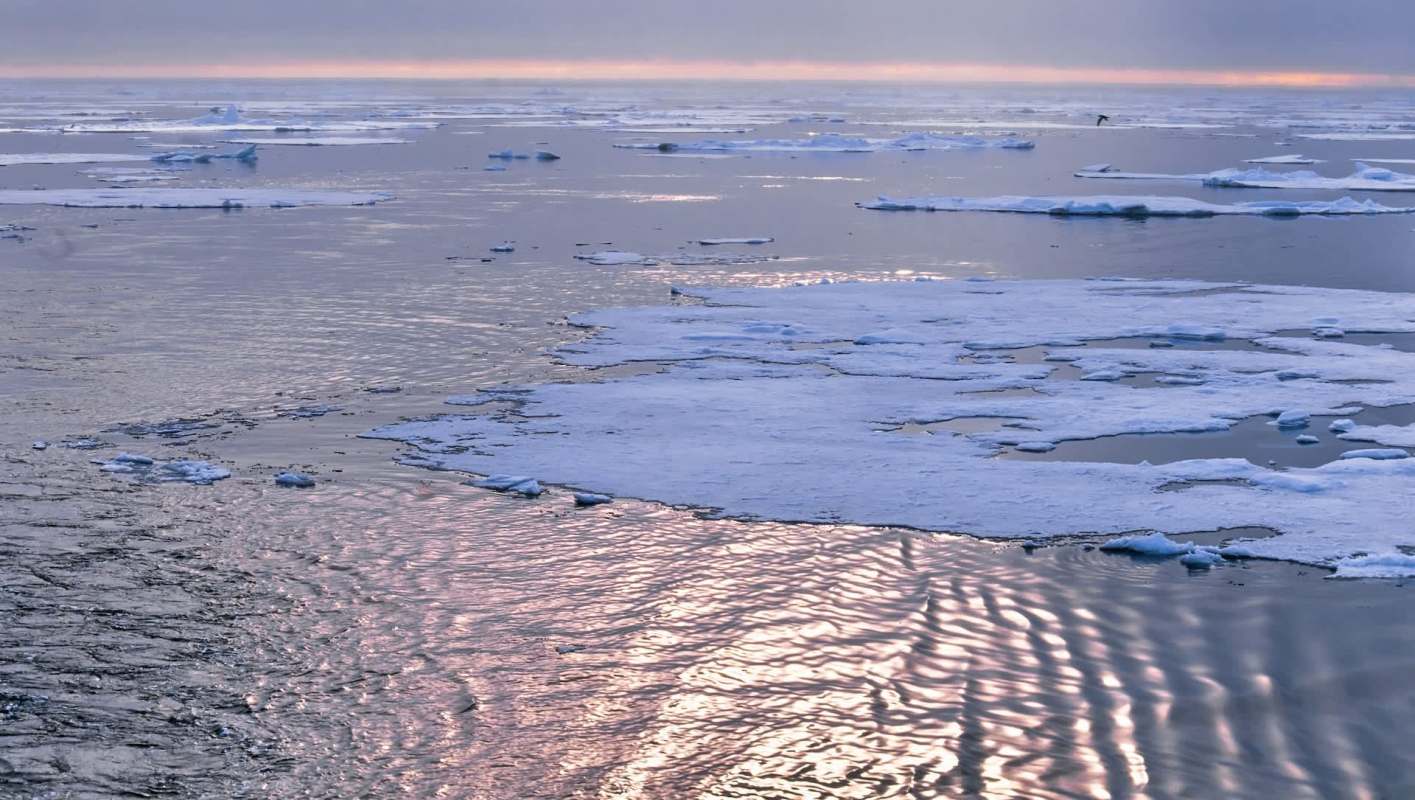
Arctic sea ice moves and spreads in ways that wind alone cannot explain, making it harder for scientists to predict where it will travel as the region warms.
A new study suggests a more intuitive explanation than one might expect. Collisions between individual ice floes appear to be driving the movement.
Here's what to know
In a press release on their new paper published in Physical Review Letters, Bryan Shaddy and his co-authors Alex Greaney and Bhargav Rallabandi argue that Arctic ice movement makes more sense when collisions between floes are included.
Rather than forming one uninterrupted sheet, Arctic sea ice is broken into separate pieces known as floes. These chunks can measure anywhere from several feet to a few miles across, and while winds push them over the ocean, their overall drift has not matched what wind-only predictions would suggest.
Scientists have recognized that gap for a long time. Two patterns have been especially hard to explain, the researchers say. The ice pack often spreads more slowly than expected, and its speed changes in ways simple models do not fully capture. Proposed reasons have included unusual wind behavior, ocean eddies, and fractures in the ice.
The new study points to one mechanism that could tie those observations together. As floes crash into each other, they pass energy through the ice pack and alter how the broader system moves.
TCD Picks » Quince Spotlight
💡These best-sellers from Quince deliver affordable, sustainable luxury for all




"We showed that that's the only ingredient you need to explain these observations," Rallabandi declared in the release.
More background
To validate that idea, the researchers created a computer simulation that represented sea ice as many moving, grain-like pieces instead of a single solid slab. In the model, turbulent winds pushed those floating units while ocean drag and repeated impacts with nearby floes also shaped their motion.
The team then checked the model against real-world observations from the Fram Strait, the passage between Greenland and Svalbard where Arctic ice moves toward the Atlantic Ocean.
A stronger model could help researchers anticipate changes in the region with greater confidence, rather than relying on incomplete assumptions about wind alone.
What's being done?
The most immediate step is improving the models, per the researchers. By showing that collisions among floes can explain several puzzling observations at once, the study offers a simpler framework that researchers may be able to incorporate into broader forecasting tools.
The work suggests that wind-driven motion must be understood alongside the chain reaction that occurs when one moving floe strikes another. That interaction could help explain why large groups of ice drift differently from isolated pieces.
It also potentially extends to other research outside of sea ice to other natural phenomena like avalanches and landslides.
"The model is not restricted to ice," Rallabandi explained in the release. "It just needs a noisy source of force and the things that are moving to experience collisions."
Where can I learn more?
Outside of this study, changes in the Arctic are occurring in ways that defy scientists' expectations.
• Across the Arctic, aerosol particles influence melt more than many models assumed.
• Beneath thinning Arctic ice, ocean light patterns are shifting in unexpected ways.

Get TCD's free newsletters for easy tips, smart advice, and a chance to earn $5,000 toward home upgrades. To see more stories like this one, change your Google preferences here.






