


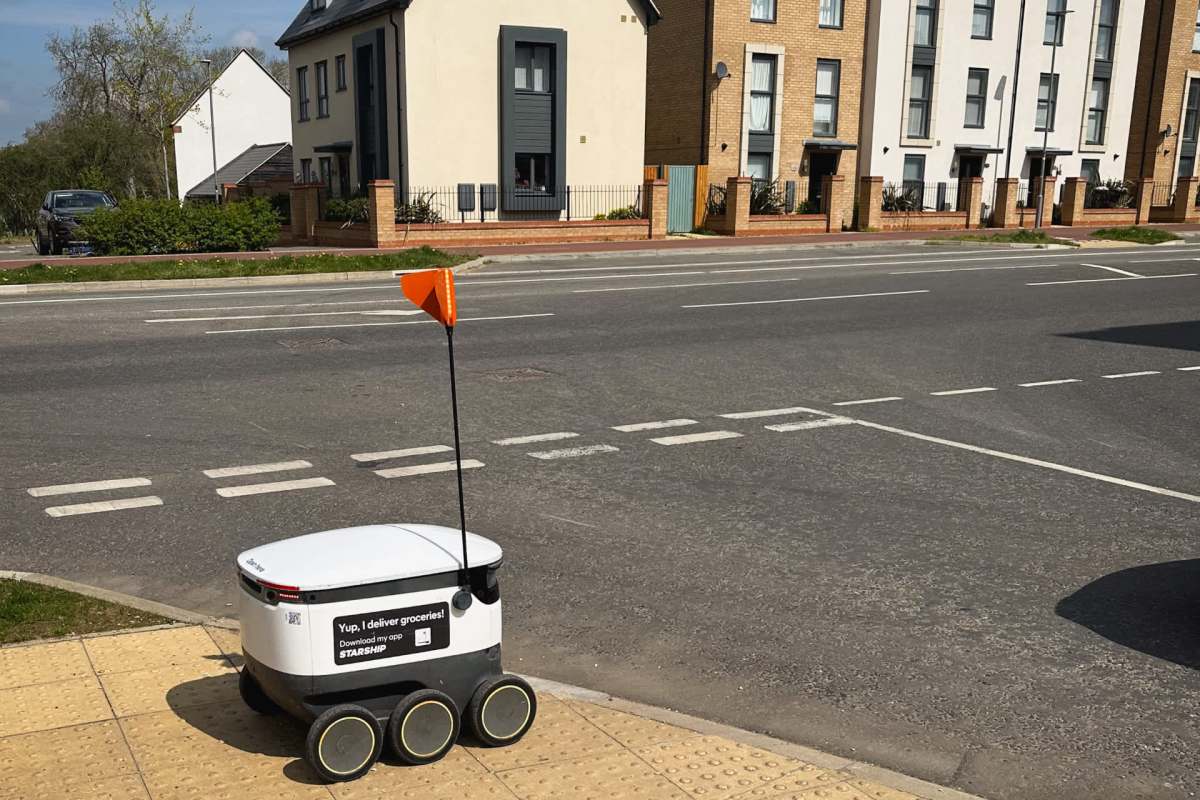
A growing fight over sidewalk delivery robots in the U.K. is raising a bigger question: Who should public spaces be designed for first — fast-moving tech services, or the people who rely on safe, accessible pavements every day?
In reporting on the dispute, The Independent said campaigners are pressing to bar the machines from pavements, arguing that disabled pedestrians are being left to absorb the risks of a technology that spread before clear rules were established.
Here's what to know
Living Streets is calling for autonomous delivery robots to be taken off pavements unless and until the U.K. introduces safety legislation to protect pedestrians, with disabled people a particular concern.
The six-wheeled devices are already active in Leeds, Milton Keynes, Bristol, and Manchester, and they can move at speeds of up to 4 miles per hour carrying takeouts and groceries.
Critics say the expansion has taken place in a regulatory gap. U.K. road traffic law still has no dedicated statutory framework for personal delivery devices, which means companies can operate without rules written specifically for sidewalk use.
That absence of clear law is heightening concern among people who already encounter barriers in public spaces.
TCD Picks » Quince Spotlight
💡These best-sellers from Quince deliver affordable, sustainable luxury for all




Public support for a crackdown appears significant. A YouGov survey found that 60% of respondents support banning delivery robots from public footpaths entirely.
"Our pavements are not for sale and should be for people. Delivery robots are putting pedestrians at risk and creating accessibility issues," said Tanya Braun, director of external affairs at Living Streets.
More background
For disabled people, the debate is far from theoretical. Dr. Amit Patel, who lost his sight in 2013, said encounters with the robots have affected his guide dog.
"If you can see, walk, or hear, you probably won't be affected by delivery robots," Dr. Patel said. "But for those of us who have worked so hard to get our independence back, this is yet another hurdle."
He warned that declining street accessibility is pushing vulnerable people out of public spaces altogether.
Wheelchair users, too, have said many pavements are already narrow or cluttered.
"There's a real danger that large numbers of disabled people will have our routes blocked, stopping us from getting to the bus stop, the local shops, our GP surgery, or from taking our children to school," said Ben Foley, campaigns and policy lead at Wheels for Wellbeing.
What's being done?
Living Streets wrote to Transport Secretary Heidi Alexander, calling for a halt to current commercial robot operations until safety legislation is in place.
Companies in the sector argue that a full ban could come with trade-offs.
A spokesperson for Starship Technologies, a major U.K. operator, said: "Starship agrees we need regulation for pavement robots. But that regulation shouldn't be putting the U.K. on the back foot when it comes to innovation, job creation and reducing carbon emissions. Regulation should make sure operations are safe and accessible, and give local communities a say over what works for their areas."
The Department for Transport said it plans to create a new legal category for "low-speed zero-emission vehicle[s]" and run trials on how pavement robots and pedestrians can safely share space.
"Everyone should be able to use our pavements safely, and while we welcome innovation and advances in technology, it's vital that pedestrians and vulnerable road users are put first," a government spokesperson said. "We will carry out trials to see how pavement delivery robots can operate safely alongside pedestrians, so we can make sure the right safeguards are in place and update the law."
Where can I learn more?
These stories look at delivery robots, last-mile shipping systems, underground delivery tubes, and other robots in public spaces.
• In Los Angeles, Serve Robotics is expanding autonomous electric food delivery on city streets.
• Researchers are testing a hybrid last-mile system that pairs vans with delivery robots.
• Pipedream is building underground robotic delivery tubes to move packages beneath neighborhoods.
• At a modern recycling plant, intelligent sorting robots are separating materials with high accuracy.
• On public beaches, the BeBot is using autonomous sand-sifting technology to collect debris.

Get TCD's free newsletters for easy tips, smart advice, and a chance to earn $5,000 toward home upgrades. To see more stories like this one, change your Google preferences here.






