


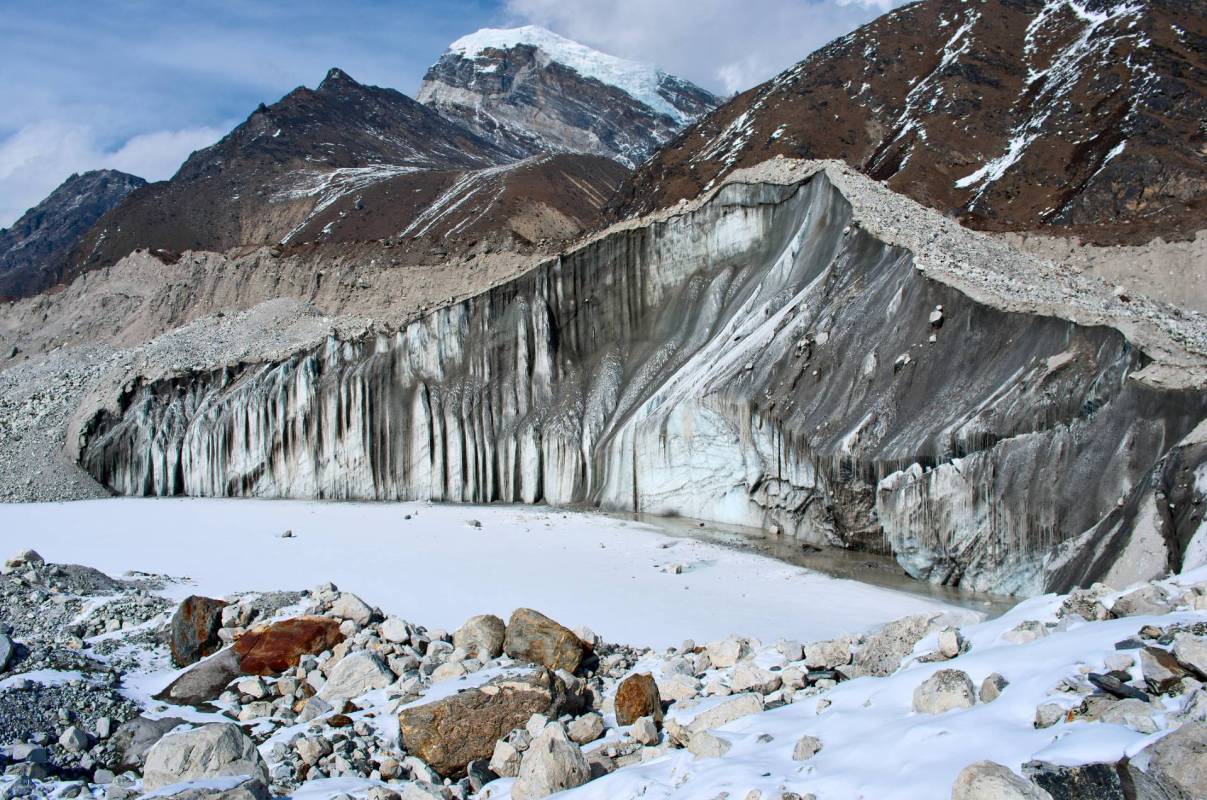
A scientific review has pointed to climate-related instability, not just bad geological luck, in the glacier collapse that unleashed devastating flooding across Nepal and Tibet.
Researchers from World Weather Attribution and Imperial College London said long-term warming likely weakened the mountain landscape before the fatal Aug. 26 failure.
Here's what to know
According to The Guardian, the researchers concluded that rising heat helped destabilize the section of Langtang Lirung that broke away — an overhanging expanse of glacier and rock measuring about 2,153,000 square feet (200,000 square meters).
More than 1,300 people were killed, over 5,000 were still missing by September 17, and downstream communities were hit with little warning when a huge surge of water, ice, rock, and sediment tore through them.
Researchers estimated that about 3.885 billion cubic feet (110 million cubic meters) of snow and ice fell roughly 4,660 feet (1,400 meters) into the valley below, contributing to a freezing flood that moved at more than 110 miles per hour.
Instead of tracing the catastrophe to one specific weather event, scientists at World Weather Attribution and Imperial College London described it as the result of several interacting factors. Their analysis pointed to rising temperatures, retreating glaciers, thawing ground at high elevations, and possibly lingering effects from the region's 2015 magnitude-7.8 earthquake.
TCD Picks » Quince Spotlight
💡These best-sellers from Quince deliver affordable, sustainable luxury for all




Their study said the area is about 3.6 degrees Fahrenheit (2 degrees Celsius) warmer than it was in preindustrial times. It also found that July and August 2026 were the hottest ever recorded locally, and that temperatures in the days leading up to the collapse were 8 degrees Fahrenheit (5 degrees Celsius) above the 30-year average.
Dr. Ben Clarke, a researcher on extreme weather and climate at Imperial College London, said the "fingerprints of climate change" were visible in the long-term changes around the glacier before it failed.
More background
Events on this scale are highly uncommon, the study said, with estimates suggesting a rock avalanche this large occurs roughly once every 1,000 to 10,000 years.
The researchers also reported that the Himalayas' freezing line has been rising by about 328 feet (100 meters) per decade since the 1980s. As a result, ground that used to stay frozen is thawing for longer periods, raising the odds of instability on steep mountain terrain.
The flood destroyed homes, roads, bridges, and settlements, stranding survivors and severing access to essential services.
The disaster also highlighted how communities that have contributed little to global warming can still endure some of its deadliest effects.
Dr. Friederike Otto, a climate science professor at Imperial College London, said: "Communities in Nepal are paying with their lives for a crisis driven by fossil fuel emissions thousands of miles away."
What's being done?
According to the report, Nepal has formally sought financial help from the UN loss and damage fund to recover from the flooding.
The fund is designed to help countries deal with irreversible climate damage, and applications such as Nepal's partly rely on demonstrating a link between a disaster and a shifting climate.
The country's foreign minister, Shisir Khanal, also urged major polluters, including China and India, to "wake up" and share responsibility for the disaster, according to The Guardian.
The analysis stops short of saying warming alone caused the collapse, but it said hotter conditions gradually destabilized the glacier's surrounding geology.
Madhab Uprety, senior technical advisor for the Red Cross Red Crescent Climate Centre, which is part of World Weather Attribution, said: "In addition to the human tragedy on an unimaginable scale, the cost of recovery for this disaster is substantial. For a nation that's done virtually nothing to contribute to this problem, it underlines the need to find fairness in helping climate vulnerable nations cope with the problems they have not unleashed."
Where can I learn more?
Worldwide ice loss because of rising temperatures is increasing the risk of glacier collapse.
• Scientists have warned that a lot of glacial damage cannot be undone by future cooling.
• Researchers have outlined the extent of unprecedented glacier melt rates due to a warming planet.
• In Antarctica, Thwaites Glacier could trigger catastrophic sea-level rise if its collapse accelerates.
• In Svalbard, ocean warming is driving retreat at Austfonna, Norway's largest glacier.

Get TCD's free newsletters for easy tips, smart advice, and a chance to earn $5,000 toward home upgrades. To see more stories like this one, change your Google preferences here.






