


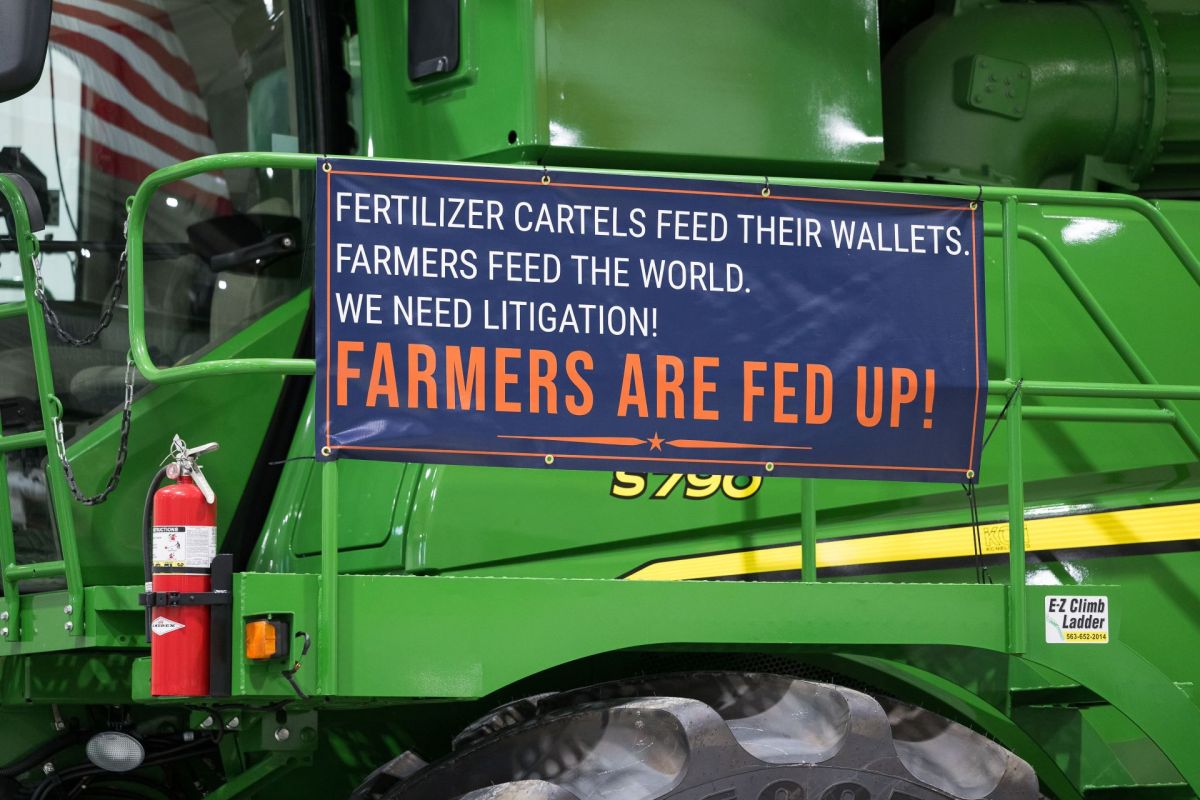
As fertilizer costs continue straining farm budgets, federal officials are asking producers to provide evidence that could underpin a potential antitrust case.
At an Iowa gathering, U.S. Department of Agriculture officials heard from growers in several states who said the market often feels shaped by pressure from dominant sellers rather than by open competition, according to the Iowa Capital Dispatch.
Here's what to know
U.S. Department of Agriculture Deputy Secretary Stephen Vaden went to Iowa to collect firsthand accounts from farmers about industry concentration and fertilizer pricing.
Those accounts are expected to help a Federal Trade Commission investigation into possible unfair pricing and anti-competitive behavior.
The Iowa Corn Growers Association and other agricultural groups hosted the event, and participants were directed to SaveFamilyFarms.US, which allows farmers and others in the industry to submit evidence anonymously.
Vaden noted that anonymity matters because producers may be "reasonably worried about retaliation."
TCD Picks » Quince Spotlight
💡These best-sellers from Quince deliver affordable, sustainable luxury for all




Speakers returned to that fear repeatedly.
Linda Thrasher, co-founder of Greenfield Nitrogen, said her farmer-created company spent 12 years trying to secure enough off-take commitments to open a 300,000-ton Iowa anhydrous ammonia facility, but potential partners worry about being "blackballed" by major suppliers.
"They're scared," Thrasher admitted. "I think the intimidation is very real."
Because fertilizer is a major input in food production, its price directly affects family farms' survival.
When a small group of companies can effectively set prices, margins are squeezed, bankruptcies accelerate, and effects reverberate through rural communities and grocery costs.
More background
Farmers and other industry participants described a market so concentrated that buyers have almost no bargaining power.
Steve Kuiper, president of the Iowa Corn Growers Association, alluded to a market with "so few sellers" that there is no "shopping around."
"Farmers are simply told the price, and you're forced to take it," Kuiper explained.
Kuiper called the situation "dire" and "unlike anything we have seen since the '80s."
Figures cited by the Iowa Capital Dispatch from SaveFamilyFarms.US show that Iowa farm bankruptcies are up 220%.
Farmers at the event warned that fertilizer is only one piece of their overall cost structure, but that rising input prices are intensifying already severe financial strain.
Speaking to reporters, Vaden acknowledged that some of the accusations sounded "like we're talking about 'The Godfather,' not the fertilizer market."
"You don't have to be an economist and you don't have to be a lawyer to hear what we have heard today and realize something's not right," he added.
What's being done?
Officials said the federal response is not limited to the investigation.
Alongside the FTC effort, the USDA is supporting steps meant to increase domestic fertilizer production and weaken the grip of dominant suppliers.
As examples, Vaden pointed to new fertilizer projects in Louisiana, including what he said would be the first newly built U.S. phosphate plant since 1984, as well as a large ammonia plant.
He also said the administration suspended countervailing duties on Moroccan phosphate fertilizer imports to increase supply and lower prices.
The department has also launched the Fertilizer Investment & Expansion for Long-term Domestic Supply program, or FIELDS, a $500 million initiative meant to support new or expanded facilities owned outside the dominant fertilizer companies.
Iowa Attorney General Brenna Bird likewise encouraged producers to document their experiences and submit evidence.
Vaden said there is no specific end date yet for a Justice Department case and that officials are trying to build one around firsthand accounts from farmers.
"The reason why I am here with you today and am so interested in being here and listening to what you have to say, is we all know something hasn't been right in the fertilizer market," Vaden told farmers. "We all know that it's not really a free market."
Where can I learn more?
For more context, these articles explore pressures associated with fertilizer and corporate oversight, from the damage caused by runoff to rising scrutiny of business claims.
They help explain why farmers and federal officials want a closer look at input markets and industry behavior.
• In the Gulf of Mexico, runoff fuels a dead zone, underscoring fertilizer's wider consequences.
• In the U.S. and Europe, officials are moving to curb greenwashing as scrutiny of corporate claims grows.
• At Inditex, carbon pollution increased after shipping changes, prompting backlash over environmental commitments.
From fertilizer prices to pollution and corporate claims, the throughline is the same: when oversight falls short and power is concentrated, farmers and the public can end up bearing the cost.

Get TCD's free newsletters for easy tips, smart advice, and a chance to earn $5,000 toward home upgrades. To see more stories like this one, change your Google preferences here.






