


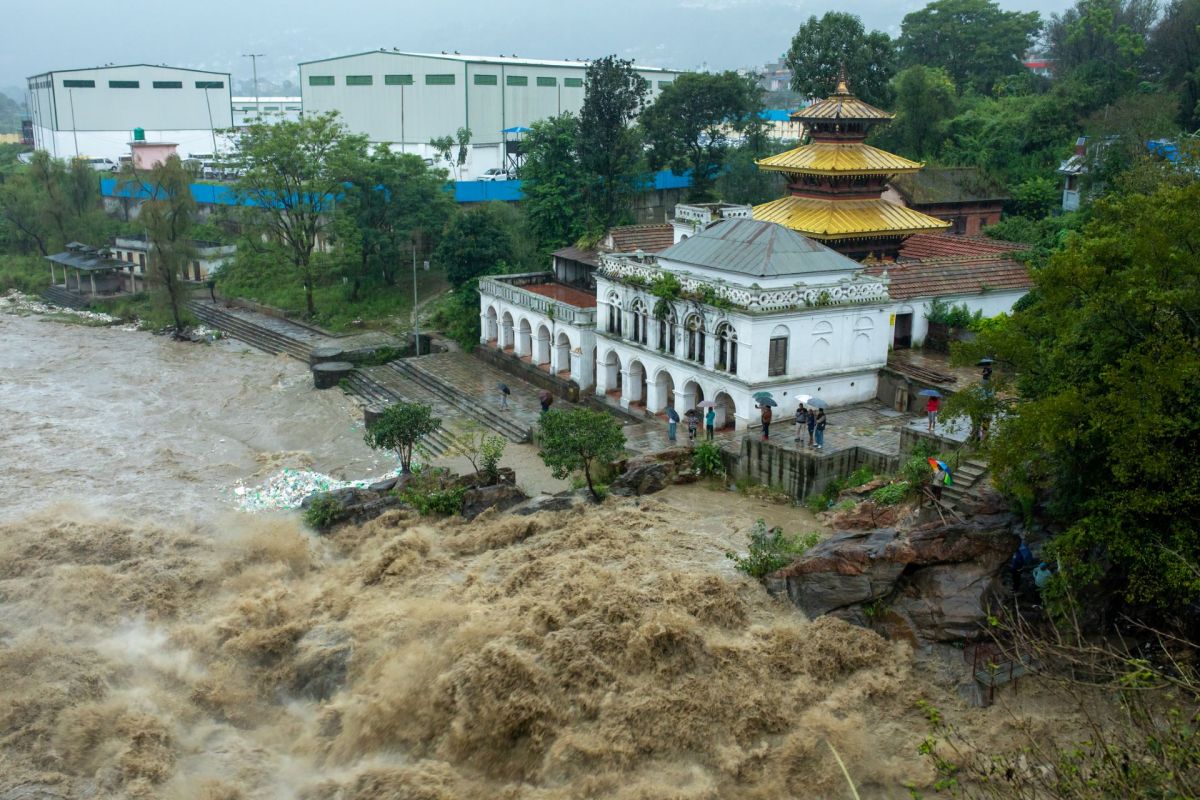
After catastrophic flooding in mountain communities, Nepal is seeking $20 million in climate compensation, pointing fingers at countries it holds responsible for global warming.
Here's what to know
Late-August floods and landslides left more than 6,000 people dead or missing, according to The Guardian. More than 1,300 deaths had been confirmed, and after 12 days of rescue work, there was little remaining hope for the roughly 5,500 people still unaccounted for. Nepal has asked the U.N. for $20 million in disaster relief.
The devastation followed a partial glacier collapse that unleashed a deadly landslide and sudden flooding across Chinese-controlled Tibet and Nepal. Shisir Khanal, Nepal's foreign minister, said, "This felt like a tsunami that was coming from the Himalayas. We experienced waves as high as 60, 70 feet, which were mixed with debris, mud, stones, rocks, and came at the speed of almost 180km per hour. Towns, villages and highways were completely wiped out and there are some areas still disconnected."
The foreign minister said the countries most responsible for global warming cannot keep ignoring the damage falling on nations that have contributed almost nothing to the crisis. Despite producing less than 0.1% of global greenhouse gas emissions, Nepal is in a region warming at nearly one-and-a-half times the global average. The U.N. said in 2023 that Nepal's mountains had lost nearly a third of their ice over a little more than 30 years.
More background
Khanal said the $20 million request represents only a fraction of what Nepal will ultimately need. He acknowledged that the amount sought is "obviously not nearly enough to cover the damage that we have sustained," with some estimates putting total losses above $5 billion.
More than 20,000 homes may need to be rebuilt, along with the main highway, and river communities in exposed areas could have to move to higher, safer ground.
TCD Picks » Quince Spotlight
💡These best-sellers from Quince deliver affordable, sustainable luxury for all




The U.N. says the loss and damage fund created in 2022 under the Paris climate agreement is facing a major financing shortfall. Requests total about $2.8 billion from roughly 119 countries, while contributions amount to only around $400 million. The United States has given just $17 million.
What's being done?
Beyond immediate emergency relief for Nepal, Khanal called for stronger international support for preparedness and climate-risk mitigation, arguing that recovery funding alone will not protect communities from the next catastrophe.
Khanal said he was in talks with China about improving coordination and data sharing for the Himalayan region after the glacier collapse. He also pushed back on claims that China had withheld adequate warning or data, saying neither Nepalese nor Chinese scientists knew in advance that the collapse was imminent.
Khanal said, "The global community should not see this as one-off disaster; it should be viewed in the context of the changing climate in the Himalayas. We know it is going to be a recurring scenario that more and more communities, not just in Nepal but around the world, will have to face."
Where can I learn more?
Nepal's crisis is a prime example of a country that did little to drive global warming yet bears some of its worst costs. These articles look at that same divide, from rising glacier-flood risks in the Himalayas to mounting estimates of what wealthy consumers and major emitters should pay for climate damage.
• Across the Himalayas, growing threats in the Himalayas could send catastrophic waves from swollen high-altitude lakes.
• The world's richest consumers owe up to $5.7 trillion for climate and biodiversity damage.
• Worldwide, the cost of intensified natural disasters is climbing as warming worsens losses.
• In the Solomon Islands, climate damage is costing nearly 9% of GDP each year.
These stories make clear that without stronger prevention and more funding, disaster losses will keep outpacing recovery efforts.

Get TCD's free newsletters for easy tips, smart advice, and a chance to earn $5,000 toward home upgrades. To see more stories like this one, change your Google preferences here.






