


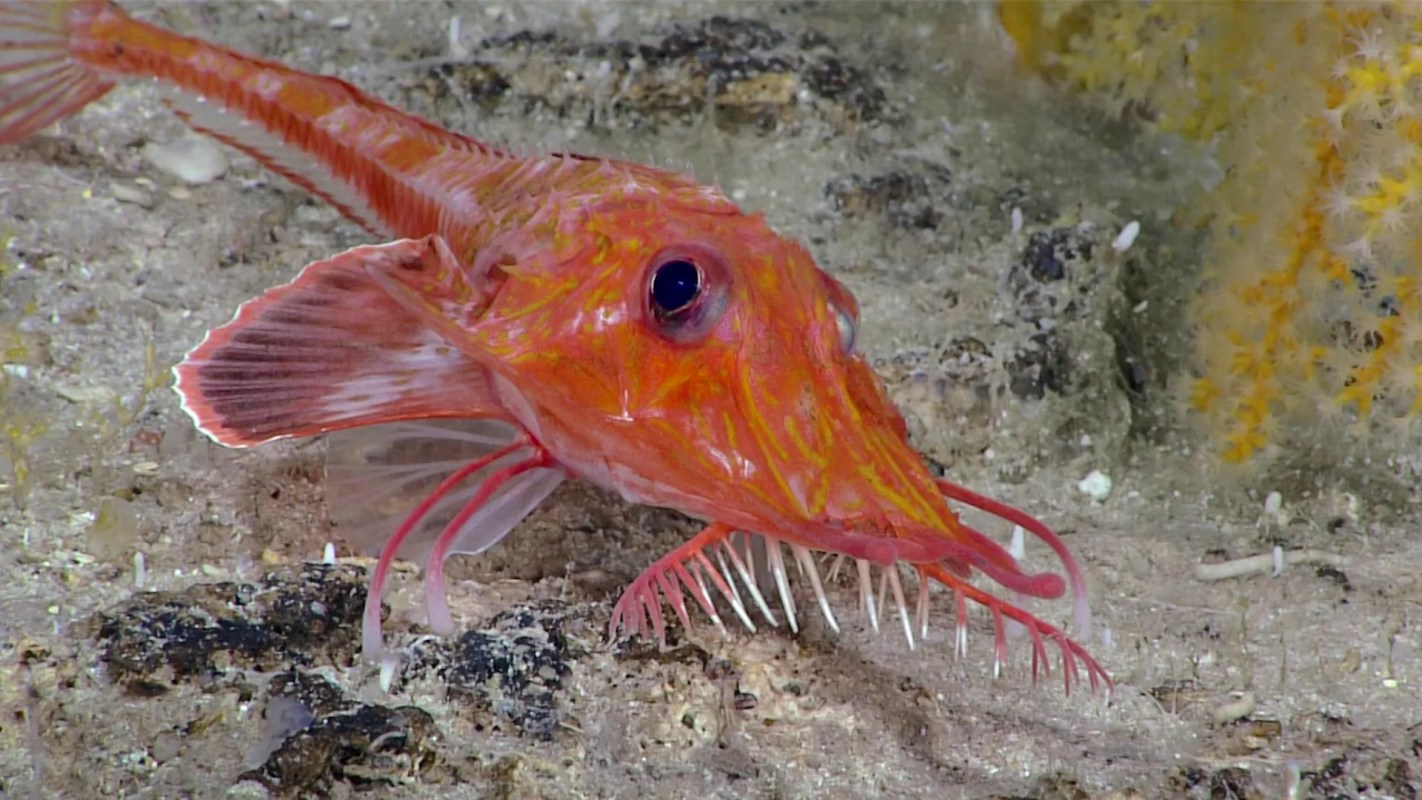
A deep-sea fish that already seems as though it belongs in science fiction has revealed yet another surprise: It can "walk" backward.
Using footage collected by a research team in China, scientists documented what appears to be the first known video of a fish using leg-like fins to move in reverse along the seafloor — a reminder of how many deep-sea behaviors remain unseen.
Here's what to know
Known as Scalicus engyceros, the animal belongs to the armored searobins, a group marked by bony body plates and detached pectoral fin rays that act almost like small legs. According to Popular Science, researchers captured the behavior with a deep-sea diving vehicle in the northern South China Sea, in what they described as the first reported case of a fish moving backward.
Reported in the journal Ocean-Land-Atmosphere Research, the study includes footage of the shrimp-like fish traveling across the seafloor and adds to scientists' understanding of how some species navigate extreme underwater habitats.
In a statement, Han Tian, a postdoctoral researcher at Sun Yat-sen University in Guangzhou, said: "[Our] study delivers a paradigm-shifting revelation: the deep-sea fish Scalicus engyceros, a representative of fishes characterized by highly specialized free pectoral-fin rays, is among the few fish species known to walk."
The footage also revealed a rake-like barbel projecting from the fish's body. Researchers said the structure seems to make walking awkward, even though it likely gives the animal "an advantage in probing, digging, or hunting for food buried in the sediment."
TCD Picks » Quince Spotlight
💡These best-sellers from Quince deliver affordable, sustainable luxury for all




More background
Deep-sea animals often evolve unusual traits because they survive in cold, dark, high-pressure environments that humans rarely have a chance to observe directly. In this case, the armored searobin also has unusually large eyes, another clue to how it manages life far below the surface.
Researchers said the fish appeared unbothered by the vehicle's approach, but it seemed to react to the vehicle's light before swimming away. That response suggests the species may still retain some sensitivity to light.
This fish was observed only because researchers sent a lit vehicle into one of the darkest ecosystems on Earth.
Deep-sea ecosystems face pressure from industrial activity, pollution, and warming waters even as scientists are only beginning to understand some of the species that live there.
What's being done?
Watching animals in their natural habitat can reveal behaviors that preserved specimens would otherwise never show, including how they move and how they respond to disturbances such as light. In the case of Scalicus engyceros, this linked a strange-looking preserved specimen to a living animal with an entirely new documented behavior.
Tian said, "Modern deep-sea diving vehicles allow not only discovery of new species but also add a new in situ, functional dimension to the study of species based solely on the morphology of preserved specimens."
He added, "By observing deep sea animals alive in their surrounding environment, we can gain insight into the adaptation and evolution of the species."
Where can I learn more?
Rare ocean footage is giving scientists and the public a clearer look at life underwater, from strange deep-sea movements to surprising encounters closer to shore. Each of these stories echoes the armored searobin video: Marine animals still do things researchers don't expect until a camera happens to catch it.
• Off Taiwan, divers captured footage of a rare oarfish as it drifted near the surface.
• In warming seas, scientists found female angel sharks gathering where cooler waters persist.
• Near Spain, killer whales are targeting watercraft in a rare behavior tied to humans.
• In British Columbia, a filmmaker's camera caught a giant octopus approaching directly underwater.
• On a California beach, a round stingray lashed out after a tourist grabbed it.
That's why seeing animals in the wild matters so much underwater. As scientists and cameras reach farther into these habitats, even familiar marine life keeps revealing behavior that feels newly discovered.

Get TCD's free newsletters for easy tips, smart advice, and a chance to earn $5,000 toward home upgrades. To see more stories like this one, change your Google preferences here.






