


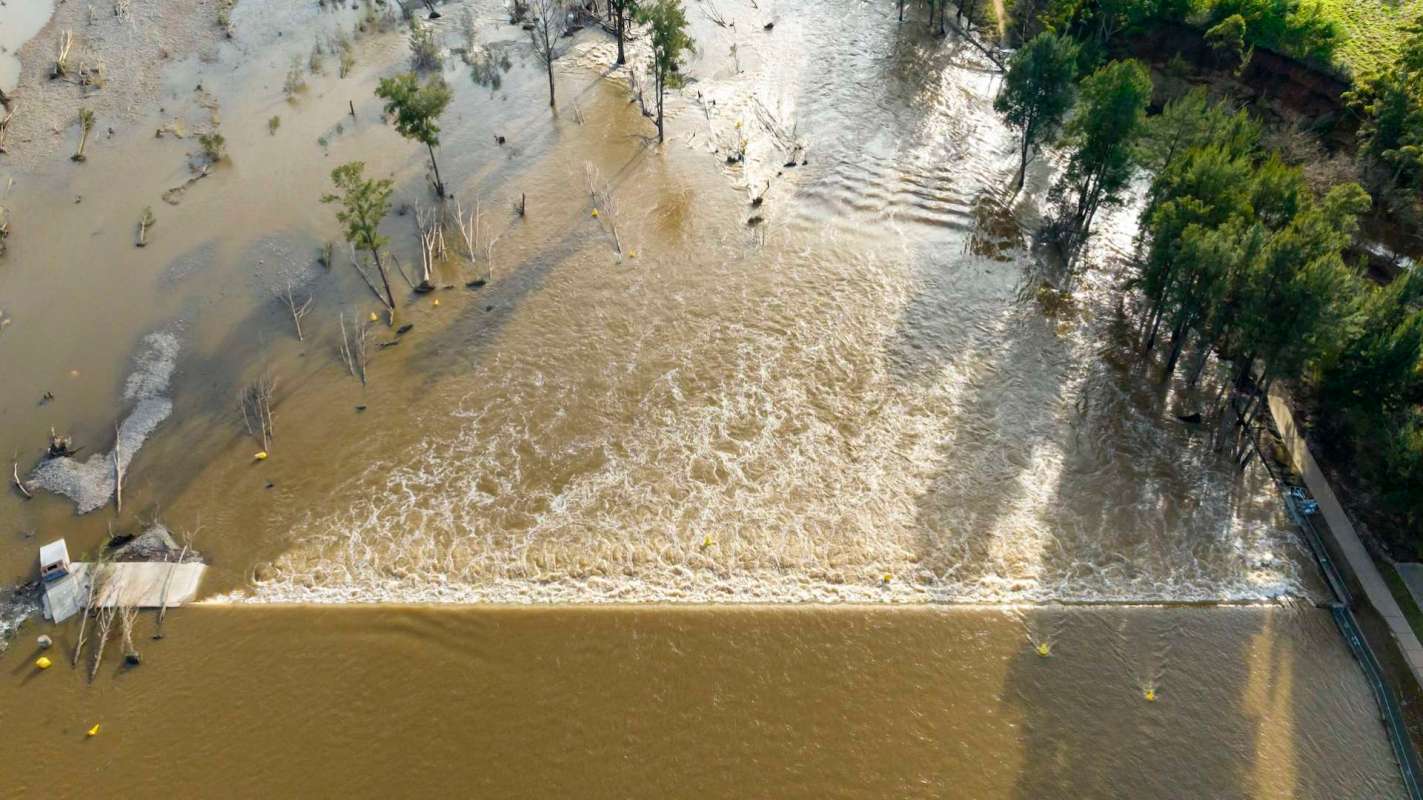
As Australia's sea levels rise, safe land is disappearing, and the consequences are not cheap.
Here's what to know
Australia's rising seas are no longer a distant warning for people living and working along the coast. By 2100, coastal flooding could damage more than 267,000 properties in Australia as well as 2 million hectares (4.9 million acres) of land, according to a Climate Council report cited by The Guardian.
The report puts the total economic toll at $855.1 billion, including $274.3 billion tied to property damage and $580.7 billion in land-use losses.
Grazier Peter Lake in New South Wales' Clarence Valley is already experiencing the fallout.
Since 2009, flooding has hit Peter Lake's farm five times, reducing the amount of ground that stays above water during major events. The cattle property lies beside the Coldstream River in the Yamba-Grafton area, and Lake told The Guardian that when he moved there in 2007, he understood he was "buying in flood country with … eyes open."
The 2022 flood left almost none of that refuge. "We only had just a few acres of flood-free land," Lake said. He added that repeated flooding, along with drought, has also made it difficult to produce feed: "We just haven't been able to successfully grow a fodder crop for some years."
TCD Picks » Quince Spotlight
💡These best-sellers from Quince deliver affordable, sustainable luxury for all




More background
Urban losses are expected to concentrate on the Gold Coast, Brisbane, and Melbourne, with the Gold Coast alone facing $84.4 billion in projected damage, The Guardian summarized from the report, which also places Queensland, New South Wales, and Western Australia atop the list for total at-risk properties.
Using localized projections from 239 hotspots around Australia, the report modeled sea-level rise and storm surges under what's known as RCP4.5. This pathway would mean about 2.7 degrees Celsius (4.9 degrees Fahrenheit) of warming by the end of the century.
Professor Tom Kompas of the University of Melbourne was among the report's co-authors and said the estimate should be seen as conservative because it does not account for coastal erosion or major ice-sheet melt. He also warned that losses affecting 619,713 hectares (around 1.5 million acres) of farming land could create food security concerns.
What's being done?
Global sea levels have already risen more than 8.7 inches (22 centimeters) since 1900, and Australia could see another 5.5 inches (14 centimeters) by 2050.
That would make tidal flooding and permanent inundation increasingly common, The Guardian reported. For Lake and his farmland, it means long-standing flood-preparation strategies may no longer be enough.
"If we're going to have more frequent and more severe major events … we need to change the way we think about how we manage," Lake said. "If rising sea levels impact on us, it'll just make property less and less viable."
For Kompas, the top priority is cutting greenhouse gas pollution to curb global heating. "We have to start planning and responding and adapting now," he said, according to The Guardian. "The nice thing about the work is it shows where the hotspots are and what … assets will be impacted. So we can start to plan for how to deal with that. The first thing, of course, is not to build on floodplains, which is common still."
Where can I learn more?
Rising seas and heavier floods put pressure on coastal communities in different ways. The articles here look at how that plays out in forced relocations, business costs, deadly disasters, and places already losing land and resources that people rely on.
• Across coastal communities, forced relocations are becoming a reality as climate risks intensify.
• Across Europe, flood risk is raising borrowing costs for small businesses.
• In Libya, deadly floods are becoming more destructive as global warming loads the atmosphere.
• In Vanuatu, rising seas are eroding resources that communities depend on every day.
• From Alaska to Maine, climate threats are arriving sooner and costing far more.
Climate shifts are changing where people can live, work, and rebuild. They also underscore the urgency of adapting sooner and making smarter land-use decisions.

Get TCD's free newsletters for easy tips, smart advice, and a chance to earn $5,000 toward home upgrades. To see more stories like this one, change your Google preferences here.






