


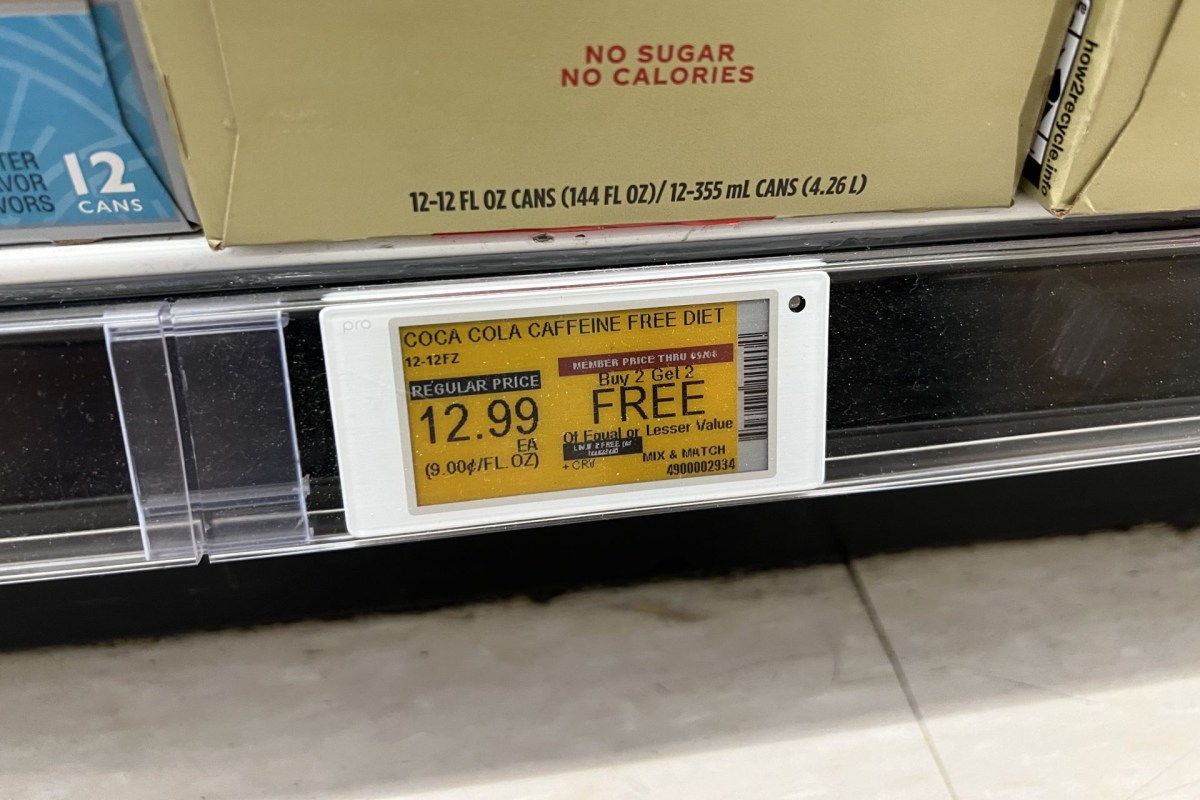
A supposedly simple swap to digital price tags in stores could have more significant impacts, with a new labor report saying the technology could affect both grocery workers and shoppers.
Electronic shelf labels give major grocery chains a way to cut labor time, shrink workers' pay, and update prices at a pace store employees cannot match.
Here's what to know
As Common Dreams reported, a report from the AFL-CIO Tech Institute said electronic shelf labels, or ESLs, are being sold to grocers as more than a convenience. The technology is also being promoted as a way to automate tasks and lower staffing costs.
To make its case, the researchers relied on company studies from Pricer and Vusion Group. Vusion acknowledged in 2024 that its system saved about 600 labor hours over six months, or roughly 1,200 hours a year, while Pricer reported in a 2022 study that one store cut around 5,200 worker hours annually by automating price changes.
The AFL-CIO then used U.S. Bureau of Labor Statistics figures to project what those reductions could mean nationwide.
If similar reductions were spread across nearly 60,000 grocery stores in the U.S., the report estimated a loss of 71 million to 308 million worker hours a year, equal to 44,000 to 192,000 full-time jobs and $1.61 billion to $6.97 billion in annual wages based on hourly pay data.
TCD Picks » Quince Spotlight
💡These best-sellers from Quince deliver affordable, sustainable luxury for all




Ademola Oyefeso, an international vice president of the United Food and Commercial Workers International Union, warned that the industry's promises about the labels obscure what workers are likely to face.
"Grocery giants like to claim that electronic shelf labels will free up workers to serve customers directly, but this report shows this is not the case," Oyefeso told Common Dreams. "Using studies and marketing material from the manufacturers pushing the technology, we know ESLs could actually cost workers and their families billions of dollars in lost income."
More background
Jobs are only part of the dispute over ESLs. Lawmakers have also questioned whether the technology could make it easier for retailers to charge shoppers more.
Democrats in the U.S. House and Senate have proposed legislation to ban "surveillance pricing," in which companies use personal data to set prices for individual consumers.
The report said versions of that approach have already shown up online, from grocery delivery to airline tickets.
Labor groups have said the next step could be bringing that kind of fast-changing pricing into brick-and-mortar stores, especially as facial recognition and other surveillance tools become more advanced.
Sunny Glottmann, a policy and programs manager at the AFL-CIO Tech Institute and a co-author of the report, detailed some of its findings.
"Through our analysis, we found that the implementation of electronic shelf labels are likely going to drive prices even higher," she explained, per Common Dreams. "The reason being that these labels are connected to the same algorithmic pricing software that online retailers are already using."
"Electronic shelf labels create the infrastructure that would make rapid algorithmic price changes easier to implement at scale, and this raises concerns for consumers that are already struggling with grocery costs."
What's being done?
Several states have already taken action on at least one part of the issue. Connecticut, Maryland, and New Jersey already prohibit some surveillance pricing practices, and other states are considering similar restrictions.
Still, unions including the AFL-CIO and UFCW have argued that those efforts do not go far enough because they address only one possible abuse. They maintain that the labels themselves create an underlying system that enables both labor cuts and faster price manipulation.
"Policymakers should ban ESLs outright, rather than rely on narrower disclosure or dynamic-pricing laws that leave the underlying technology in place," the AFL-CIO report stated.
It also cited New Jersey's one-year pause on the technology as a possible model.
Where can I learn more?
Questions over electronic shelf labels are part of a much wider debate about what grocery labels mean for workers, prices, and food waste.
Lawmakers, shoppers, and brands are already wrestling with the information attached to food and packaging in stores.
• In 2024, California passed the first statewide rules standardizing date labels to reduce food waste.
• Shoppers are rethinking thin produce bags as another persistent grocery-store waste problem.
• Brand experts warn that misleading label claims make sustainable shopping harder.
• Consumers are learning how packaging symbols and labels can obscure real sustainability standards.
Small changes to store labeling can have ripple effects for workers, shoppers, and waste. That's part of why electronic shelf labels are drawing attention for more than just the price on the screen.

Get TCD's free newsletters for easy tips, smart advice, and a chance to earn $5,000 toward home upgrades. To see more stories like this one, change your Google preferences here.






