


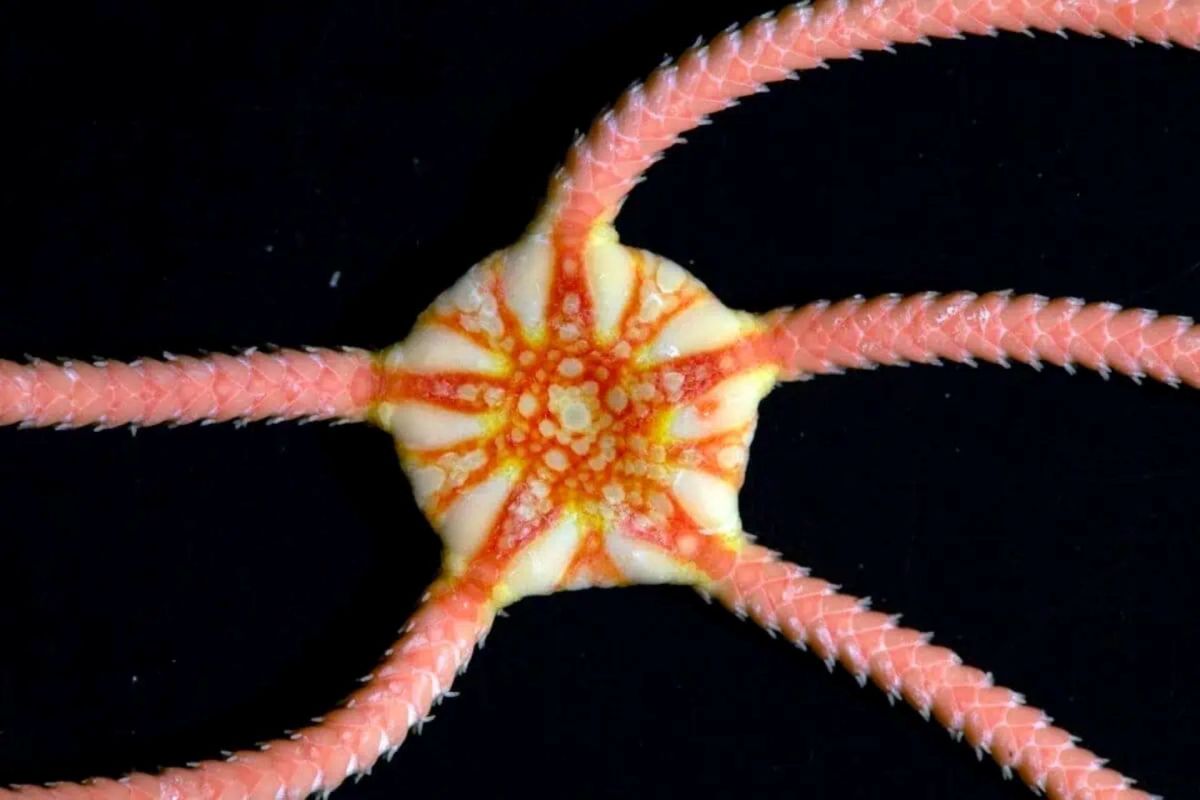
In a sparsely studied stretch of the Indian Ocean near Australia, researchers examining ancient underwater volcanoes identified 149 species never before described.
The species turned up on deep seamounts off Christmas Island and the Cocos Islands, helping close what scientists have called a major blind spot in knowledge of the Indian Ocean seafloor.
Here's what to know
According to Good Good Good, drawing on Mongabay's original reporting, a deep-ocean survey of Indian Ocean seamounts found 1,059 species in total, including 149 that were new to science. The findings appeared in June in Deep-Sea Research Part II: Topical Studies in Oceanography.
The team worked around isolated undersea mountains southwest of Indonesia, between Australia and Sri Lanka, and sampled waters from 308 feet down to 17,818 feet.
Tim O'Hara, the study's lead author and a scientist at Museums Victoria in Melbourne, told Mongabay that no previous deep-ocean research had been conducted in that area.
"People had been around the islands in shallow water before, but no one had looked at life in the deep. It was a massive hole in the data," O'Hara said.
TCD Picks » Quince Spotlight
💡These best-sellers from Quince deliver affordable, sustainable luxury for all




The newly identified organisms included a sea cucumber in the genus Oneirophanta, a greeneye fish from the family Chlorophthalmus, and a parasitic barnacle from the genus Rhizolepas.
More background
Roughly one-fifth of the world's ocean area lies in the Indian Ocean, and about 90% of that basin extends deeper than 3,280 feet.
Scientists still know far less about deep-sea life there than they do in the Atlantic or Pacific. The seamounts in the central eastern Indian Ocean have received especially limited study.
Seamounts can act as underwater oases. Rising thousands of feet above the seafloor, they alter currents and can concentrate nutrients, creating conditions filter feeders and other marine life depend on.
Jim Barry, a senior scientist at the Monterey Bay Aquarium Research Institute who was not involved in the study, told Mongabay that seamount currents can benefit filter feeders.
"If you're on a seamount, as this current is coming by and hits the seamount, that flow accelerates across the top," Barry said. "If you're a filter feeder that needs food, you may be able to optimize feeding by positioning yourself in an area where the currents are faster."
Researchers also mapped previously unknown features, including a caldera nicknamed the Eye of Sauron because it resembles an eye.
One especially memorable trawl brought up about 1,000 shark teeth, including Megalodon fossils, spanning more than 22 million years of evolution.
What's being done?
The findings give scientists a baseline for ecosystems that could face growing pressure from climate change, overfishing, marine heatwaves, and deep-sea mining.
Researchers also found polymetallic nodules, mineral-heavy rocks valued for uses such as electric vehicle batteries and wind turbines.
Australia approved the expedition in 2020 to better understand biodiversity before the area became the Indian Ocean Territories Marine Parks.
A custom-built research vessel, the RV Investigator, made the mission possible and let Australian teams study offshore waters far deeper than they'd reached before.
O'Hara told Mongabay that researchers are exploring seamounts in the Coral Sea Marine Park, while a German research vessel is examining seafloor structure near New Zealand.
Barry told Mongabay, "I am just amazed that every time we go somewhere and look carefully, we discover so many new species in the deep sea. One of the surprises to me was all the fish."
Where can I learn more?
This finding is part of a recurring pattern in deep-ocean research: when scientists reach remote seamounts and polar waters, they keep turning up life no one had documented before. Similar expeditions off Australia, in the southeast Pacific, and in Antarctic seas underscore how much of the ocean's biodiversity is still uncharted.
• Off Australia, scientists discover over 100 new species while racing to document fragile deep-sea ecosystems.
• In the southeast Pacific, every single seamount had a distinct ecosystem thousands of feet below.
• Across the world's oceans, explorers uncover hundreds of never-before-seen species in a sweeping marine census.
• A historic deep-sea expedition revealed over 1,000 new ocean species in remote underwater habitats.
• During Antarctic sea exploration, researchers uncovered new species and untold biodiversity beneath increasingly vulnerable waters.

Get TCD's free newsletters for easy tips, smart advice, and a chance to earn $5,000 toward home upgrades. To see more stories like this one, change your Google preferences here.






