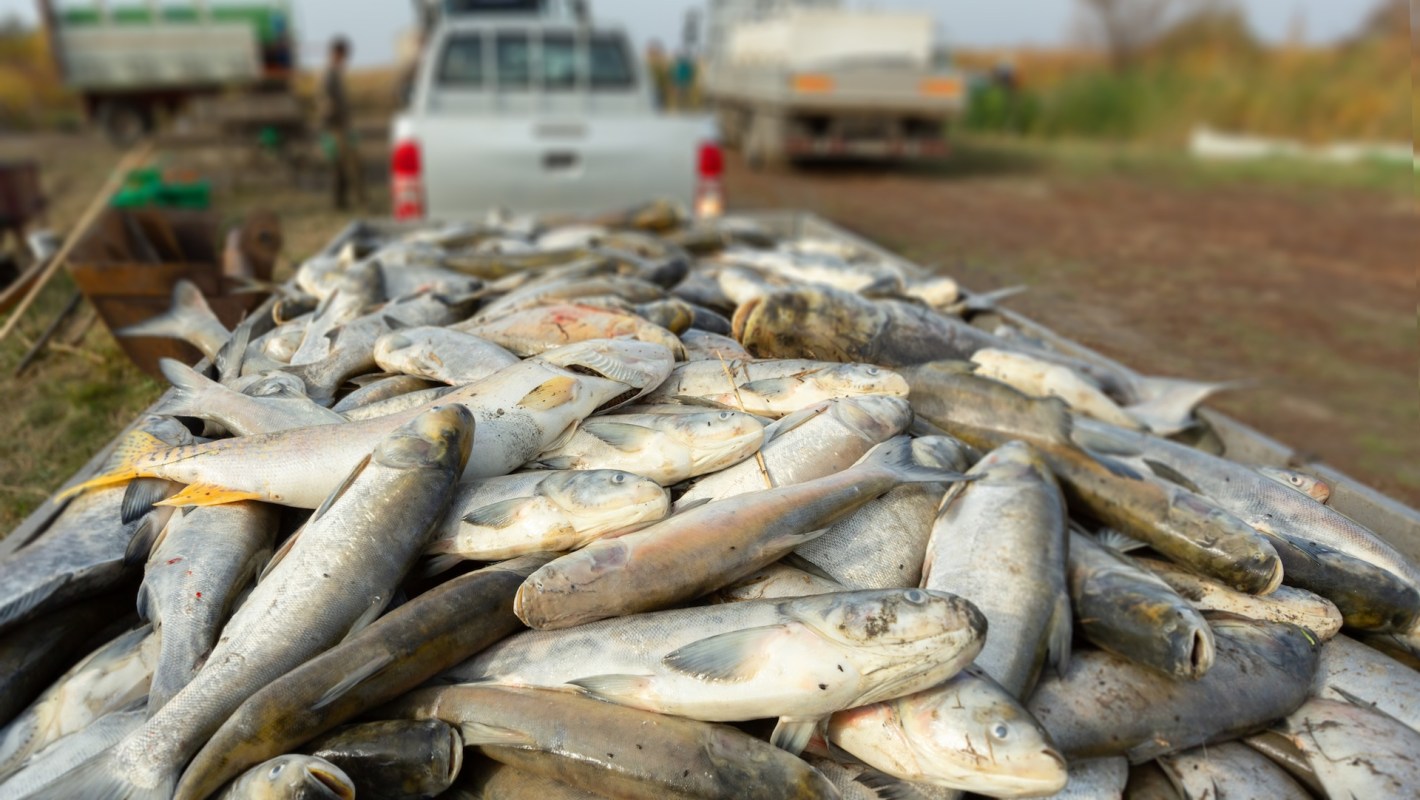
A drought-driven fish kill at one of Hungary's biggest fish farm complexes has shown how extreme heat and water shortages can harm food production, local livelihoods, and wildlife areas protected at the highest levels in Europe.
The crisis unfolded at Rétimajor, south of Budapest, where receding water across the wetland system influenced the deaths of hundreds of tons of fish. The same landscape is also a refuge for rare birds and amphibians.
Here's what to know
In August, the Rétimajor fishponds lost several hundred tons of fish at a 1,980-acre (800-hectare) network of shallow lakes and reedbeds in the former Sárrét marshlands.
As Euronews reported, the damage affected both a business and an important ecological sanctuary.
According to Ferenc Lévai, who owns the aquaculture farm Aranyponty Zrt. and serves as its chief executive, low inflows left large sections of the site in severe distress.
"Around 150 hectares of our area are already dry, on another roughly 400 hectares the fish are eking out an existence in 30 to 40 centimetres of water, because they are not really living, and it is only on about 200 to 250 hectares that we have more than half the normal depth, where proper fish farming can take place," he told Euronews.
TCD Picks » Quince Spotlight
💡These best-sellers from Quince deliver affordable, sustainable luxury for all




Lévai estimated that about 331 to 386 tons (300 to 350 tonnes) of fish died, causing losses of around 400 million to 500 million forints, or roughly €1.1 million to €1.4 million.
The consequences are not limited to the farm, because the Rétszilasi Lakes area is protected under both Natura 2000 and the Ramsar Convention. Euronews said that Ramsar status recognizes it as an internationally important wetland.
More background
Lévai said water allocation was part of the problem, arguing that the site could not even keep the ecological minimum level needed to leave at least half its surface covered. In his view, upstream irrigation demands were given priority while the fishponds — and the wildlife that depend on them — were not.
The water authority, the Central Transdanubian Water Directorate, stated that it complied with drought restrictions imposed from July 26.
According to Euronews, those rules allowed fishpond water use to be cut by up to 20% and irrigation by 60%. It also said no water had been withheld. Instead, the authority pointed to extreme heat as the underlying cause of the disaster.
In August, officials sent about 311.7 million gallons (1.18 million cubic meters) from the Fehérvárcsurgó reservoir into the ponds over a two-week period, according to Euronews. Even so, they estimated that the ponds may have been losing about 26.4 million gallons (100,000 cubic meters) per day to evaporation across the 1,980-acre (800-hectare) water surface.
That mix of falling water levels and soaring temperatures proved deadly. As the water grew warmer and shallower, gas buildup accelerated, and emissions from the sludge killed the fish.
What's being done?
Lévai said he is less focused on assigning blame than on preventing another collapse. His proposed solution is for crop-growing businesses to create their own reservoirs so they can store water during wetter periods instead of competing for the same supplies during drought.
The water authority said it is also taking a look at the system, reviewing the area's hydrological conditions along with water reserves already committed to existing users and permits.
"We were unable even to maintain that 50% level: the extent of evaporation and the inadequate water supply led to a catastrophe," Lévai said.
Where can I learn more?
What happened at Rétimajor is part of a wider issue with freshwater shortages. Drought, extreme heat, and strain on water systems can put pressure on fish habitat in rivers, rescue efforts, and fish farms alike, with possible consequences for biodiversity and food production.
• Globally, freshwater fish have plunged 83% since 1970 as rivers dry out.
• Worldwide, a quarter of freshwater fish now face extinction from overlapping pressures.
• At Tennessee Aquarium, biologists rescued endangered fish from shrinking streams before drought killed them.
• In Iceland, thousands of escaped salmon showed how fish farms can imperil wild waters.
Seen alongside those stories, Hungary's losses reflect the wider strain on freshwater systems. They also help explain why preventing the next collapse will take more than emergency water deliveries.

Get TCD's free newsletters for easy tips, smart advice, and a chance to earn $5,000 toward home upgrades. To see more stories like this one, change your Google preferences here.