


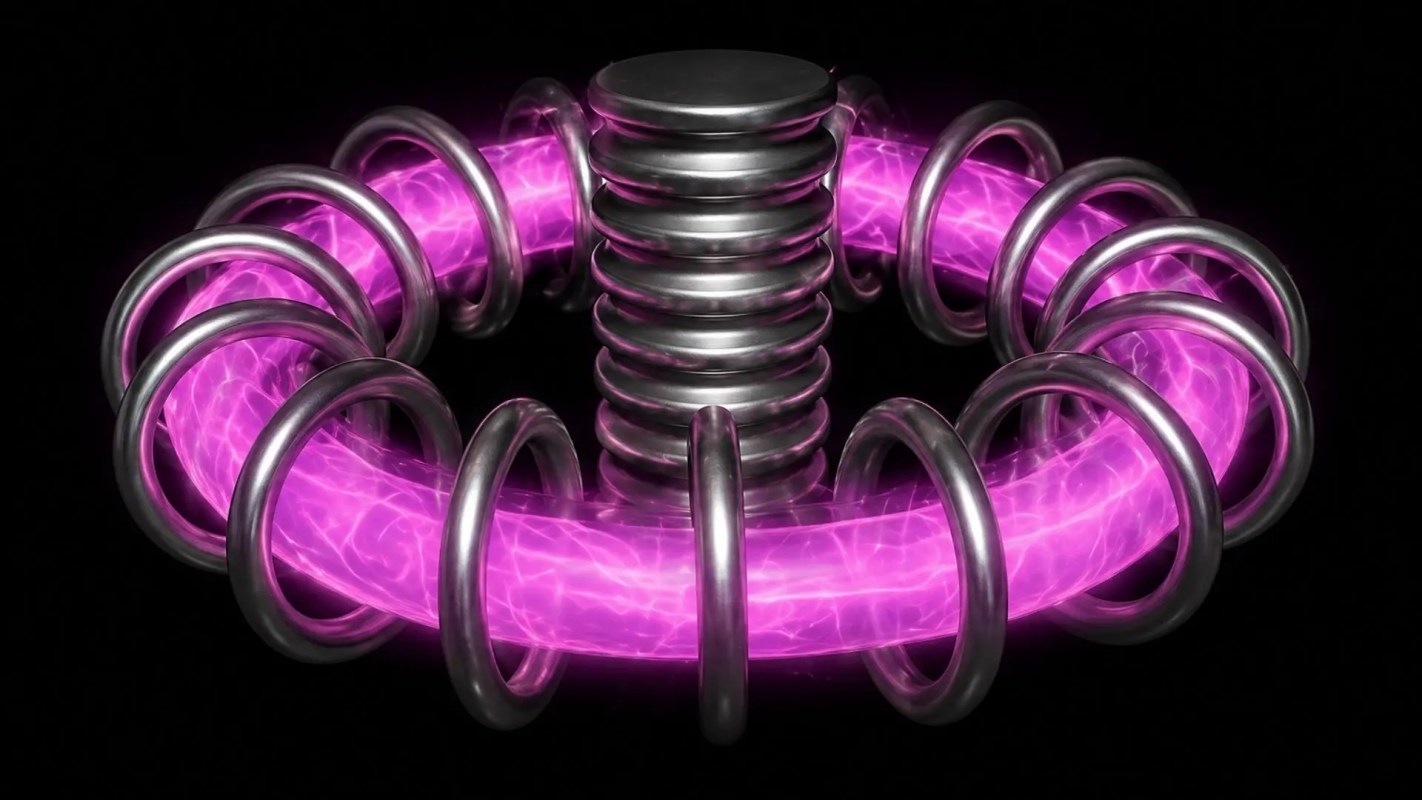
Nuclear fusion firm American Fusion is preparing another round of plasma experiments around its Texatron concept after receiving a portable vacuum vessel.
The system is designed to create extreme plasma conditions through a fusion approach that avoids the huge magnets used in many traditional reactor concepts.
If the company's approach proves successful, it could open another path toward producing large amounts of low-carbon electricity. However, the effort is still in its early stages, and the findings are based solely on theory and lab testing.
Here's what to know
The company says Texatron is being developed as a modular line of systems spanning 1 to 500 megawatts. To support the next series of Texatron Fusion Engine plasma experiments, American Fusion has placed a portable vacuum vessel at its assembly site, according to Interesting Engineering.
Instead of depending on large superconducting magnets to confine plasma for long periods, Texatron uses microsecond pulses of electromagnetic energy to compress a dense plasma column.
The company said tests repeatedly reached internal plasma pressures of 100,000 atmospheres, which is equivalent to about 160 tesla (a strong household magnet is about 0.005 tesla) when a perfectly balanced plasma is achieved (a plasma beta of one).
TCD Picks » Quince Spotlight
💡These best-sellers from Quince deliver affordable, sustainable luxury for all




Using the same modeled plasma conditions, 700 million Kelvin, 100,000 atmospheres, and a one-microsecond confinement time, American Fusion estimated different results for two chamber sizes. Its projections show 1.3x10¹⁵ fusion reactions per pulse for an 11-inch chamber in a 500-kilowatt unit, compared with 1.1x10¹⁶ reactions per pulse for a 23-inch chamber planned for a 5-megawatt device.
Still, American Fusion chief technology officer John E. Brandenburg said no single figure captures fusion performance. "Fusion is ultimately determined by the complete plasma condition — not by any single measurement — and that is exactly why our testing program is progressing methodically from one milestone to the next," he said, per IE.
More background
A high theoretical gross energy output would not automatically mean net electricity generation. As the company noted, achieving net power would still require meeting the Lawson criterion, meaning the plasma's density, temperature, and confinement time must together overcome major losses such as bremsstrahlung radiation.
Fusion has long been seen as a possible source of abundant energy with less climate pollution than fossil fuels, and some approaches may avoid part of the long-lived waste burden associated with today's nuclear technologies. Though the technology is promising, fusion systems are expensive to build, hard to scale, and still far from widespread commercial use.
American Fusion's work also stands out because it is testing deuterium-helium-3 reactions rather than more common fusion fuels. It is another example of companies exploring alternatives that could one day support grid reliability without the same fuel, waste, and safety profile as conventional nuclear power, though those benefits are not guaranteed.
What's being done?
With the new vacuum system in place, American Fusion plans to study plasma behavior across a range of 50 to 200 kiloelectron-volts. The company said it wants to determine whether pulsed magnetic compression can remain stable enough to move toward self-sustaining fusion conditions.
Stability is one of fusion's core challenges. Companies can model impressive power bursts on paper, but the real test is creating repeatable conditions that generate more energy than the system consumes.
Across the industry, researchers are pursuing that goal through several competing designs, including tokamaks, stellarators, laser-based systems, and pulsed concepts such as Texatron. That range of approaches could prove valuable since no single design has emerged.
A future energy mix will likely depend on a combination of sources. Fusion's role, if it reaches scale, will hinge on cost, safety, reliability, and how quickly it can move from experiment to infrastructure.
"Achieving repeatable high-pressure pulsed plasma conditions is an important part of the path we have laid out for the Texatron," Brandenburg said, per IE.
Where can I learn more?
Texatron is one piece of a much broader push to rethink nuclear energy, spanning experimental fusion systems, updated fission designs, and new ways to manage waste. These stories give a sense of where pulsed-plasma research fits in the larger effort to build reliable low-carbon electricity.
• Across the fusion sector, new reactor designs are moving toward smaller, more practical power systems.
• Engineers are turning nuclear waste into glass to improve how radioactive material is stored.
• In France, Calogena is advancing miniature reactors for cities through its small modular nuclear program.
Fusion is just one track in a much wider wave of nuclear innovation. Texatron's plasma experiments are paving the way alongside the many other paths being tested.

Get TCD's free newsletters for easy tips, smart advice, and a chance to earn $5,000 toward home upgrades. To see more stories like this one, change your Google preferences here.






