


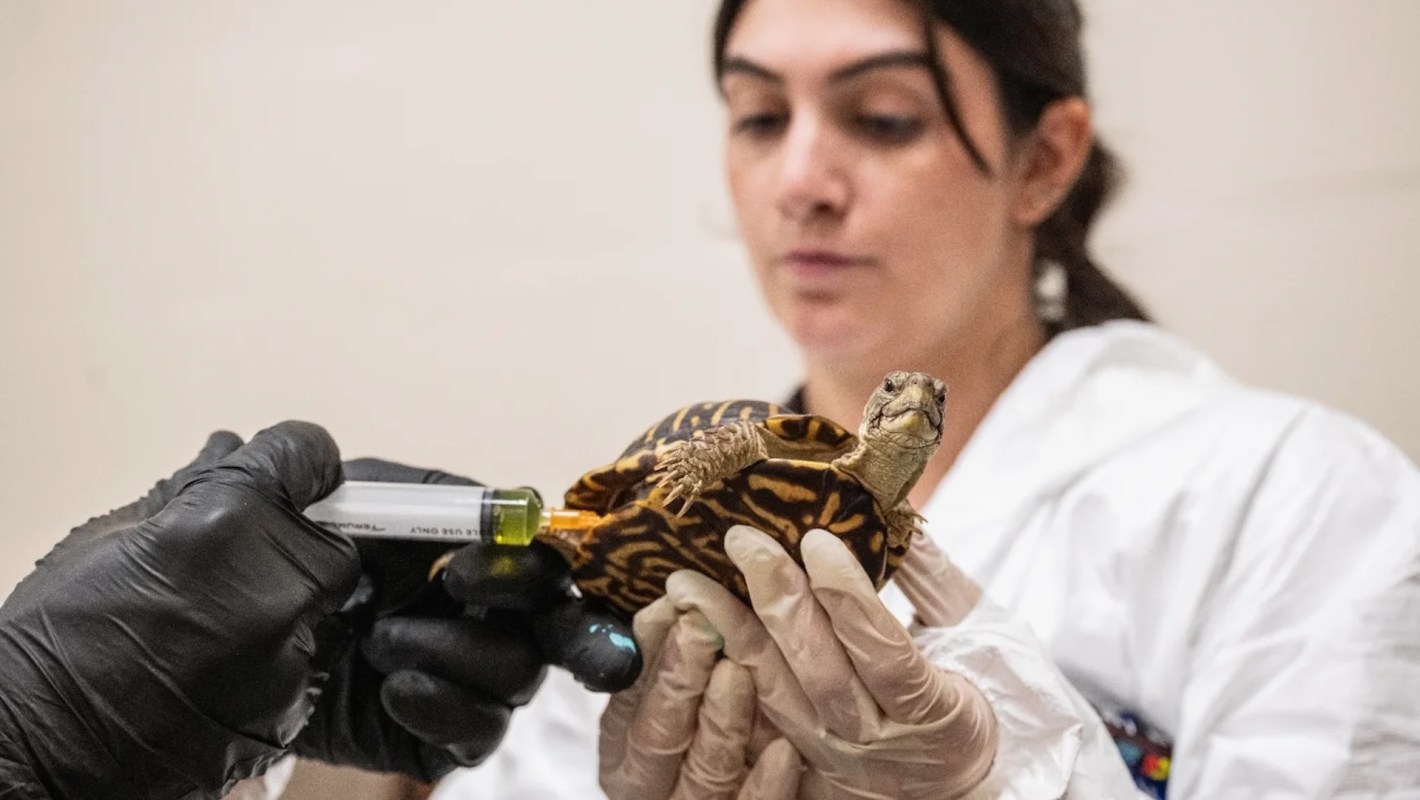
More than 800 North American box turtles taken from traffickers at New York-area airports have been rescued and rehabilitated with help from the Bronx Zoo, marking a grim benchmark in the battle against wildlife trafficking.
Here's what to know
According to Good Good Good, the Wildlife Conservation Society's Bronx Zoo marked the milestone with the United States Fish and Wildlife Service. The zoo has been treating turtles confiscated in the New York area since October 2024.
Officials believe many of the animals were pulled from the wild to supply the international pet market, and zoo staff often receive them in serious condition. "The Wildlife Conservation Society's Bronx Zoo plays a critical role in combating the illegal wildlife trade by partnering with law enforcement agencies to provide triage, quarantine, veterinary care, rehabilitation, and placement for confiscated turtles and tortoises," said Kevin Torregrosa, WCS Bronx Zoo curator of herpetology.
Most of the rescued reptiles have been North American box turtles, including eastern, three-toed, ornate, and Florida varieties. Officials have also intercepted smaller numbers of species such as diamondback terrapins, spotted turtles, and Gulf Coast box turtles.
Some of these animals are protected under international trade rules, while others are protected under state law, including eastern box turtles, which are covered by laws in New York and New Jersey.
More background
Box turtles are slow to recover as a species. They are long-lived animals that mature gradually and reproduce at comparatively low rates, which means wild populations cannot quickly replace adults removed from their habitats.
TCD Picks » Quince Spotlight
💡These best-sellers from Quince deliver affordable, sustainable luxury for all




"Removing large numbers of breeding adults from the wild can devastate local populations," Torregrosa said. "It may take decades — or even generations — for those populations to recover, if they recover at all."
What's being done?
At the Bronx Zoo, each turtle goes through a full intake process. Veterinary teams assess dehydration, injuries, disease risk, weight, species, and sex before administering fluids and other care, then moving the animals into quarantine or rehabilitation.
Not every turtle survives, but many do recover. Once they are healthy enough to move on, they are transferred under USFWS guidance.
As a WCS press release explained, "Depending on the species, health status, circumstances of the case, and legal requirements, animals may be placed with accredited zoological institutions or conservation organizations or, when appropriate and permitted, returned to protected habitat in the wild."
Law enforcement agencies stop the trafficking, while animal care specialists give surviving animals a chance to live.
Demand for wild-caught animals can carry consequences far beyond a single sale.
Torregrosa said, "These efforts not only rescue individual animals but also contribute to broader efforts to combat wildlife trafficking, protect threatened and endangered species, and safeguard wild turtle and tortoise populations."
Where can I learn more?
The Bronx Zoo's work in New York is part of a much bigger story. Turtles are being rescued elsewhere too, including in Madagascar, at sea, and in protected habitats.
• In Madagascar, conservationists at a rescue center are trying to rescue more than 20,000 tortoises.
• At sea, the Coast Guard releases hundreds of baby sea turtles rescued from poachers.
• In the Columbia River Gorge, conservationists set 22 endangered turtles free after captive raising.
• In India, experts release over 100 rare turtles into protected sanctuary ponds.
Each story underscores that the pressure on box turtles in the Northeast is part of a much broader trafficking and conservation crisis. They also show how much coordination it takes — from rescue to rehab to release — to give these animals another chance.

Get TCD's free newsletters for easy tips, smart advice, and a chance to earn $5,000 toward home upgrades. To see more stories like this one, change your Google preferences here.







