


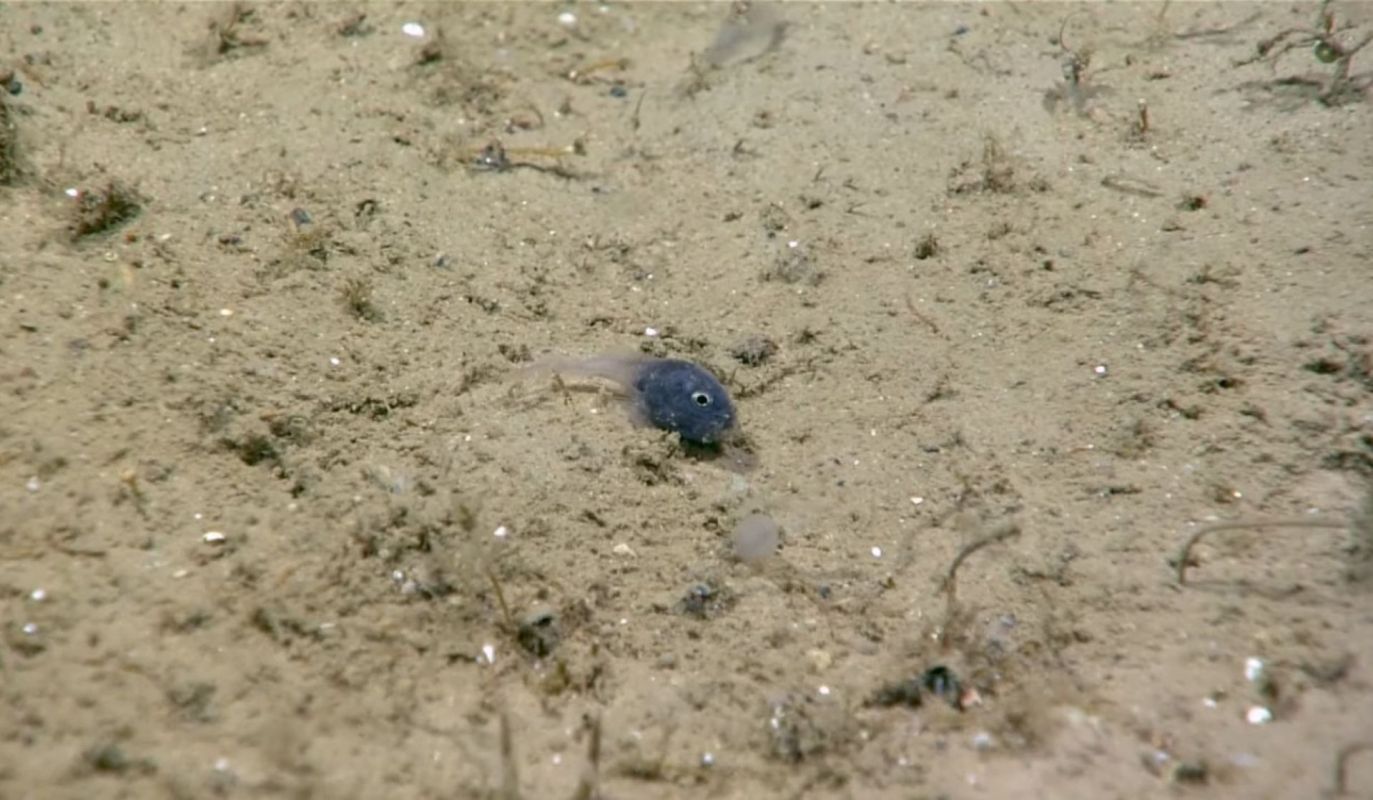
Deep-ocean expeditions still produce encounters that show how much marine life remains undocumented. During one NOAA mission off New England, researchers recorded an exceptionally small fish that scientists still cannot identify with certainty.
Here's what to know
According to Popular Science, the sighting happened during a deep-sea exploration of the Atlantic canyons and seamounts of the U.S. and Canada.
From the footage, NOAA's Ocean Exploration team estimated the animal was about five millimeters to one centimeter long (0.19 to 0.4 inches).
Scientists think the fish may have been a juvenile toadfish, also called a sea toad. Members of that bottom-dwelling predatory group are known for wide faces that can look almost grumpy, and they typically wait on the seafloor for prey to come within striking distance.
More background
NOAA's deep-sea work has continued well beyond the 2019 Atlantic expedition.
The agency completed its 2026 Cook Islands remotely operated vehicle exploration in the Pacific; teams recovered a whale beak and observed glass sponges, among other findings.
TCD Picks » Quince Spotlight
💡These best-sellers from Quince deliver affordable, sustainable luxury for all




Popular Science reported that NOAA is also partnering with Nautilus Live on a 30-day expedition near Wake Island, a highly isolated island roughly midway between the Hawaiian and Mariana Islands.
The mission is using remotely operated vehicles, mapping tools, and the E/V Nautilus to gather baseline data across a 157,236-square-mile area.
What's being done?
With ROVs and advanced mapping systems, researchers can explore habitats that are too deep or too remote for conventional diving. These tools also allow teams to collect images, samples, and environmental data while causing less disturbance than older methods.
That work can help support better marine management, especially in protected areas such as national monuments. The more scientists learn about species distributions and seafloor habitats, the easier it becomes for decision-makers to identify threats and set priorities for conservation and research.
These missions also make a largely hidden part of the planet more visible. Livestreams, expedition updates, and published findings show the links between ocean health, wildlife, global ecosystems, climate, food webs, and the natural systems humans depend on.
Where can I learn more?
This tiny mystery fish is just one example of how often marine researchers run into the unexpected. Along New England's coast and in other U.S. waters, unusual sightings are offering fresh clues about how ocean life is changing and where animals are showing up.
• Off New England, unusual sea creatures are appearing, hinting that warming waters are reshaping coastal ecosystems.
• Off Massachusetts, scientists spotted a gray whale far from its usual range.
• Near Cape Cod, researchers found a manatee this far north, baffling marine experts.
• In Southeast Alaska, biologists spotted a bowhead whale well south of normal waters.
Ocean scientists are still working with an incomplete picture, and sightings like these help fill in the gaps.

Get TCD's free newsletters for easy tips, smart advice, and a chance to earn $5,000 toward home upgrades. To see more stories like this one, change your Google preferences here.






